On a humid morning in Gurugram, Priya steps nervously onto the floor of a buzzing retail outlet. She has been training for weeks in Smile Foundation’s vocational centre — learning everything from basic English phrases to the fundamentals of customer service — but today is different. Today she is no longer just a student; she is standing behind an actual counter, shadowing an employee who handles twenty customers an hour without breaking a sweat. Priya watches closely: how he greets, how he scans a barcode, how he deals with a mildly irritated customer who insists that the discount isn’t showing up.
By the end of the day, she has scanned items herself, printed receipts, even attempted a polite upsell. Her hands tremble at first, but by the fifth customer, something clicks. What had seemed abstract in the classroom—“customer interaction,” “transaction accuracy,” “conflict resolution”—suddenly becomes muscle memory. When her trainer later asks what she learned, Priya laughs: “The book said five steps to handle complaints. I forgot them. But I remembered to listen first. That worked.”
This is the quiet revolution of industry interaction where training steps out of the four walls of a classroom and meets the messy, fast, exhilarating world of work. It is where theory bends to reality, where confidence is forged and where employability becomes tangible.

Why industry exposure is not a luxury but a necessity
India is a country of young people. Every month, over a million Indians join the working-age population. But employability remains a stubborn problem. Studies repeatedly show that while many youth have degrees or diplomas, fewer than half are “job-ready” by employer standards. The gap is not always knowledge — it is the ability to apply knowledge under real-world pressures: noise, deadlines, customers, systems, accountability.
Smile Foundation’s skilling programme was built with this gap in mind. Its philosophy is simple: exposure beats rote learning. Every trainee is encouraged to touch, feel and practice the rhythms of industry — whether in a warehouse, a clinic, a hotel kitchen, a call centre or a retail floor.
Why? Because workplaces are living classrooms. And just as doctors learn best in hospitals, future service workers, technicians or entrepreneurs learn best when immersed in actual environments of work.

The skill stack you don’t see in textbooks
Ask any employer and they’ll tell you: the first 90 days decide whether a fresher thrives or struggles. A candidate with theoretical knowledge but no exposure needs weeks of handholding. But one who has shadowed, practiced and made mistakes in real settings is productive almost from day one.
So, what exactly do trainees like Priya or Arjun (a healthcare trainee) gain when industry becomes their teacher? Let’s walk through it — narratively, not as a checklist.
1. Technical literacy becomes second nature
In a hospital ward, Arjun learns how to measure blood pressure. In the classroom, the sphygmomanometer looked like a complicated gadget. In the ward, guided by a nurse, he learns to wrap it snugly around a patient’s arm, to place the stethoscope just so, to listen carefully for the whoosh of blood flow. The first time he tries, he gets it wrong. The nurse smiles and says, “Again.” By the third attempt, he nails it.
That moment — when a skill shifts from anxiety to ease — is the essence of technical training. Whether it’s a multimeter in an electrical lab, a barcode scanner in a warehouse or a hotel’s reservation software, only practice in real conditions can demystify the tool.
2. Process discipline comes alive
Walk into a factory floor and you’ll see why processes exist. The yellow lines on the ground, the checklists taped to machines, the silence when a “defect” is spotted. Trainees often confess they never understood why teachers spoke so much about discipline — until they saw how one missed step could mean rework, loss or even danger.
For Arjun, it was the hand hygiene routine. “Wash for 20 seconds, dry with disposable tissue, sanitise before touching another patient.” It seemed tedious — until a nurse told him a single lapse could transmit infection. Suddenly, the ritual wasn’t about following rules; it was about protecting lives.
3. Safety becomes instinct
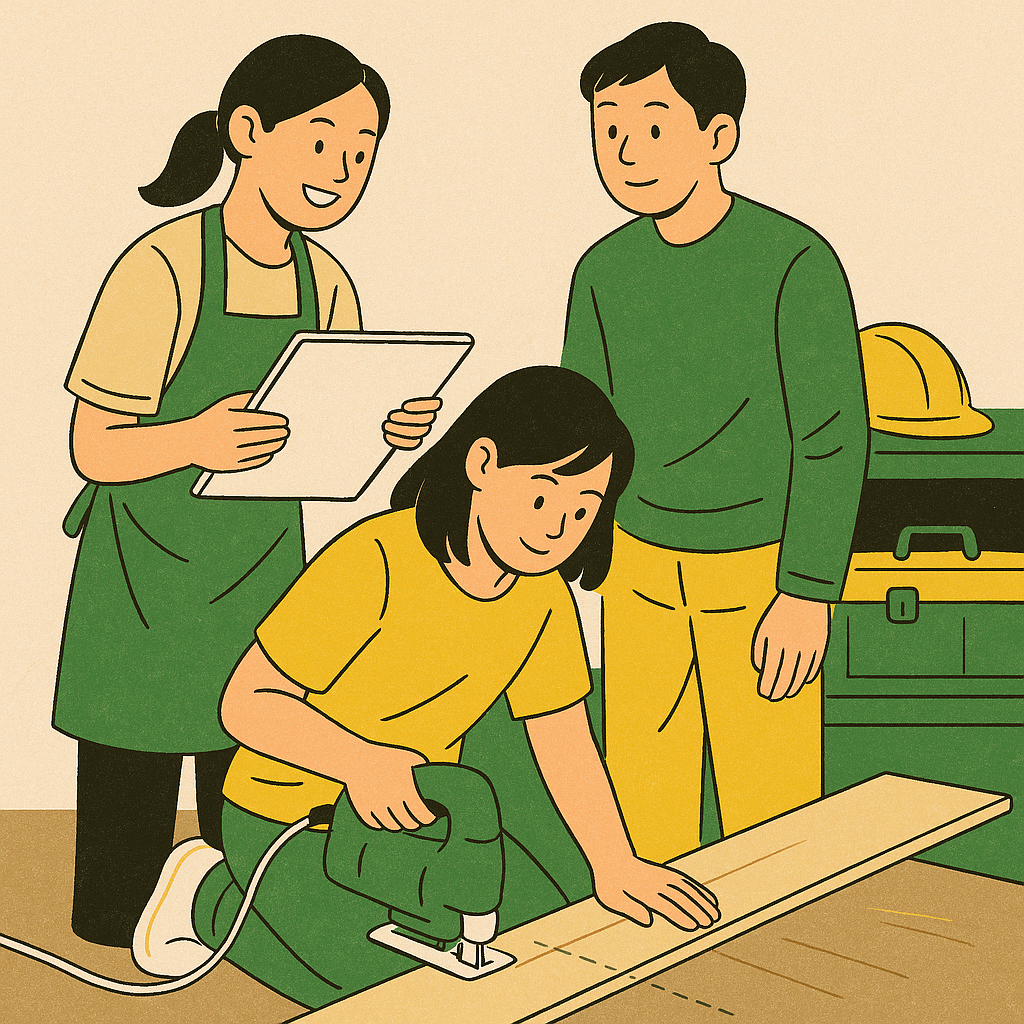
At a construction site, a trainer points to a trainee climbing a ladder without fastening his helmet. Work halts. Everyone watches as he’s corrected. It’s a lesson no PowerPoint slide could drive home. Safety, the trainees realise, isn’t theoretical — it’s survival, reputation, liability.
This is true across sectors. In hospitality, handling knives or boiling oil. In logistics, lifting heavy loads without injury. In healthcare, wearing gloves while handling blood samples. Industry exposure turns safety into instinct — something you do before you even think.
4. Quality is no longer abstract
In a retail store, Priya discovers the magic of “first-time-right.” She scans a product, but the discount doesn’t apply. She apologises, rechecks and corrects it. The customer nods, satisfied. Her trainer later explains: “A small error can mean a lost customer. Accuracy is respect.”
That’s the quality mindset: not perfection for its own sake, but precision because real people depend on it.
5. Communication adapts to context
Perhaps the most underrated skill trainees pick up is practical communication. At an Anganwadi centre, a health trainee realises mothers don’t understand technical jargon. “Nutritional deficiency” makes no sense. But “Halka khana, rozana doodh aur ande” (light meals, daily milk and eggs) clicks immediately.
In a call centre, another trainee learns the opposite: being precise, using scripts, logging details in the system. Same skill — adapted to audience.
6. Confidence under pressure
The magic moment comes when trainees face real customers or patients. They stumble, sweat, recover and succeed. Each interaction is a mini-apprenticeship in handling pressure. The confidence it breeds cannot be taught — it must be lived.

The invisible curriculum: Habits and attitudes during industry exposure
What makes industry exposure transformative isn’t just technical learning. It’s the invisible curriculum trainees absorb:
- Punctuality. Workplaces run on time, not on excuses.
- Team spirit. Everyone’s job is interconnected; you don’t leave until the next person is briefed.
- Accountability. Mistakes have consequences but so does honesty and fixing them.
- Resilience. A tough customer, a long shift, a rude supervisor — bounce back, don’t break.
Employers often say these “soft” skills matter more than technical ones. Smile Foundation’s trainers, therefore, see industry visits as not just about skills, but about shaping professional identity.
Stories from the ground: When theory met reality
- Ritu, hospitality trainee: “I had memorised how to fold napkins in class. But in the hotel banquet hall, with 200 chairs to set before a wedding, I learned speed and teamwork matter as much as technique.”
- Faizan, retail trainee: “In class, we practiced customer greetings. But on the shop floor, I realised body language is half the greeting. The trainer taught me to stand tall, smile and look at the customer — not the screen.”
- Meena, healthcare trainee: “I learned about empathy in class. But it became real when I held the hand of an anxious patient before a blood test. Sometimes care is touch, not words.”

Why industry exposure matters for employers
Employers benefit too. When trainees arrive with exposure, they require less handholding, adapt faster and reduce errors in the probation phase. Industry partners often remark that Smile Foundation trainees feel “workplace-ready” in weeks, not months.
This alignment also strengthens CSR linkages. Corporate partners see skilling as talent pipeline building — a strategic investment in future workers.

The policy angle: Why India must scale industry exposure
India’s skilling ecosystem is vast — multiple government schemes, private training providers and CSR initiatives. Yet one critique recurs: the employability gap. Reports by bodies like NASSCOM and McKinsey highlight how theoretical training often fails to translate into workplace readiness.
The National Skill Development Corporation (NSDC) has been pushing for more apprenticeships, internships and industry partnerships. Smile Foundation’s model complements this vision — proving that even short, structured exposures can dramatically improve outcomes.
Beyond jobs: Industry exposure as dignity
There’s a deeper layer too. For many trainees from marginalised backgrounds, stepping into an office tower, a hotel lobby or a hospital ward is transformative. It’s not just about learning skills — it’s about belonging.
When Priya tells her parents she worked a full shift at a retail store, they beam. For the first time, they can picture her in a professional role. That sense of dignity of seeing oneself as part of India’s modern economy is as important as the pay check.
Smile Foundation difference
Smile Foundation’s skilling programme integrates industry interaction not as an add-on, but as a core pedagogy. Partnerships with companies in retail, hospitality, healthcare, IT/ITeS and logistics ensure that trainees move fluidly between classroom drills and workplace immersion.
- Exposure visits turn theory into observation.
- Guest lectures bring role models into the classroom.
- Job shadowing lets trainees watch, then try.
- Internships embed learning in real workflows.
The result is higher placement rates, lower attrition and more confident youth.
The way forward
India’s demographic dividend is often described as an opportunity or a ticking time bomb. Which way it tilts depends on whether millions of young people like Priya and Arjun find meaningful, dignified and sustainable work. Classrooms are necessary, but they are not sufficient. The bridge between aspiration and employment is industry interaction—structured, mentored, reflective and scaled.
As one employer put it: “A trainee who has spent even a week on my shop floor is worth three months of classroom learning.”

From exposure to empowerment
When we talk about “hands-on skills,” we are really talking about hands-on lives. The skill to greet a customer confidently, to handle a tool safely, to log data correctly, to calm a nervous patient — they are pathways to dignity, growth and independence.
Smile Foundation’s skilling programme shows that with the right blend of classroom teaching and industry immersion, India’s youth are fully trained.
And in that transformation lies the promise of an employable, empowered and equitable future.