India’s rapid economic rise is shadowed by a troubling reality: it now ranks alarmingly high on several global health and environment indices. For example, Indian citizens live years in poor health (healthy life expectancy ≈62.6 vs overall life expectancy ≈70.8 years) and Delhi’s air pollution routinely exceeds WHO limits by 20×. India also ranked 5th most polluted country in 2024 and 9th most climate‑vulnerable (1995–2024). Moreover, UNEP’s 2025 report found India’s emissions grew faster than any country in 2023–24(even as its per‑capita emissions remain low).
Health and Life Expectancy: Longevity without Full Health
India’s life expectancy has improved, but healthy life expectancy has not kept pace. In 2022, average life expectancy was about 70.8 years, yet healthy life expectancy (years in “full health”) was only ~62.6 years. In effect, Indians spend over 8 years on average in ill health – coping with chronic diseases and disabilities – despite living longer. Non‑communicable diseases (heart disease, diabetes, COPD) are rising, and many lack access to timely healthcare, especially in rural areas. This health gap mirrors inequalities: poorer states and women (who live longer) bear a disproportionate share of chronic illness. Put bluntly, gains in longevity are tempered by years lived with sickness.
The burden of disease is reflected in rankings: health metric analyses place India among the worst-performing large economies. For instance, one global survey noted India’s citizens spend roughly 8–15 years in poor health (estimates vary by method) – a stark contrast to healthier nations. This translates into productivity losses, strained families and rising healthcare costs. The Lancet’s Global Burden of Disease reports (cited by WHO) show India losing the equivalent of ~1.7 million lives in 2019 to air pollution alone, and many more to cardiovascular and other chronic illnesses.
Air Pollution: A National Health Crisis
Air pollution exemplifies the health-environment nexus. India’s cities dominate global pollution lists. The 2024 World Air Quality Report ranked India the 5th most polluted country overall (population-weighted average PM2.5 ~50.6 µg/m³). Delhi stands out: its residents breathe particulate matter levels exceeding WHO’s annual guideline by over 20 times. In winter, smog blankets the capital, forcing schools to close and hospitals to brace for respiratory crises. According to Reuters, toxic air caused 1.67 million premature deaths in India in 2019 (18% of all deaths that year), a catastrophe of chronic bronchitis, heart attacks and strokes among the populace.
Delhi provides a human-scale case: even in the “cleaner” summer months, roadside pollution often far exceeds safety thresholds. The Wire reports that of the world’s 100 most polluted cities, 74 are in India, including Delhi (the second‑worst in 2024). Rural areas are not spared: brick kilns, cooking fires and burning fields pollute small towns and villages year-round. The health costs are palpable: doctors note rising asthma and lung cancer in non-smokers.
These problems persist despite policy efforts. India’s National Clean Air Programme (NCAP) set targets to cut particulate pollution by 40% by 2026, yet implementation lags. A recent analysis pointed out that “despite measures such as NCAP, inconsistent policy implementation and inadequate infrastructure” mean air quality remains poor. The COVID‑19 lockdown showed a glimpse of what cleaner air can look like, but as economic activity resumed, pollution rebounded, highlighting the challenge of sustaining improvements.
Urban case study – Delhi, 2024: In November 2024, Delhi’s average PM2.5 reached 300 µg/m³ on some days, about 60× the WHO annual guideline. Schools shut, hospitals filled. Studies estimate Delhi’s air pollution shortened residents’ lifespans and increased child asthma rates dramatically. Even the recent 7% national decline in PM2.5 (2024 vs 2023) was insufficient to meet health safety standards. This urban example shows how environmental neglect directly translates into public health crises.
Climate Vulnerability: Rural Lives in the Line of Fire
India’s climate story is dual: it is both a victim and a growing source of global emissions. The Global Climate Risk Index 2025 (Germanwatch) ranks India 9th worst over 1995–2024. India suffered over 80,000 deaths from 430 extreme weather events in 30 years – from Himalayan floods to deadly heatwaves. Economic losses approached $170 billion in that period.
Rural communities often bear the brunt. Poor farmers and labourers live in floodplains or drought-prone areas with little protection. For example, a 2013 flash flood in Uttarakhand (triggered by intense rains and landslides) killed over 1,000 people and washed away hundreds of villages. More recently, cyclones Amphan (2020) and Tauktae (2021) devastated coastal states; relentless heatwaves in 2015 and 2019 caused thousands of deaths in Andhra Pradesh and Telangana. These events make clear that India’s rural poor are increasingly exposed to climate shocks – even though the country’s carbon footprint per capita remains relatively low.
Simultaneously, India’s absolute greenhouse gas emissions are rising fast. UNEP’s Emissions Gap Report 2025 found India had the largest increase in annual emissions of any country in 2023–24, adding about 165 million tonnes of CO₂e. This growth is partly due to recovering coal use and industry. However, India’s per‑person emissions are still low (well below OECD levels) because of its population size. This dichotomy – a low per-capita emitter by history yet a high total emitter by scale – places India in a “climate justice trap”. At the upcoming UN climate talks, India may face pressure to reconcile development with emission cuts.
Rural case study – Bihar floods, 2024: In September 2024, record monsoon rains flooded large parts of Bihar. Over two million people were displaced, and at least 150 deaths were reported. Crops were destroyed, exposing villagers to both economic and health crises (contaminated water led to spikes in cholera and diarrhoea). This local example underscores how climate extremes in low-lying, agrarian states translate into immediate threats to life and livelihoods.
Emissions: Growth vs Responsibility
India’s greenhouse gas numbers highlight a critical nuance. On one hand, its absolute emissions are among the world’s largest (India is the 3rd-largest emitter). On the other, its per-capita emissions remain modest (around one-third of the OECD average). Current UNEP data show India’s total emissions (~3.5 Gt CO₂e) are far below China’s, but India’s rapid growth means each year adds significantly to the global total. This paradox often fuels international debate: India insists on development needs, while climate scientists warn that even its low per-capita rate must peak and fall to avoid overshooting 1.5°C warming.
It’s also worth noting recent progress: India is aggressively expanding renewables (reaching 40% non-fossil capacity by 2030) and aims for net-zero by 2070. But interim targets (NDCs) are modest, and India has missed deadlines for updating them. Meanwhile, pollution and climate footprints are causing direct harm at home. The emissions story, therefore, is not just global responsibility, but domestic health and environmental policy.
Three Pillars for Change: Mitigation, Resilience, Reform
To break the cycle of “growth vs. well-being,” India needs practical, prioritized reforms. We propose three pillars:
- Pillar 1 – Clean Air and Energy: Intensify pollution control through stricter emission standards, rigorous enforcement and shift to clean energy. For example, aim to meet WHO’s PM2.5 guideline in all cities by 2030. Expand the National Clean Air Programme (NCAP) with reliable monitoring and penalties. Accelerate the phase-out of coal and diesel by boosting solar, wind, and electric vehicles. Short-term metric: increase % of cities with annual PM2.5 < 40 µg/m³ by 2028 (the Indian standard is 40 µg/m³). Medium-term: halve average PM2.5 nationwide by 2035.
- Pillar 2 – Health Systems and Social Protection: Strengthen primary healthcare and preventive medicine to reduce years in poor health. Expand insurance coverage and rural clinics, and focus on non-communicable disease screening (e.g. nationwide hypertension and diabetes detection). Build early warning systems for heatwaves and vector diseases. For vulnerable populations (elderly, slum dwellers), launch community health outreach and subsidised treatments. Metric: increase the UHC service index (it was ~69 in 2023); aim for >80 by 2030. Track declines in DALYs (disability-adjusted life years) from key conditions.
- Pillar 3 – Climate Resilience and Governance: Mainstream climate adaptation into development. Invest in flood defences (embankments, drainage) and drought-tolerant agriculture. Expand crop insurance and livelihood support in climate‑exposed regions. Improve building codes (heat‑resistant roofs, ventilation) and widen tree cover in cities. Revise disaster relief funds for faster response. At the same time, toughen climate policy: commit to net-zero and transparent reporting. Metrics: reduce number of people affected by climate disasters by x%; improve India’s CRI ranking (currently 9th) by data-driven measures.
Each pillar requires strong institutions. A cross-sector task force (government, scientists, civil society) should set interim targets and monitor progress quarterly. Interventions must be tailored regionally: e.g. Punjab needs crop-stubble solutions, Chennai needs urban cooling, Gujarat needs coastal defences. Crucially, policy must prioritize the poor and socially disadvantaged – those who disproportionately suffer India’s “top-15” burdens.
| Indicator | Current Reality | Policy Response Needed |
|---|---|---|
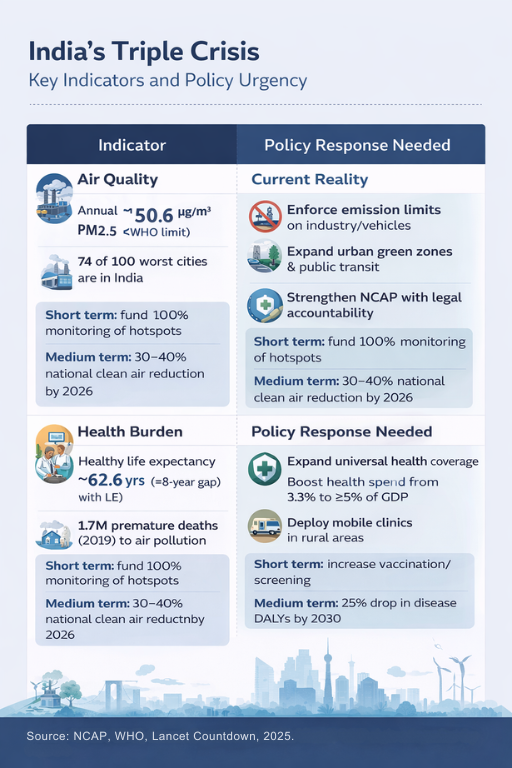
| Air Quality: Annual average PM2.5 ~50.6 µg/m³ (10× WHO limit). 74 of 100 worst cities are in India. | Persistent hotspots (Delhi, Kolkata, small cities). NCAP targets missed. Poor public awareness about pollution health risks. | Enforce emission limits on industry/vehicles. Expand urban green zones and public transit. Strengthen NCAP with legal accountability. Short term: fund 100% monitoring of hotspots. Medium term: meet national clean air targets (30–40% reduction by 2026). |
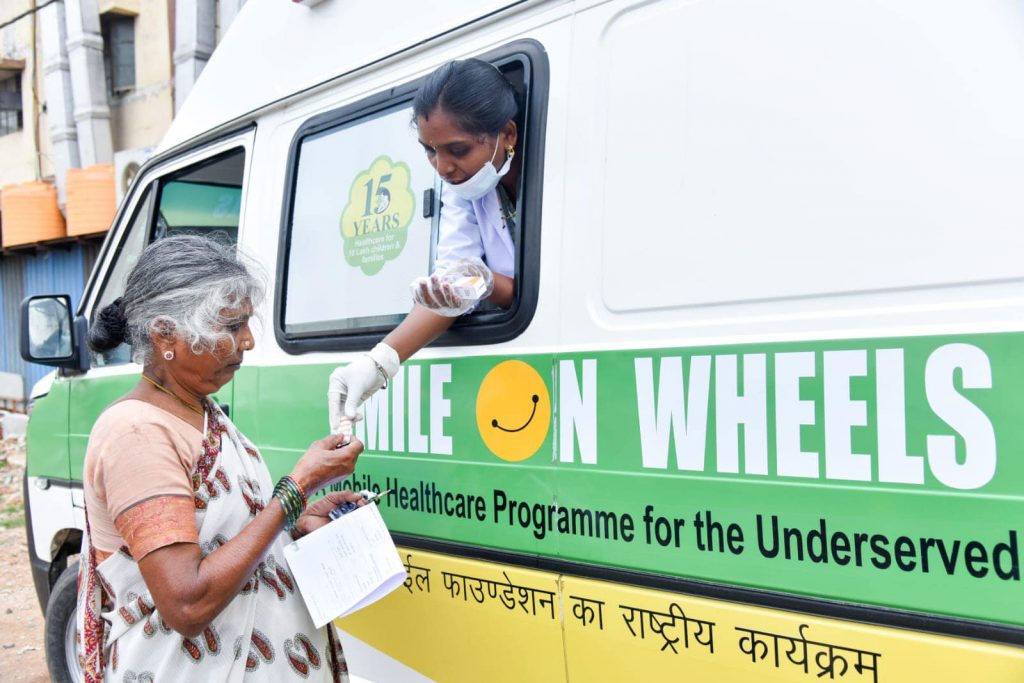
| Health Burden: Healthy life expectancy ~62.6 yrs (≈8-year gap with LE). 1.7M premature deaths (2019) linked to air pollution. | Chronic diseases (heart, lung, diabetes) rising. Rural/urban and gender disparities. Limited insurance/primary care access. | Universal health coverage expansion. Increase health spending from 3.3% of GDP (2021) to ≥5% by 2030. Deploy mobile clinics in rural areas. Short term: increase vaccination and screening. Medium term: reduce disease DALYs (e.g. 25% drop in NCD DALYs by 2030). |
| Climate Risk: Ranked 9th worst (1995–2024). 80,000+ deaths, USD170B losses in 30 years. | Frequent heatwaves, floods, cyclones. Recovery is slow in poor regions. Early warning gaps. | Invest in disaster infrastructure (flood barriers, cyclone shelters). Strengthen weather services and community preparedness. Scale up climate‑smart agriculture. Short term: operationalize 100% flood/heat warning in districts. Medium: reduce disaster mortality rate (e.g. halve loss of life per extreme event by 2030). |
Conclusion: Aligning Ambitions with Accountability
India’s high rankings in pollution, disease burden and climate impacts are not inevitable – they reflect policy choices. The impressive GDP and digital achievements can coexist with clean air and healthy lives, but only with deliberate effort. As the Reuters analysis warned, India cannot afford laxity: even its economic targets will suffer if the health of its citizens is neglected. National consciousness around these issues is growing (e.g. recent public health advisories, pollution awareness), but the government and private sector must deepen commitments.
In practical terms, that means making environmental health as important as economic growth in policy planning. For example: treating air quality improvements as a public health emergency; ensuring every new city development includes pollution controls; and linking farmers’ welfare programs to climate adaptation. Financial metrics (like “economic loss as % of GDP due to disasters”) should be reported annually to keep momentum.
Call to Action: India’s citizens, businesses and governments should now demand and enact cleaner, greener growth. Delhi’s smog-bound skyline and Bihar’s submerged fields shouldn’t be the legacy of this generation. Politicians must integrate environmental performance into the development agenda; companies must invest in cleaner technologies; households must support sustainable lifestyles. Only by aligning ambition with accountability can India transform its “top‑15 for wrong reasons” record into a story of sustainable progress.