
In a village near Bangalore, Yajjiamma turned a domestic chore into a livelihood. “I have turned a simple habit into something more — a source of income, confidence and purpose,” she says. After joining Swabhiman’s entrepreneurship training last year, Yajjiamma began hygienically packaging and selling fresh paneer (“cottage cheese”) every other day. “Some people from nearby towns place regular orders. A local shop also buys from me,” she reports, and the extra income now pays for her son’s school books, letting her “save a little too”. Stories like hers are multiplying across rural India.


Figure 1 and 2: Yajjiamma (left) extracting paneer from curdled milk. She displays a plate of paneer (right) they now sell commercially, thanks to Smile Foundation’s Swabhiman training.
Nearby, Pavithra of Bangalore Rural had a similar transformation. “I grew up in a small village near Bangalore, where survival was all we knew… There was no room for dreams,” she recalls. With her husband’s encouragement, Pavithra tried Swabhiman’s training and “came across beekeeping. It seemed simple, but it felt right. Working with bees… gave me a sense of purpose.” Today she sells honey from her own hives, which “became a way for me to provide for my family and build something lasting.” For the first time, she felt she could create something of her own.

Figure 3: Pavithra with a jar of honey from the beehives she manages as an entrepreneur.
These personal accounts scoop up a broader trend: rural women are stepping into entrepreneurship at unprecedented rates. According to NITI Aayog’s latest data, women borrowers in India have surged with a 22% CAGR from 2019 to 2024, and most of the new borrowers come from semi-urban and rural areas. In fact, as of December 2024 some 27 million Indian women are monitoring their credit scores, a sign of rising financial awareness that grew 42% over the previous year. Importantly, women’s share of business loan applications has also climbed – reaching 35% of all business borrowers by late 2024 – though consumer loans (for personal needs) still dominate their borrowing. In sum, more rural women are seeking loans and education on finances than ever before.
Yet entrepreneurship remains a small share of the total. Women constitute only about 14% of all entrepreneurs in India, and they own roughly 22% of micro, small and medium enterprises (MSMEs) overall. The Economic Survey notes that women’s entrepreneurship falls off sharply with scale: women own 22% of micro-enterprises, but only 12% of small and 7% of medium firms. In rural areas the pattern is similar: most women-led businesses are micro-enterprises employing only family members or a handful of workers. Globally, India also lags. A World Bank analysis found female entrepreneurs account for less than a fifth of business owners in India, and female-led firms tend to employ more women than male-led ones.
Despite these gaps, the potential impact of rural women entrepreneurs is vast. The World Bank highlights that women-led enterprises in rural India already employ an estimated 22–27 million people. Supporting these growth-oriented, opportunity-driven enterprises (GOWEs) through tailored finance and services could dramatically expand rural jobs and reduce poverty. As one NITI report observes, encouraging women’s entrepreneurship “could create employment opportunities for 150 to 170 million people” while boosting overall economic growth. In other words, each village woman who starts a viable business can spark change far beyond her own home.
Systemic barriers towards women entrepreneurship
However, significant barriers still hold many rural women back.
- Access to credit is a perennial challenge. Banks often require collateral that most rural women lack, and financial products are rarely designed for tiny micro-enterprises. The NITI report notes persistent “credit aversion” and collateral issues for women, despite rising awareness.
- Formal financial institutions tend to focus on larger loans, leaving rural entrepreneurs dependent on informal SHGs (self-help groups) or local lenders with limited capacity. In practice, even women with proven small businesses hit a ceiling; one Tamil Nadu vendor, Bhai Amma, made ₹700–800 a day selling biryani and eggs, but couldn’t find the ₹100,000 she needed to expand beyond her local lending group.
- Skills and training gaps compound the problem. Many rural women have valuable craft or agricultural skills but limited business know-how. They may not know cost-pricing, bookkeeping, or marketing. A recent World Bank feature emphasizes that rural women often “miss critical business development services like marketing, technology, and advisory”.
- Another analysis highlights that rural women entrepreneurs suffer from limited business skills, weak market access, and technology deficits, along with a shortage of mentors and networks. For example, Yajjiamma needed training on hygiene, pricing and communication before she could scale her paneer sales.
- Infrastructure and markets are also weak in rural areas. Poor roads, unreliable power or internet, and lack of cold storage can make scaling a dairy or food enterprise nearly impossible. Local markets may pay low prices or remain closed to small producers. Women entrepreneurs often have to travel long distances on difficult terrain or depend on middlemen who take a large cut.
- Finally, social norms and time poverty limit many women. Even with interest in business, women typically bear the bulk of household chores and childcare. As Pavithra recalls, her “days were filled with chores and working in the fields” and “there was no room for dreams” until she found the courage and support to try something new. In some villages, families may oppose women traveling alone or doing “men’s work.”
- Lack of mentorship means many women feel isolated. One report notes that rural entrepreneurs often lack exposure and networking, unlike urban businesswomen.
Support from the state and NGOs for women entrepreneurship
Recognising these issues, both government and civil society have launched numerous initiatives to help rural women entrepreneurs. The Government of India created the Women Entrepreneurship Platform (WEP) in 2017, an online ecosystem run by NITI Aayog. WEP aggregates information on funding, mentorship, incubators and skill training. Through partnerships it provides services in key areas like funding access, compliance assistance, mentoring and marketing for women entrepreneurs.
Other national schemes include Stand Up India (subsidised loans for women and SC/ST entrepreneurs), Mudra Yojana (collateral-free loans up to ₹10 lakh for new businesses, with 3–5 year tenures), PMEGP (subsidies to create micro-units), and targeted credit lines like Mahila Samriddhi Yojana. There are also industry-specific programmes (e.g. skill training for women artisans under the Mahila Coir Yojana).
At the state and local level, governments have set up incubators, startup grants, and women’s SHG federations to channel funding. For example, some states offer reserved industrial plots or reduced fees to women-owned enterprises. Broadly, policy efforts have raised awareness of credit access, launched entrepreneurship modules in rural livelihoods programmes, and created awards and capacity-building grants for women.
The Swabhiman approach
Development organisations and corporate CSR funds complement these schemes on the ground. Smile Foundation’s Swabhiman programme is a prime example. Launched in 2015 and now active in over 20 states, Swabhiman takes a holistic approach: it integrates health, nutrition, skill training, and entrepreneurship development in villages. Our team organises village-level groups of women and girls for regular sessions. These include
- Nutrition education (teaching low-cost healthy recipes to combat anemia),
- Health check-ups,
- Life skills, and
- Livelihood training.
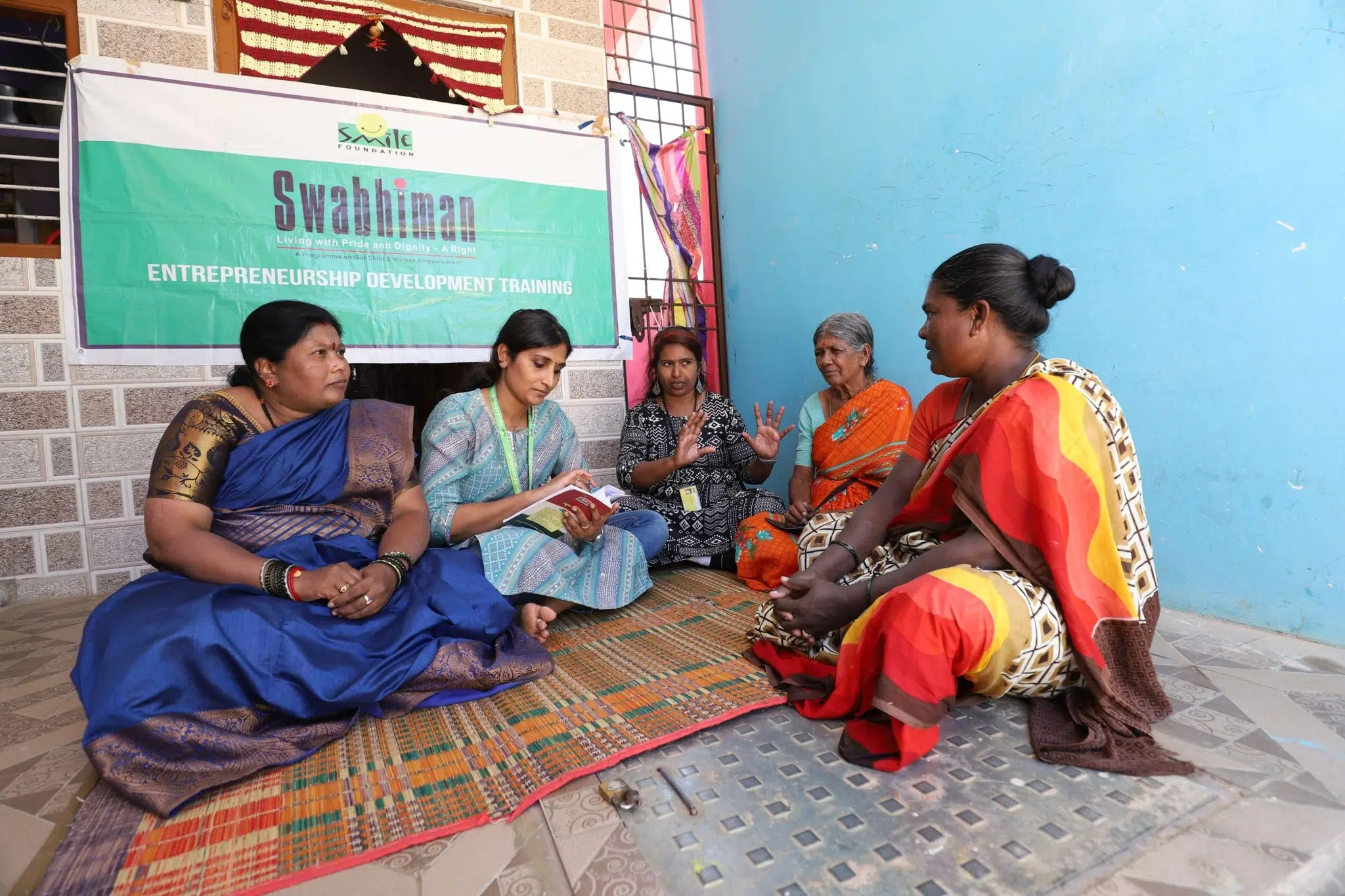
Critically, Swabhiman runs Entrepreneurship Development Trainings: multi-day workshops led by experts that cover business basics, financial literacy, product development and marketing. Sarita Pradhan, who heads Swabhiman, notes that the programme “empowers marginalised women through nutrition, healthcare, and livelihood support” and uplifts them “through skill training [and] financial literacy”.
Since its inception, Swabhiman has reached thousands of villages and has benefited over half a million women and girls with its interventions. In one district alone, hundreds of women in Modgaon (Maharashtra) have completed Swabhiman’s training. They now help each other start cottage businesses or cooperatives. As Pradhan reports, women in remote Modgaon are learning to manage money and turn ideas into businesses – exploring ventures from small catering services to artisanal products. Elsewhere, Swabhiman groups have formed village savings clubs and even shared grain mills, multiplying their economic options.
Other NGOs and CSR initiatives follow similar models. For instance, ITC’s “Shakti” programme (corporate-sponsored) has enabled tens of thousands of rural women to sell FMCG products through rural retail networks. Microfinance organisations and NGOs like Self-Employed Women’s Association (SEWA) provide credit and training to women artisans and farmers. Tech nonprofits (e.g. Digital Green, Agri-fintech startups) are also piloting business training and market linkages in villages. The common thread is combining training, access to markets and finance, and community support – as seen in Swabhiman and other programmes – to turn latent skills into viable enterprises.
Case studies: Beyond the expected
The case studies above show how women are pursuing unconventional enterprises tailored to their local context. Yajjiamma’s dairy-based paneer business and Pavithra’s honey enterprise are far from Silicon Valley startups, but they are just as entrepreneurial in spirit.
Similar stories abound: in Modgaon, for example, women have started roadside eateries serving locally-grown grains and vegetables, using recipes learned through Swabhiman’s nutrition workshops.

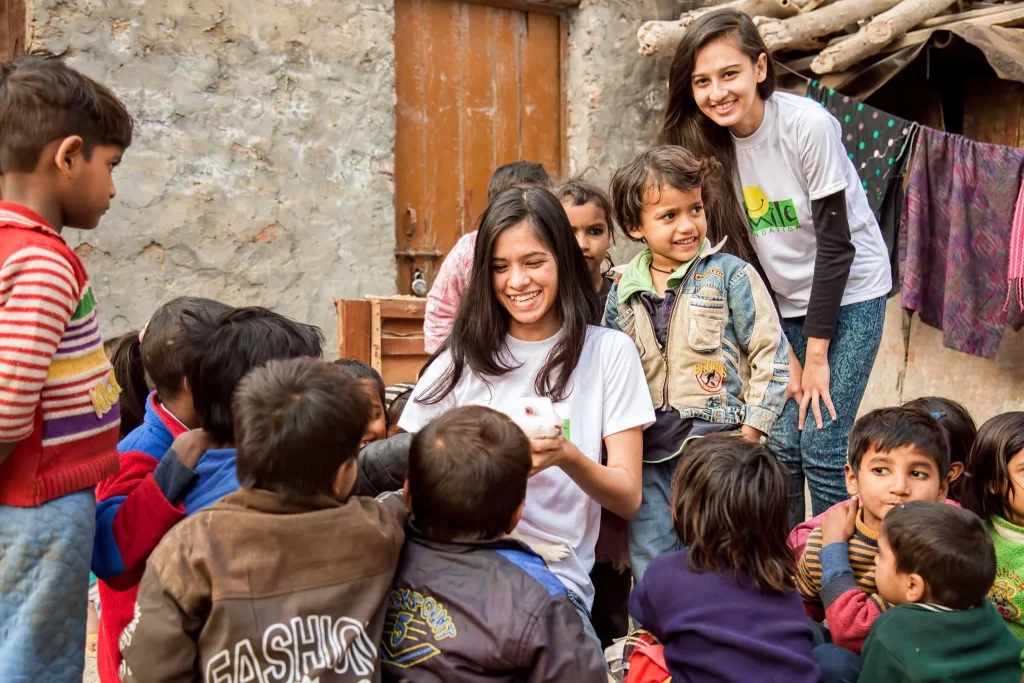
Figure 4: Women and adolescent girls learning to prepare healthy dishes using locally available ingredients through a session led by a nutrition expert,
Others have revived traditional crafts: one beneficiary, Ranjana, launched a backyard poultry farm during the pandemic, supplementing her family’s income by selling eggs in neighboring villages (with advisory support from Swabhiman on feed and hygiene). Another cluster of villages trained villagers to dry and package local chilies and herbs, creating packaged foods sold in city markets.
These ventures challenge conventional definitions of entrepreneurship. They are often informal (many women cook or craft at home), small-scale, and community-rooted, yet they produce real economic value and empowerment. They show that an illiterate farmer’s wife can be an entrepreneur too, given the chance. As one development expert puts it, “recognising and supporting growth-oriented women’s enterprises can boost rural job creation, close gender gaps in entrepreneurship, and drive long-term economic growth”.
Recommendations for scaling up
Experts and experience point to concrete steps government, industry and NGOs can take to amplify this transformation:
- Improve Access to Finance: Tailor credit products for rural women – for instance through collateral-free loans, group lending, or loan guarantees by governments or CSR funds. Training frontline bankers to understand women’s enterprises can help overcome “credit aversion” and paperwork hurdles. Expanding microfinance and linking village banks to national programmes would channel capital to women’s ventures at scale.
- Expand Training and Mentorship: Scale successful programmes like Swabhiman that provide practical business education. Bundling financial literacy, marketing skills and digital training is key. Establish mentoring networks or helplines so women entrepreneurs can get advice. As one report notes, “raising awareness, providing skill training, and improving access to government benefits” are cost-effective ways to empower women. Peer networks of rural entrepreneurs can also offer mutual support and collective bargaining power for inputs and sales.
- Build Market Linkages: Create more platforms that connect rural women producers to larger markets. CSR and private companies can source directly from women-led SHGs (as in ITC’s Shakti or KKV Karghewale initiatives). E-commerce tie-ups, rural fairs, and incubators that help women entrepreneurs brand and package goods will increase sales. Public procurement (for school lunches or uniforms) can earmark quotas for women’s groups.
- Leverage CSR and Public-Private Partnerships: Corporations should partner with NGOs to co-fund training and infrastructure (e.g. shared cold storage or solar power for village enterprises). CSR can sponsor joint projects linking entrepreneurship with health or education. Governments can incentivise such partnerships. For example, multi-stakeholder schemes could provide matching grants for CSR contributions to rural livelihood programmes.
- Address Social Barriers: Simultaneously run social campaigns that normalise women’s entrepreneurship. Community meetings should involve husbands and elders to win their support. Providing childcare or flexible training schedules can help women juggle family duties. Tackling issues like safety, transport and time poverty will free more women to participate.
Implementing these measures in a coordinated way could have multiplier effects. The World Bank and NITI Aayog emphasise that integrated support structures and sector-specific programmes are essential for growth-oriented women entrepreneurs. Similarly, a government review stresses the need to streamline credit links, sensities bankers, and deliver efficient support mechanisms for rural women.
Breathe more life into these local entrepreneurs
In summary, India is witnessing a quiet revolution in its villages. From paneer-making in Karnataka to honey-harvesting in Tamil Nadu and nutritious food stalls in Maharashtra, rural women are transforming their limited resources into enterprises that support their families and communities. These unconventional entrepreneurs – often invisible in official statistics – are beginning to reshape local economies. The success of initiatives like Swabhiman shows the power of targeted training and community networks. To ensure that Yajjiammas and Pavithras become the rule rather than the exception, stakeholders across society must double down on policies, investments and social support that build on this momentum. With sustained effort, rural women’s entrepreneurship can truly drive inclusive growth and change in India.
Smile Foundation’s Swabhiman initiative presents corporates with a meaningful opportunity to align their CSR efforts with inclusive, grassroots development. By combining vocational training tailored to local economies with financial and digital literacy, Swabhiman equips women to launch and sustain viable enterprises. The programme goes beyond skilling — it builds confidence, nurtures leadership, and strengthens market linkages, enabling women not just to earn, but to lead.
Through a partnership with Smile Foundation, companies can help catalyse real, measurable change — empowering women to rise, enabling families to thrive, and contributing towards resilient communities. Swabhiman isn’t asking companies to rescue women; it invites them to partner with communities already pushing against the limits of the possible.
Sources: Recent government and World Bank reports, news analyses and NGO publications were used to compile statistics and insights.