

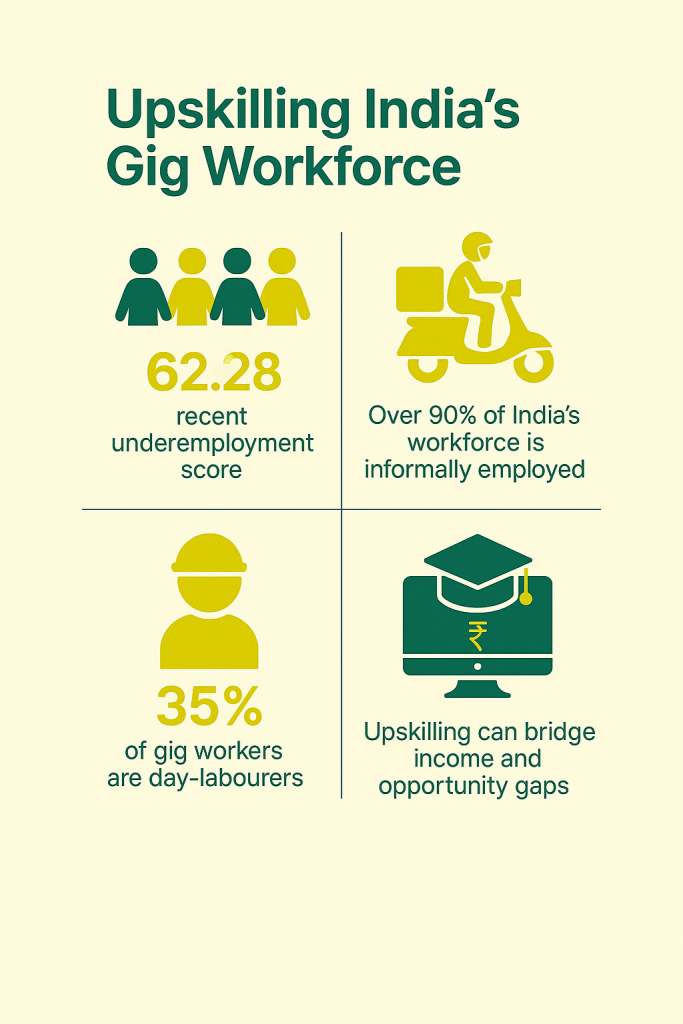
India’s economic story is often told through the lens of innovation, startup growth, and digital disruption. But behind this dominant narrative lies the fact that millions of working Indians are underemployed, not unemployed. According to the Ministry of Statistics and Programme Implementation, India’s underemployment score stands at 62.28, even though official unemployment remains below 7 percent.
The distinction matters. While unemployment refers to those without jobs, underemployment captures those working below their skill level or in insecure, low-paying roles. A large portion of these workers belong to India’s informal or gig economy. They drive cabs, deliver groceries, repair appliances, or assist in homes and hospitals. They are essential to daily urban life, but remain invisible in policy conversations. Without intervention, they risk being left behind in an economy that is moving faster than their ability to catch up.
The solution lies in reimagining skill development, especially for blue-collar gig workers. This is not about formal degrees or certificates, but about equipping people with the tools they need to succeed in the real economy.
Gig economy: A growing workforce with shrinking opportunities
India’s gig economy is expanding rapidly. Reports estimate that gig work could contribute up to 1.25 percent of India’s GDP by 2030. Platform-based jobs now stretch across services from delivery and ride-hailing to beauty, domestic care and field tech support.
Yet most of these roles sit at the bottom of the value chain. They are transactional, poorly paid, and offer little upward mobility. More than 90 percent of India’s workforce is informally employed, and within that, a significant share are blue-collar gig workers with little to no social security.
A Bain & Company study notes that only 12 percent of gig workers use platforms to grow their earnings or build businesses. A staggering 35 percent are financially strapped day labourers who survive on daily wages, making them particularly vulnerable to inflation, illness, or platform shutdowns.
The skills gap explains much of this stagnation. Gig work today is no longer just physical—it is digital and customer-facing. A delivery worker needs to manage orders through apps, handle cashless payments, communicate with customers and navigate real-time changes. These are not intuitive tasks, especially for first-time earners from rural or low-income urban households.
The problem is not a lack of aspiration. Most of these workers seek better lives, more stable incomes, and opportunities to grow. What they lack is access to the kind of skilling that prepares them for the future of work.
The limitations of current skilling programmes
India has made considerable investments in skilling through schemes like Skill India Mission and PMKVY. These programmes have helped formalise vocational training across sectors. But for gig workers, especially blue-collar ones, most skilling options remain out of reach.
First, traditional training centres often operate on fixed schedules and at fixed locations. Gig workers, with unpredictable shifts and long hours, cannot easily attend. Second, many programmes still teach generic skills like tailoring, data entry, beauty services without linking them to current market demand or platform-specific roles. Third, most workers receive little support after training. Placement services, mentorship, and access to finance are rarely integrated into the training lifecycle.
There is also a gender gap. Women in gig work, particularly in domestic or care roles, are rarely targeted for upskilling despite growing demand in health and home-based services. Digital safety, mobility constraints, and childcare responsibilities make it harder for them to access training.
Skilling that meets workers where they are
For skill development to truly empower India’s gig workforce, it needs to adapt to the realities of blue-collar work. This means making training modular, mobile, vernacular, and hyper-local.
An effective skilling model for gig workers should include:
- Hands-on vocational training that mirrors real-world tasks
- Soft skills and life skills like communication, time management, and customer interaction
- Basic digital literacy to help navigate apps and online platforms
- Financial literacy to improve savings, budgeting, and credit access
- Entrepreneurial skills for those who want to build micro-enterprises or transition out of platform dependency
These elements are not optional. They form the foundation of a future-ready, inclusive workforce that can adapt as platforms evolve and new jobs emerge.
Smile Foundation’s skilling model: Linking training to livelihoods
Smile Foundation’s work in the area of employability offers valuable insights into how blue-collar workers can be prepared for a modern economy. Through our Smile Twin e-Learning Programme (STeP), we provide market-linked training to youth aged 18 to 32 from underserved backgrounds. The curriculum focuses on retail, hospitality, logistics, beauty, and wellness—sectors where gig work is concentrated.
What sets STeP apart is its emphasis on end-to-end support. Participants are trained not just in job-specific skills but also in communication, basic English, financial literacy, and digital tools. The programme also partners with over 200 companies to ensure placement opportunities after training.
In 2023–24, more than 12,000 youth completed training through STeP. Of those, around 72 percent secured jobs in sectors aligned with their training, many in gig and service roles. The programme operates in 25 states, with a special focus on rural and tier-2 regions where formal skilling infrastructure is limited.
Beyond STeP, Smile Foundation collaborates with companies through CSR partnerships to reach larger numbers of gig workers. These partnerships fund mobile skilling vans, doorstep training and digital courses. This convergence of civil society implementation with corporate investment can accelerate change on the ground.
Corporate engagement: Not just good CSR, but good business
The private sector has a critical role to play in building a robust, inclusive gig economy. Better-skilled workers lead to better service delivery, improved customer satisfaction, and brand trust. In a competitive platform economy, quality, and reliability are key differentiators. Companies like Urban Company, Zomato, and Amazon are already experimenting with in-house training modules and health coverage for gig workers.
Others, like Quess Corp and Tata STRIVE, are running placement-linked skilling programmes that bridge the supply-demand gap in blue-collar services. Platforms that invest in upskilling their workers tend to have lower attrition and better ratings—benefits that directly affect their bottom line.
Government incentives could further encourage such investments. For example, public-private partnerships could tie skilling outcomes to tax credits or regulatory benefits. Micro-credentials co-designed by platforms and skilling partners can provide gig workers with verified, portable skills that enhance employability across platforms.
What needs to happen next for the gig economy
India’s demographic dividend will only pay off if its working-age population has the skills to meet 21st-century demands. For the blue-collar gig workforce, this requires a new approach that is agile, inclusive, and outcome-focused.
Here is what policymakers, nonprofits and corporate leaders can do:
- Map sectoral needs: Regularly update demand forecasts for gig sectors and tailor skilling programmes accordingly.
- Encourage digital skilling: Make short-form, mobile-first learning content available in multiple Indian languages.
- Target women workers: Design training that includes mobility support, childcare solutions, and safe working conditions.
- Link training to finance: Combine skilling with access to microcredit, insurance and savings products.
- Certify and recognise skills: Create micro-credential systems that allow workers to build and stack skills over time.
- Strengthen local ecosystems: Build partnerships between municipalities, industry, and nonprofits to ensure local implementation and accountability.
These steps require collaboration, not duplication. Skilling cannot succeed in silos. It must be embedded into public policy, supported by private innovation and delivered through grassroots networks.
Looking ahead: From labour to leverage
India’s gig economy is here to stay. It represents an opportunity to make the labour market more flexible, more inclusive, and more resilient. But without a concerted focus on upskilling, it could also deepen existing inequalities.
Blue-collar gig workers are not just labourers. They are caregivers, problem-solvers, and digital citizens in the making. When we invest in their growth, we invest in the very infrastructure that keeps our cities moving and our economy running.
A delivery worker today could become a team leader tomorrow, a home services provider could become a franchise owner, a ride-hailing driver could transition to fleet management. All this is possible if the right skills meet the right opportunity.
As India builds its future of work, the question is not whether gig work will grow, but whether gig workers will grow with it.