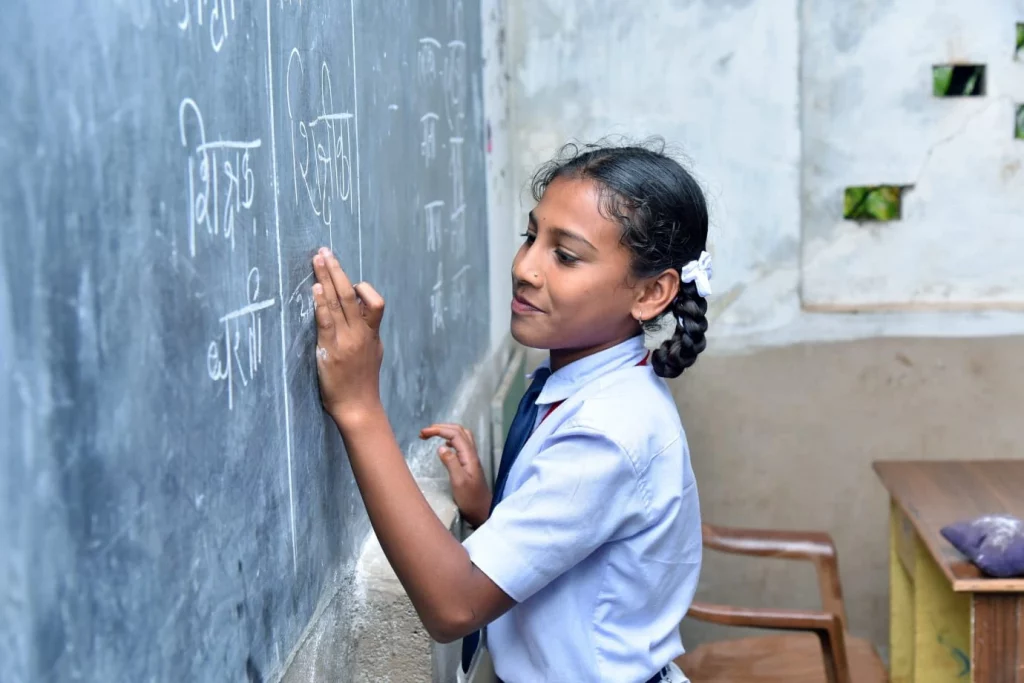
A curious thing happens when you walk into a rural classroom in India. You’ll see rows of children, bright-eyed, uniformed, ready to learn. The blackboard carries a neat lesson in English or Hindi. But if you flip open a child’s notebook and ask them to read a short sentence — something as simple as “The sun rises in the east” — many cannot. If you ask them to subtract 37 from 52, most will stumble.
This is not because the children are less capable, less ambitious or less curious. It’s because the foundation — the bedrock of learning itself — was never laid properly.
Welcome to the world of FLN: Foundational Literacy and Numeracy.

What FLN really means
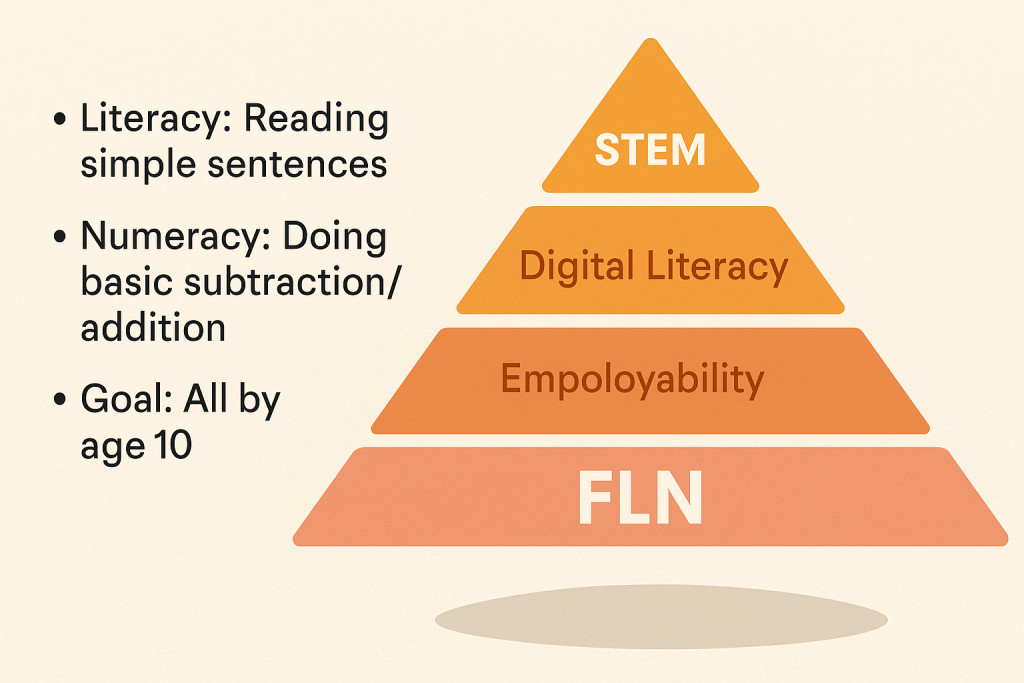
Think of FLN as the educational equivalent of learning to walk. Before you run, before you dance, before you climb mountains — you need to take those first steps. Reading simple texts and doing basic arithmetic by the age of 10 is not just a milestone. It’s a life-defining skill. Without it, children fall into what the World Bank and UNICEF call “learning poverty”: the inability to read and understand a basic story by the end of primary school. Globally, 7 in 10 children in low- and middle-income countries face this challenge.
In India, the numbers are starker. According to ASER 2022, only 20.5% of Grade 3 students in rural India could read a Grade 2-level text and just 25.9% could do basic subtraction. Imagine trying to study science, history or even computer coding without this base. It’s like trying to build a skyscraper on sand.
Why should anyone care?
Because FLN is a growth, a health and even a democracy story — all put together.
- The economic angle: Countries that improve literacy rates see GDP boosts. Every child who can read and count contributes to a more productive workforce. The World Bank estimates that every dollar invested in early education yields up to $14 in returns.
- The social angle: Literate citizens participate more in civic life, understand their rights and engage better in communities.
- The personal angle: For a child, being able to read independently sparks confidence and curiosity. That confidence compounds over a lifetime — affecting jobs, health, even how they raise their own children.
FLN, in other words, is not a “nice to have.” It is the difference between a nation of potential and a nation of missed chances.
India’s policy push — and its gaps
The good news: policymakers are aware. The National Education Policy (NEP) 2020 and the NIPUN Bharat Mission set a bold target —universal FLN by 2026-27. But a mission statement doesn’t teach a child to read.
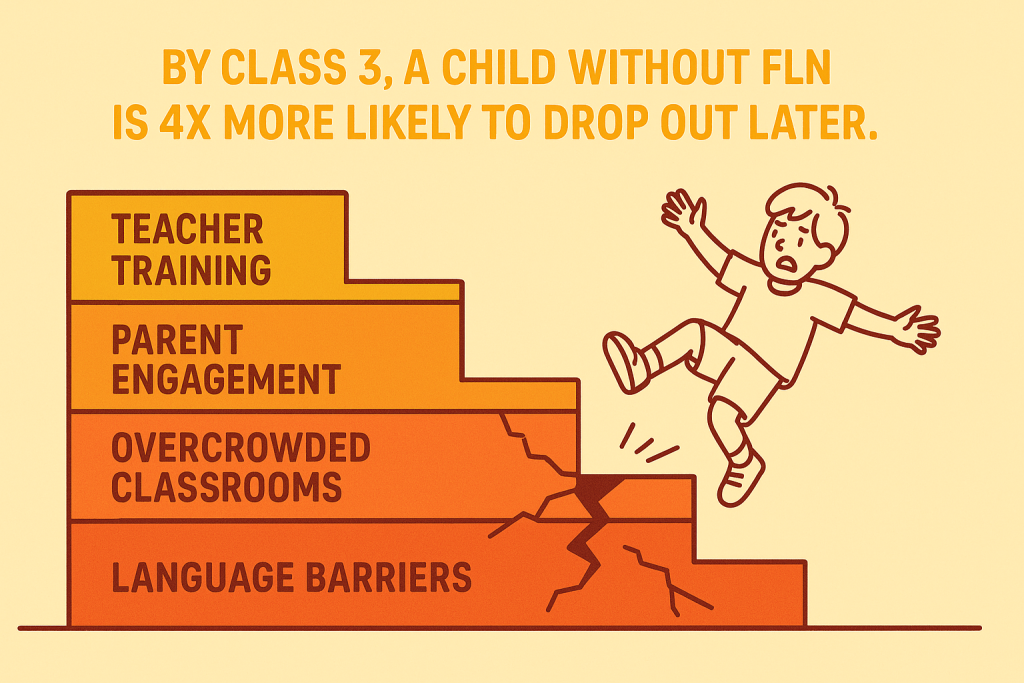
India’s Achilles heel has always been implementation. Classrooms remain overcrowded, teachers undertrained and children first-generation learners without support at home. Add linguistic diversity — over 120 major languages — and the challenge becomes even more complex.
What works: Lessons from the field
Globally, there are bright spots:
- Kenya’s Tusome programme deployed structured lesson plans, teacher coaching and continuous assessments. Within two years, students doubled their reading fluency.
- Ghana’s Mother Tongue initiative proved that children learn faster when taught first in their home language before transitioning to English.
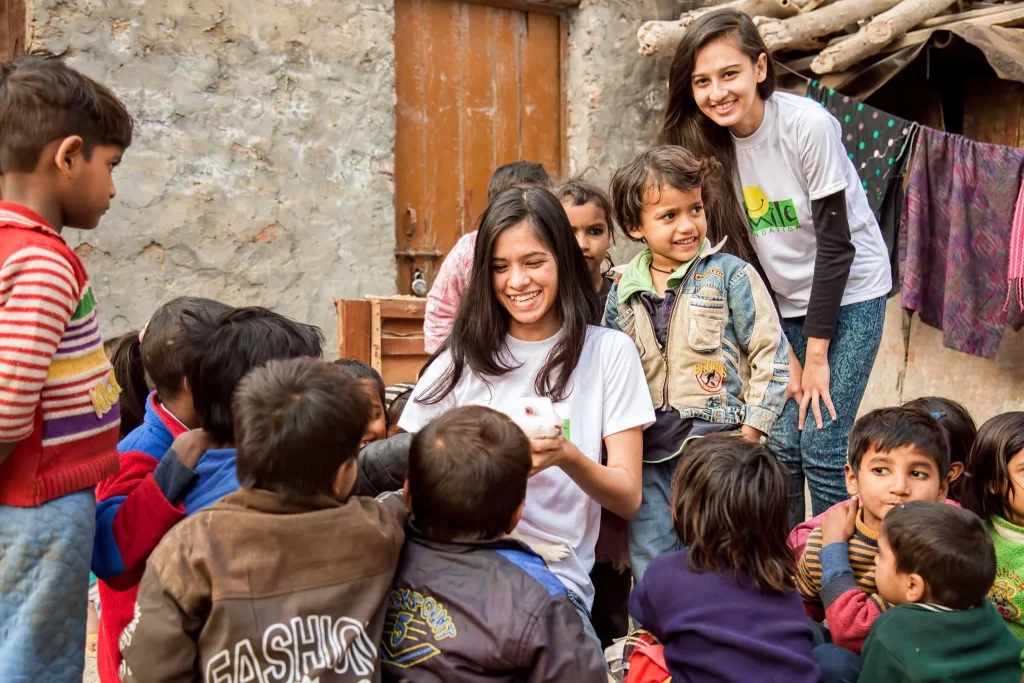
India has its own promising examples too — Smile Foundation’s Mission Education programme being one. Operating across 2,000 villages in 26 states, it reimagines the classroom by:
- Grouping children by skill, not age or grade.
- Training teachers in multilingual classrooms and hands-on methods.
- Introducing technology like tablets and smart boards to make lessons interactive.
- Involving parents so learning doesn’t stop at school gates.
One teacher from rural Odisha shared that when children were grouped by skill instead of grade, “the weakest child no longer felt left behind, and the strongest was no longer bored.” That small shift unlocked confidence for the whole class.
The missing middle: Teachers and parents
Any education reform is only as strong as the people delivering it. In India, teachers often juggle 40-60 students per class, many with varying abilities. Without training in differentiated instruction, they default to “teach to the average” — which means half the class is lost.
Equally, parents — many of whom are illiterate — feel unable to support homework. Yet, evidence shows that when parents read aloud at home, even for 10 minutes, literacy outcomes improve dramatically. Involving parents through workshops and simple activities is a low-cost, high-impact intervention India has underused.
The tech temptation — and its limits for literacy
Post-pandemic, edtech boomed. Tablets, apps and AI tutors promised to close the gap. But the catch is that technology is a tool, not a silver bullet. A tablet in the hands of a disengaged teacher changes little. What works is a blended model — community-based teaching reinforced by tech-enabled personalised learning. Think small-group storytelling circles in the village, backed by apps that track progress.
Why K-3 is where the action is
By Class 3, a child who hasn’t mastered FLN is four times more likely to drop out later. The early years matter because brains are most plastic then — absorbing language and numeracy at lightning speed. Prioritising K-3 means focusing resources where returns are highest. It also means resisting the temptation to overload children with content. A 7-year-old doesn’t need trigonometry — they need fluency in subtraction and the joy of reading.
The Triple Dividend of investing in FLN
Investing in FLN pays off three times over.
- Immediate gains: More children can learn effectively in higher grades.
- Economic gains: A literate workforce fuels innovation, jobs and GDP.
- Social Gains: Educated citizens strengthen democracy and health outcomes.
In fact, studies show early literacy improves public health because people understand prescriptions, nutrition labels and hygiene practices better.
So where do we go from here? India needs a coordinated, multi-pronged strategy:
- Empower teachers: Continuous in-service training, peer mentoring and recognition to make teaching aspirational again.
- Flexible models: Mix community centres, anganwadis and schools with mobile learning vans for hard-to-reach areas.
- Language first: Prioritise mother-tongue instruction in early years before transitioning to English or Hindi.
- Family engagement: Structured parent workshops that turn homes into mini-classrooms.
- Accountability: Use simple assessments to track progress district by district and feed results back into policy.
This isn’t about reinventing the wheel. The building blocks exist. What’s needed is scale, speed and sustained political will.
Why it matters to you and me
You might be reading this on a smartphone during your commute. You probably don’t think twice about reading an email, scanning a menu or calculating a discount. That invisible skill — literacy — shapes every decision you make. Now imagine living without it.
For millions of Indian children, that’s reality. And unless we act, it will define their future — and India’s.

Don’t get lost
Education reforms often get lost in jargon. But FLN is refreshingly simple. Teach every child to read and count by the age of 10. Do that, and we set them up not just for school, but for life. Fail, and we condemn them to struggle before they’ve even begun.
The stakes are enormous, but so is the opportunity. In a country young, restless and ambitious, there may be no higher national priority than ensuring that every child can master the ABCs of opportunity.