India has never had more graduates than it does today. Every summer, convocation photographs flood social media: young men and women in borrowed gowns, mortarboards tilted somewhat awkwardly, clutching freshly printed degrees with pride that radiates through the screen. Parents beam. Universities celebrate their placement numbers. Politicians boast of the “largest youth workforce in the world.”
And yet, in factories across Tamil Nadu, construction sites in Gujarat, logistics hubs in Maharashtra and repair shops in Uttar Pradesh, managers are saying something that feels almost absurd for a country producing millions of graduates a year: “We can’t find skilled workers.”
This contradiction — a glut of degrees but a shortage of skills — is one of the defining paradoxes of India’s current economic moment. It is a problem that sits uneasily between aspiration and reality, between what young people are told education will deliver and what the labour market is actually willing to reward.
How did we get here? Why does a nation of graduates still lack the skilled workforce its industries require? And what does it mean for a generation that believed education was its passport to stability?
The promise that degrees would be enough
For decades, India’s middle class — and those striving to join it — placed blind faith in degrees as the ultimate insurance policy. A BA, BCom, BSc or even an engineering diploma was sold as the surest pathway out of precarity. Families scraped together savings to put children through college; young people travelled to cities to pursue higher education; new private universities mushroomed across the country, offering glossy brochures, manicured campuses and the dream of a “global career.”
But somewhere between the brochures and the job market, the promise unraveled.
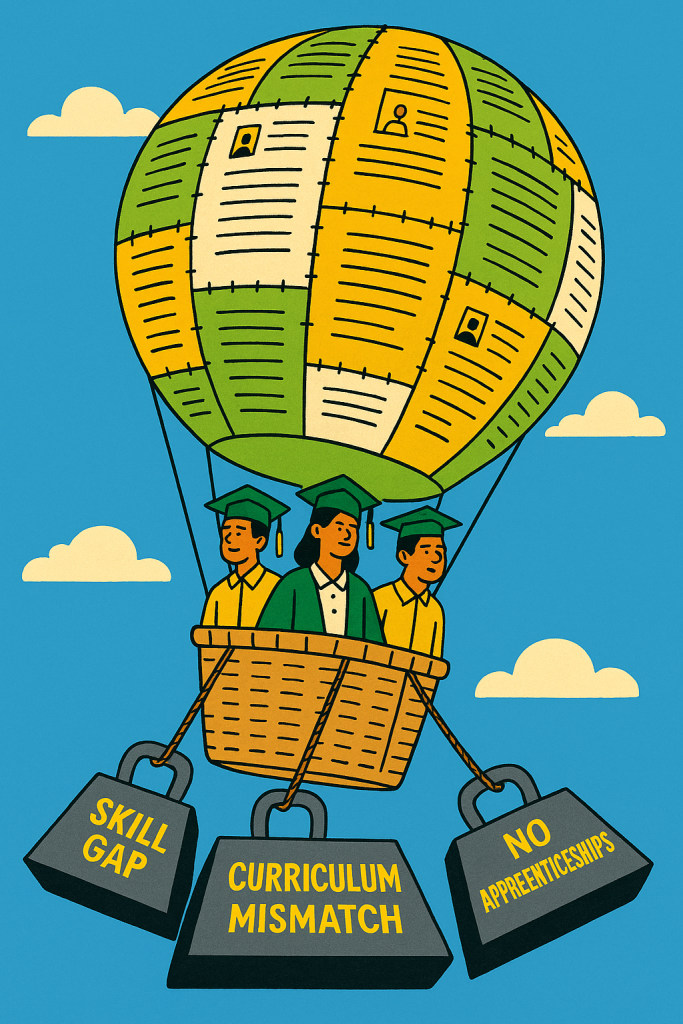
The degrees kept coming. The jobs did not.
Employers now routinely complain that graduates lack workplace readiness, basic communication skills, reliability and — in many cases — even fundamental numeracy or problem-solving abilities. Meanwhile, industries such as construction, renewable energy, manufacturing, logistics, healthcare and automotive services report chronic shortages of skilled workers in trades that require hands-on expertise.
It is as if the entire country skipped a step: producing graduates without producing professionals.
When education becomes disconnected from work
Part of the problem is structural. A large portion of Indian higher education remains anchored in rote learning, theoretical assessments and outdated curricula. The distance between classroom teaching and real-world work is vast. A student may earn a bachelor’s degree in business without ever learning how to write a professional email. An engineering graduate may leave college without having used modern equipment or software. A hospitality student may never have spent a single day in a functioning kitchen.
The result is a generation holding certificates but unable to perform confidently in the workplace.
Employers, understandably impatient, have shifted their expectations. “Don’t tell us what degree a candidate has,” one hiring manager told me last year. “Tell us whether they can solve problems, communicate clearly, and work without supervision.” The gulf between degrees and capabilities has never been wider.
The quiet decline of vocational pride
Another layer of the crisis stems from India’s cultural bias toward white-collar ambition. Young people want to be engineers, managers, analysts, designers. Very few want to be electricians, welders, plumbers, machine operators or solar technicians — even though these roles often pay more than entry-level office jobs and offer a clearer path to stability.
Vocational trades carry an unfortunate stigma in India. They are seen as “lower” forms of work, unworthy of educational aspirations. Parents discourage children from pursuing them. Schools rarely expose students to hands-on learning. As a result, industries that depend on skilled trades are left scrambling for workers, while millions of graduates chase a shrinking pool of formal white-collar jobs.
It is a mismatch of expectation, not just supply.
The automation shock
Adding to this is the rapid transformation of industries. Companies are adopting technology faster than workers can adapt. Automation, AI-based tools, digital workflows and advanced machinery are reshaping job roles — but the skills ecosystem has not kept pace.
A warehouse manager told me recently that despite dozens of job applicants, he struggles to find workers comfortable operating digital scanners or basic inventory software. A garment factory owner in Bengaluru said that new machines require precision and speed, but most applicants have never received structured training.
Even in IT — the sector long thought of as India’s unstoppable engine — companies continue to report that a large percentage of new graduates must undergo extensive retraining before they are productive.
The skills gap is not just about shortages; it is about obsolescence.
The rural-urban divide deepens the crisis
While metropolitan graduates may still find pathways through internships, networks and exposure, the situation is far more severe in smaller towns. Colleges in tier-2 and tier-3 cities often lack resources, industry linkages and updated curricula. Students graduate with degrees that have prestige but little currency in the labour market.
Parents sacrifice everything to send children to college, only to watch them return home — degree in hand — unable to secure anything more than a temporary or informal job. The disappointment is palpable and sometimes devastating.
The uncomfortable truth: India does not have a jobs shortage alone — it has a skills shortage
Governments, understandably eager to showcase growth, often highlight job creation numbers, skilling missions and placement drives. But beneath the announcements lies the quieter truth: the labour market is struggling to match people to roles not because people don’t exist, but because the right skills are missing at the right scale.
Industries need skilled technicians, not just graduates. Hospitals need trained paramedics, not just biology majors. Factories need machinists and quality controllers more than they need administrative assistants. Construction sites require electricians and carpenters in numbers the education system never prepared for. Renewable energy companies need technicians, not just environmental science graduates.
The degrees don’t align with the demand.
Young people sitting idle — not because they lack ambition, but because the system failed them
In cities across India, you will find groups of young graduates sharing rented rooms, waiting for “something” — an interview call, an exam result, a job opening that aligns with their field of study. Their days are marked not by lack of desire to work but by uncertainty.
“What’s the use of studying if this is our life?” one commerce graduate in Lucknow asked me last month. Another, an engineering graduate from Indore, said he applied for 200 jobs but received only two callbacks — both for sales roles unrelated to his degree.
Meanwhile, factories in the outskirts of the same cities are trying desperately to hire skilled technicians.
India’s demographic dividend is at risk
The country’s greatest asset — its young workforce — is in danger of becoming its greatest liability. If millions of educated youth cannot transition into meaningful employment, India will face economic, social and psychological consequences for decades.
Idle youth become disillusioned youth. Disillusioned youth become frustrated youth. And frustrated youth, especially in large numbers, can destabilise economies, communities and even political systems.
The path forward: Skills with dignity, degrees with purpose
For India to bridge this growing crisis, a few shifts are essential:
1. Reimagining the value of vocational skills
Skill-based careers must be treated with the respect they deserve. This requires cultural change: schools that introduce trades early, media that portrays skilled work with dignity and parents who see value beyond white-collar dreams.
2. Overhauling higher education
Colleges must drastically reform curricula, invest in labs and practical training and establish strong industry linkages. The era of degrees without capability is over.
3. Prioritising apprenticeships and on-the-job learning
Countries that have mastered youth employment — Germany, Japan, South Korea — have robust apprenticeship ecosystems. India must take this seriously, not as a CSR formality but as a national priority.
4. Aligning skilling missions with industry demand
Government skilling initiatives often focus on training large numbers quickly. What India needs is training that responds to real-world demand, with pathways to actual placement.
5. Supporting small entrepreneurs and self-employment
Not every trained worker must become an employee. Many can become service providers, contractors or micro-entrepreneurs — if supported with credit, markets and mentorship.
A quieter revolution: community-based skilling
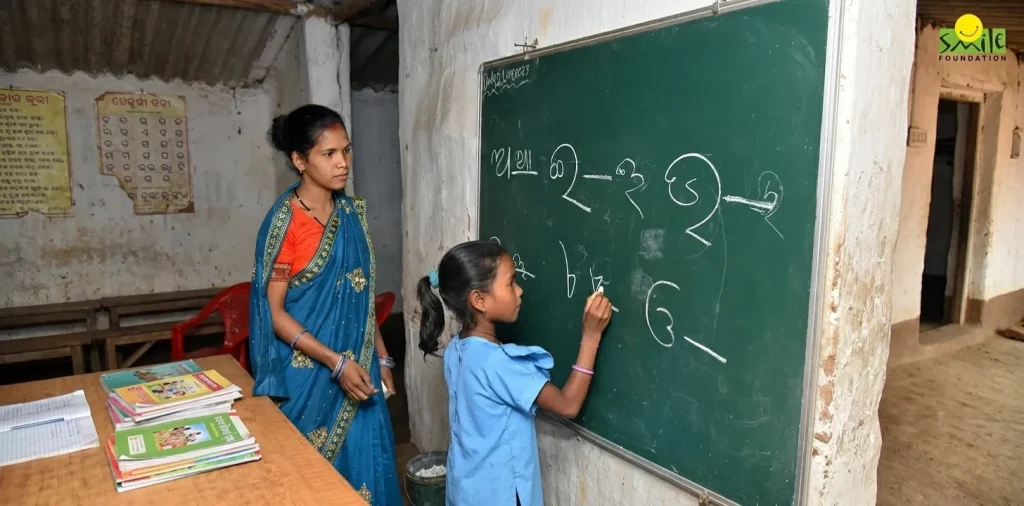
Some organisations are already tackling this crisis at its roots. Smile Foundation, for instance, has been working with young people in underserved communities to build meaningful, market-aligned skills — not just issuing training certificates, but helping them navigate interviews, build confidence and secure jobs that match their abilities. Their centres emphasize soft skills, digital literacy and hands-on learning — the kinds of practical competencies employers consistently ask for but rarely find.
The results are modest in scale but powerful in impact: young people who once feared the job market now step into it with clarity and capability. It is a reminder that while systemic change is slow, local change is possible — and transformative.
India’s choice
The shortage of skilled workers is not just a labour market issue. It is a reflection of what we value, what we teach and what we choose to ignore.
If the country continues to produce graduates who cannot find work and industries that cannot find skilled workers, the disconnect will widen into something far more dangerous.
But if India chooses to invest in real skills, real training and real dignity for its workforce, the demographic dividend could still become the engine of national transformation it was meant to be.
The question is not whether India has enough young people.
It is whether India is willing to equip them with the skills they need — and the opportunities they deserve.