Employee giving programme India is becoming a core part of how companies think about culture, responsibility and engagement. In 2026, organisations are not just asking how much they give, but how they enable their employees to participate in giving.
For many professionals, the intent to contribute exists. What is often missing is a simple, structured way to do it. This is where workplace-led giving becomes powerful. It bridges intent with action, and in the process, creates a stronger connection between employees, organisations and social impact.
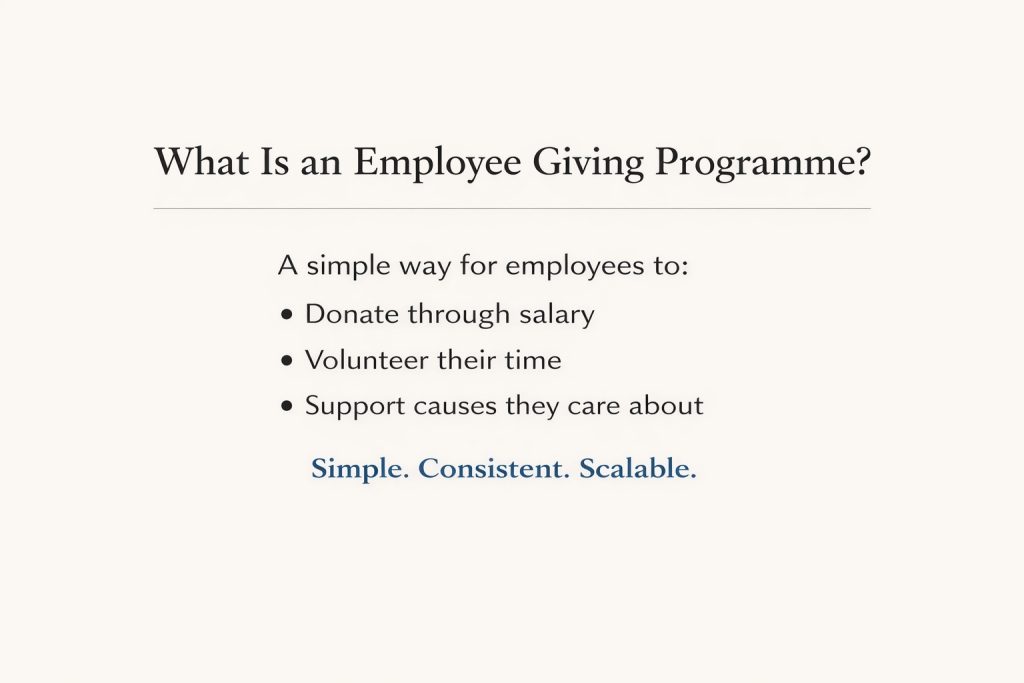
What Is an Employee Giving Programme?
An employee giving programme is a structured initiative that allows employees to donate to social causes directly through their workplace.
This can include:
- Monthly payroll deductions
- One-time contributions
- Company-matched donations
- Volunteering opportunities
In India, workplace giving India models are evolving to make giving easier, more transparent and more meaningful.
Why Companies Are Investing in Employee Giving
Companies are beginning to recognise that CSR is not only external.
It also lives inside the organisation.
Employee philanthropy India is gaining traction because it:
- Aligns company values with employee actions
- Creates a shared sense of purpose
- Strengthens internal culture
More importantly, it shifts CSR from being a department to being a collective effort.
Benefits of Employee Giving Programmes for Companies and Staff
Employee giving programmes create value at multiple levels.
For Employees
- Easy and structured way to donate
- Opportunity to contribute regularly
- Access to tax benefits
- Greater sense of purpose
For Companies
- Stronger employee CSR engagement
- Improved retention and morale
- Enhanced brand credibility
- Alignment with CSR goals
Tax Savings Under Section 80G for Employees
One of the strongest incentives for participation is tax benefit.
Under Section 80G employee donation, individuals can claim deductions on donations made to eligible NGOs.
This means:
- A portion of the donation is tax deductible
- Employees can contribute while reducing taxable income
When integrated into payroll giving India systems, this process becomes seamless and documented.
Boost in Employee Engagement and Satisfaction
Employees today are looking beyond salary and designation.
They are asking:
- Does my work matter?
- Does my company stand for something?
CSR employee satisfaction India improves when employees feel involved in real impact.
Workplace charity India initiatives create:
- Emotional connection
- Team bonding
- Increased motivation
Types of Employee Giving Programmes
Different companies adopt different models based on scale and structure.
Payroll Giving
Payroll giving India is one of the most effective methods.
Employees can choose to donate a fixed amount from their monthly salary.
Key benefits:
- Consistency in giving
- Minimal effort for employees
- Scalable for organisations
Matching Gift Programmes
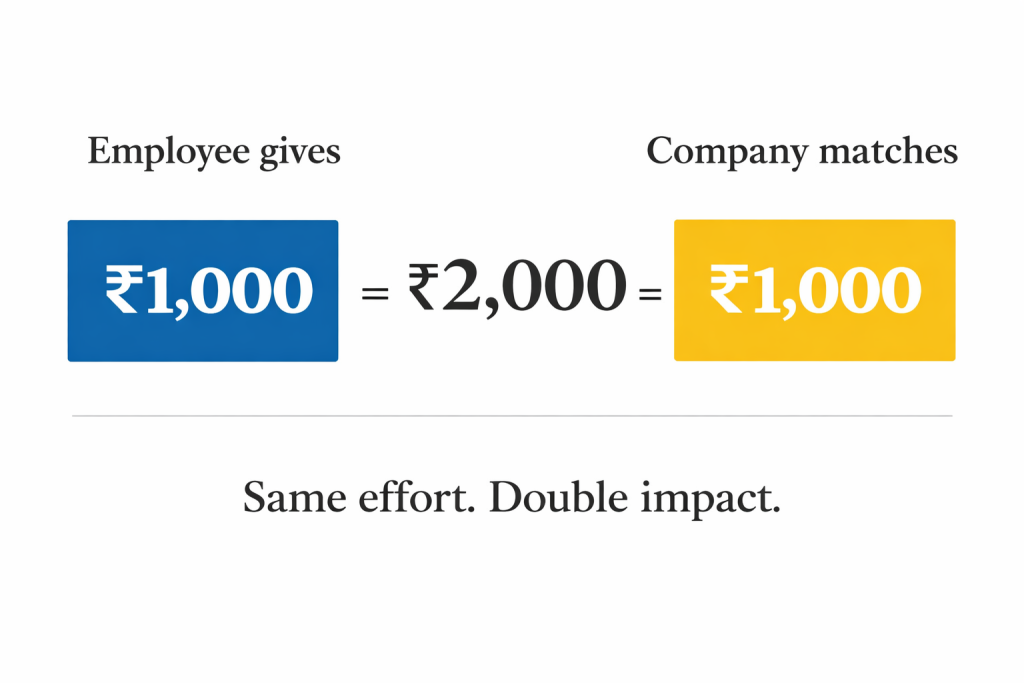
In a matching gift programme India, companies match employee donations.
For example:
- Employee donates ₹1,000
- Company contributes ₹1,000
This doubles the impact and encourages participation.
Volunteer Days and Skill-Based Volunteering
Employee volunteering India is another critical component.
Companies offer:
- Corporate volunteer day India initiatives
- Skill-based volunteering opportunities
Examples include:
- Teaching sessions
- Mentorship programmes
- Pro bono consulting
This moves engagement beyond financial contribution.
Employee Giving Programme India: Building a Culture of Participation
A successful employee giving program India is not about pushing donations.
It is about making participation easy and meaningful.
Companies that succeed in this space focus on:
- Simplicity
- Transparency
- Regular communication
Giving should feel natural, not forced.
How to Set Up an Employee Giving Programme in India
Setting up a staff donation scheme India requires both structure and intent.
Here is a simple approach:
1. Define the Purpose
- Align with company CSR goals
- Identify focus areas such as education, health, or environment
2. Choose the Right Model
- Payroll deduction donation India
- One-time campaigns
- Matching gift options
3. Partner with Trusted NGOs
- Ensure credibility and transparency
- Provide clear reporting
4. Enable Easy Participation
- Integrate with HR systems
- Keep the process simple
5. Communicate Impact
- Share stories and results
- Show how contributions are used
How Smile Foundation Partners with Companies for Employee Giving
Organisations looking to build meaningful employee giving programmes often partner with experienced NGOs.
Smile Foundation works with companies to design and implement structured initiatives that align with both business goals and social impact.
These include:
- Payroll giving campaigns
- Employee volunteering India programmes
- Awareness sessions and engagement drives
- Transparent reporting and impact tracking
If your organisation is exploring ways to strengthen employee CSR engagement, partnering with Smile Foundation can be a practical starting point.
Why Employee Giving Is Becoming a Business Priority
There is a shift happening.
CSR is no longer just about compliance.
It is about culture.
B2B CSR India conversations are increasingly focused on:
- Employee experience
- Purpose-driven work
- Long-term engagement
Companies that enable giving are not just contributing externally. They are building stronger internal ecosystems.
Conclusion
As organisations evolve, so does their understanding of impact.
An employee giving programme India is not just a tool for donations. It is a way to connect employees with purpose, simplify giving, and create shared value.
The opportunity now is to move from intention to structure.
Because when giving becomes part of everyday work life, it stops being an activity and becomes a habit.
FAQs — Employee Giving Programmes in India
What is an employee giving programme and how does it work?
It allows employees to donate to causes through structured workplace systems like payroll deductions.
How can companies set up a payroll giving scheme in India?
By integrating donation options into payroll systems and partnering with NGOs.
What tax benefits do employees get when donating through work?
They can claim deductions under Section 80G on eligible donations.
What is a matching gift programme and how does it benefit NGOs?
Companies match employee donations, increasing total contributions.
How does employee giving improve workplace culture?
It creates purpose, improves engagement and strengthens team connection.
What is skill-based volunteering and how can companies offer it?
Employees contribute professional skills such as teaching or consulting through structured programmes.
How do companies measure the impact of employee giving?
Through reports, beneficiary data and programme outcomes.
What platforms support employee giving programmes in India?
Various CSR platforms and NGO partnerships support implementation.
Can employee giving count as part of CSR?
It complements CSR but must align with compliance frameworks.
How can a company partner with Smile Foundation for employee giving?
By reaching out for customised programmes aligned with business and CSR goals.