
The consensus among educators and researchers is that STEM exposure should start as early as possible — ideally in the preschool and early primary years. Young children’s brains are highly plastic and primed to learn basic math and science concepts. Neuroscience shows that sensitive periods in early childhood make it a “window of opportunity” for learning foundational skills. In fact, infants and toddlers already display core knowledge about objects, numbers and geometry.
All experiences from birth – including simple counting games, building blocks or watching butterflies – become part of a child’s understanding of the world. This means that informal STEM activities (like exploring shapes, sorting objects or basic cause-and-effect experiments) are developmentally appropriate even for pre-schoolers. All of the experiences that children have — from birth on — inform them and the best educators can give them is the opportunity for exploration in every realm including basic science and math.
Research confirms that early math and science experiences pay off later. For example, studies find a robust association between young children’s early mathematical proficiency and later academic achievement. In other words, a child who learns to count, measure and reason spatially in preschool is more likely to excel in school math and reading in the long run. Spatial reasoning, such as understanding shapes and how things fit together, is a key part of STEM learning and is highly trainable from a young age.
Educators have long recognised that millions of young children are already in day cares and pre-schools where early mathematics and science learning can take place and that focused attention on these early foundations will yield “significant progress” over time.
Developmental Readiness: What Young Children Can Learn
Children do not need formal lectures to begin STEM learning. Even toddlers are natural explorers. Pre-schoolers readily engage in STEM through play: building block towers (engineering fundamentals), sorting and counting beads (math) or watching a caterpillar transform (life science).
Curriculum experts note that much early childhood education has always included STEM in disguise – planting seeds in a class garden (biology), cooking (chemistry/math, or even board games (patterns and logic). The key is giving children concrete, hands-on experiences and language to describe them. For instance, counting frogs at a pond or observing tadpoles helps pre-schoolers grasp life cycles and number sequences.
Psychologists report that children as young as 3–5 can learn basic STEM concepts when presented appropriately. They have innate core knowledge of objects and numbers. These intuitive abilities can be built on: a 4-year-old can sort shapes and ask “why does this tower fall?”; a 5-year-old can follow simple step-by-step instructions (an algorithm) to solve a puzzle. In fact, modern curricula in some countries introduce computing concepts at age five. For example, England’s national curriculum now teaches children (5–6 year olds) what an algorithm is – using everyday tasks like recipes or morning routines – and even lets them create and debug simple computer programmes. These examples show that with playful pedagogy, even very young learners can begin forming STEM skills.
Benefits of Early STEM Exposure
Early STEM experiences have many benefits beyond academic knowledge. They strengthen critical thinking, creativity and persistence from the start. Research in brain science shows that the preschool years are when children are active explorers and observers, building domain-general skills (like attention and reasoning) and domain-specific skills (like early math and science) simultaneously. Because learning is cumulative, giving children rich STEM experiences early can create positive momentum: strong early learning often leads to better later outcomes, whereas missed stimulation in early years can create vulnerabilities. In practical terms, a 3-year-old who intuitively sorts shapes or engages in cause-and-effect play will have an easier time learning geometry and physics later.
Studies of successful STEM programmes also underline early benefits. Young children who do hands-on science report higher curiosity and positive attitudes toward STEM subjects. A pilot study in China found that primary students who joined STEM activities were more interested in STEM careers and developed better problem-solving self-concepts.
Similarly, experts argue that teaching logic and algorithms at an early age – not only improves computer skills, but also helps children to be articulate and think logically, benefiting literacy and math too. In short, early STEM builds foundational 21st-century skills like collaboration, innovation and analytical thinking.
Global Benchmarks for Early STEM Exposure
International standards and research emphasise early STEM readiness. UNESCO and UNICEF’s recent Global Report on Early Childhood Care and Education (2024) advocates ECCE programmes that enhance literacy, numeracy and social-emotional skills as core to school preparedness. These skills are inextricably linked to early math and science concepts. UNESCO leaders stress that investing in our youngest children brings the greatest returns, pointing out that by 2030 millions of kids will lack basic skills without urgent ECCE investment. Likewise, the OECD and national academies highlight that early childhood is a critical stage: spatial reasoning and numeracy can and should be nurtured long before formal schooling.
Many high-performing education systems have taken this to heart. In England, computing education begins at age 5 (Key Stage 1), so even kindergarteners learn algorithms in context. The United States’ policy initiatives (e.g. Obama’s Educate to Innovate campaign) also stress STEM from K–12, including early grades. In Finland and parts of Scandinavia, early education is heavily play-based and often integrates basic science exploration and math games as part of daily activities. Worldwide, there is a clear trend of countries moving away from rote learning and toward inquiry-driven, hands-on curriculum in the early years.
India’s Policy Context and Challenges
India’s own National Education Policy (NEP) 2020 aligns with this global shift. NEP explicitly calls for experiential, hands-on learning at all stages and places mathematics and computational thinking at the core even in the foundational (pre-primary) stage. For example, NEP mandates using puzzles and games to make math enjoyable from age 3–8. Coding and basic computational ideas are introduced by the middle school years. Such guidelines recognise that early engagement in STEM, through play and exploration, builds the logical and creative habits Indian children will need.
However, implementing early STEM in India faces practical gaps. Many rural and government schools still lack basic science labs, let alone modern labs or trained STEM teachers. Although NEP recommends 10% of education budgets for ECCE, actual pre-primary enrolment and quality lag behind targets.
UNESCO reports that 95% of countries (including India) have made ECCE commitments, yet globally 37% of children still risk not meeting basic skills by 2030. India grapples with teacher shortages and underqualified staff in pre-schools with only a fraction of Anganwadi (pre-school) workers having formal training in early pedagogy. Large class sizes and rote curricula persist in many areas, making it hard to introduce child-led STEM activities.
At the same time, new initiatives are filling in. Central and state programmes (like Sarva Shiksha Abhiyan’s preparations and NCERT’s experiential modules) increasingly include simple math manipulatives and science corners in primary schools. The National Initiative for School Heads (NISHTHA) and others are training teachers in inquiry methods. But the equity gap remains stark with urban private schools often having labs and robotics kits, while nearby government schools may have none. Bridging this divide is urgent.
NGOs and Community Innovations: Smile Foundation’s Example
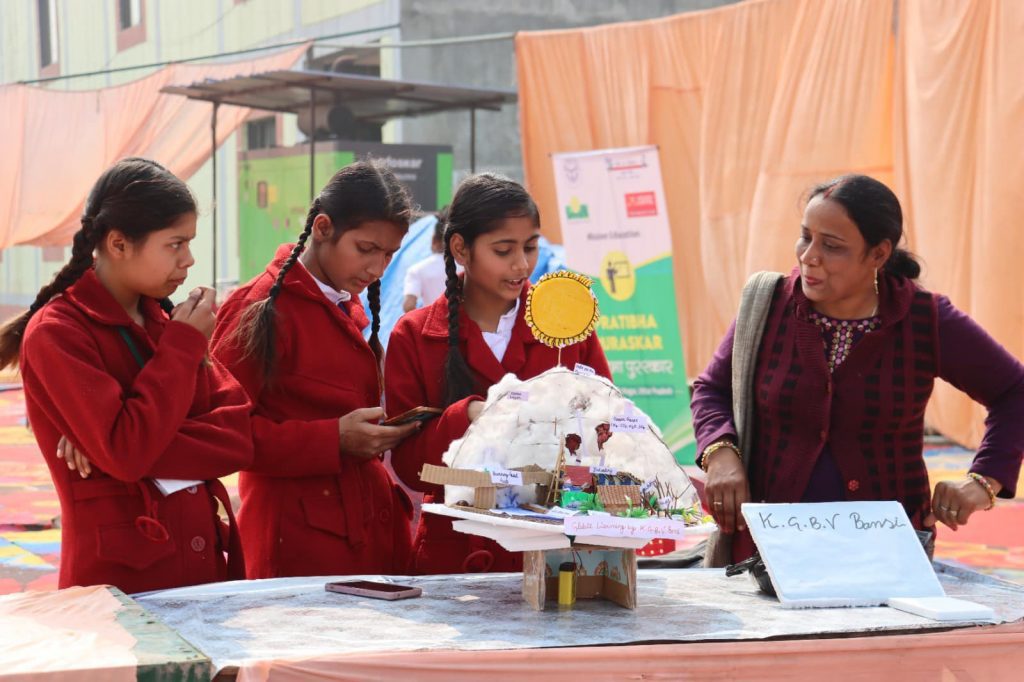
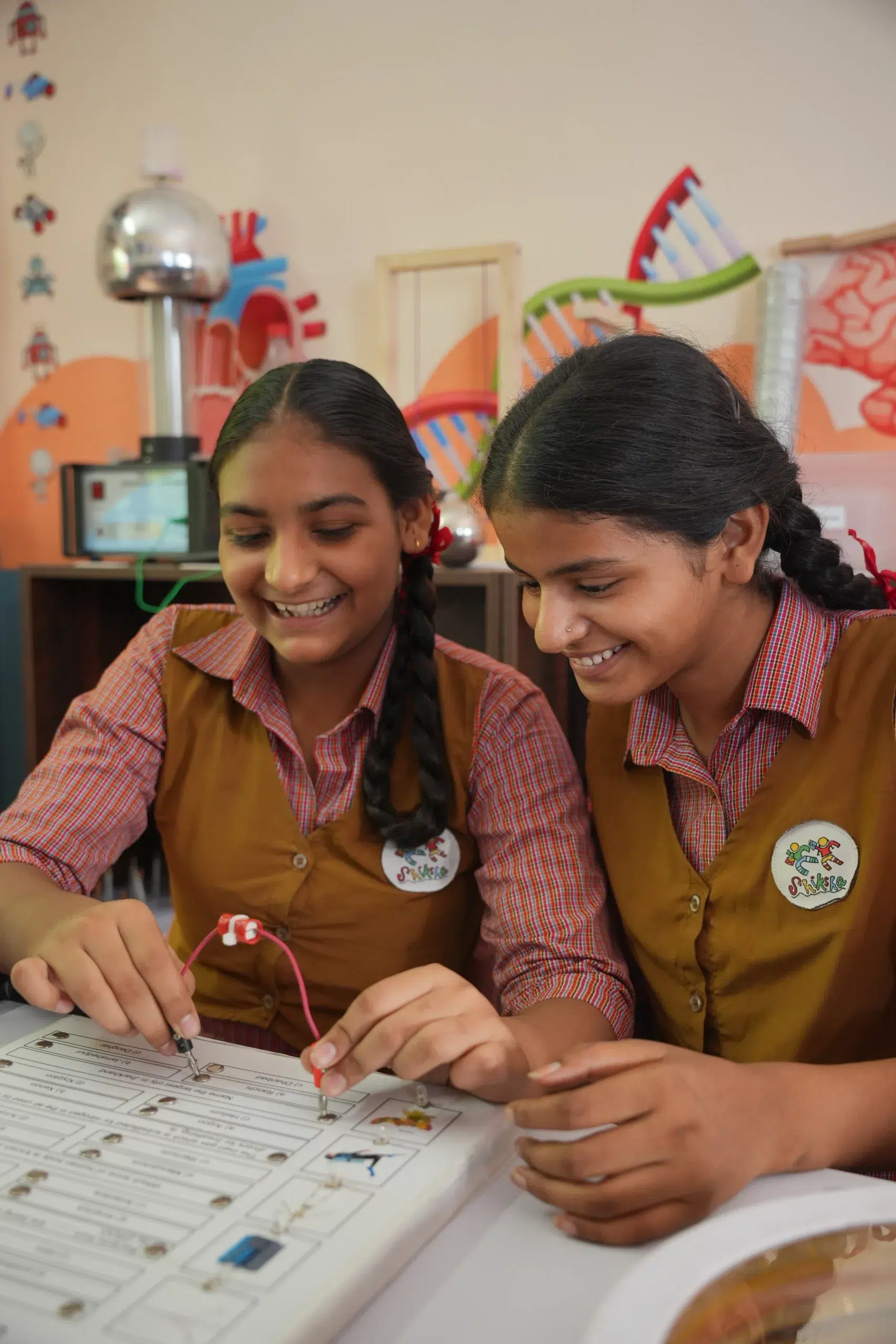
Non-profit and private partnerships offer models for reaching underserved schools. For instance, Smile Foundation is running a large-scale STEM programme reaching over 74,000 students in 450+ schools (10 Indian states) in 2024–25. Crucially, Smile’s description emphasises equitable access to quality STEM education, especially in government schools. Our multi-layered approach illustrates how targeted support can work: we help set up tinkering labs on college campuses (like an IIT-Bombay workshop) where children used real tools to make projects. We run robotics workshops for hundreds of government-school children, teaching Arduino programming and culminating in building obstacle-avoiding robots. Science fairs and DIY kit sessions are organised to encourage students across schools to create projects and experiments.
These activities do not feel like remote theory; they bring STEM concepts to life. When underserved students physically build a circuit or code a simple game, they not only grasp the ideas but also gain confidence as young scientists. Such programmes show that with even modest investment – traveling workshops, hands-on materials, teacher mentoring – the quality gap in STEM exposure can be narrowed. By linking students to colleges, competitions, and online communities, NGO initiatives like Smile’s also help sustain interest. Importantly, they demonstrate that early STEM need not be an expensive gadget show but even low-cost kits and local experiments can ignite curiosity.
Gaps and the Road Ahead
Despite these promising examples, many challenges remain. Urban–rural and public–private divides mean that a child’s ZIP code often determines her STEM exposure. Girls and disadvantaged children are underrepresented in enrichment programmes in some areas. Teacher preparedness is a bottleneck with many early childhood educators having little training in STEM facilitation or know-how to integrate math and science into play. Curricula still sometimes relegate science to textbooks, even at primary levels where interactive learning would be more effective.
The evidence is clear that starting STEM early pays dividends, yet policies and practice are often slow to catch up. For example, while NEP 2020 highlights computational thinking at the foundation stage, only limited digital infrastructure exists in rural pre-primary settings. Similarly, research-driven approaches like spatial reasoning training are far from standard practice. Without concerted action, the benefits of early STEM education will remain unevenly distributed.
Recommendations for Expanding Early STEM Exposure
Based on current research and best practices, stakeholders should take the following steps to ensure all children benefit from early STEM exposure:
- Embed STEM in foundational curricula. Early education guidelines (national and state) should explicitly include hands-on math, science and technology activities in pre-primary and early grades. This means play-based experiments (counting games, nature exploration, simple machines), coding exercises (unplugged algorithms, age-appropriate apps) and manipulatives (blocks, shapes) as routine parts of the day.
- Invest in teacher training. Empower ECCE and primary teachers with STEM pedagogical skills. Workshops, certifications and ongoing mentoring can help teachers feel confident leading inquiry and problem-solving lessons. For instance, training on using storytelling and art to teach math (as NEP suggests) or on facilitating science play will make STEM exposure richer and more engaging.
- Equip learning environments. Classrooms need basic STEM resources. Low-cost science corners, mobile science kits, tinkering labs and computer tablets can dramatically expand what children experience. Partnership models work well with local colleges or tech companies sponsoring laboratory visits or donating kits. Smile Foundation’s experience shows that even in remote schools, setting up a small tinkering station or providing a DIY robotics kit can spark student initiative.
- Focus on equity and inclusion. Special attention must be paid to under-resourced schools (rural, tribal, slum areas) and to empowering girls. Quotas or targeted outreach can bring female and disadvantaged students into STEM clubs and contests. Community engagement (educating parents about STEM’s value) can also help sustain interest. As global data suggest, without such focus, high-need children miss out on the “window of opportunity” in early years.
- Encourage public-private collaboration. Government schemes (like Samagra Shiksha Abhiyan) and NGOs should team up. Programmes similar to Smile’s – combining local outreach with expertise from IITs or universities – can be scaled up. For instance, engineering departments could run summer maker camps for local schools. The private sector can fund digital literacy drives or sponsor national science fairs for children.
- Monitor and adapt with data. Finally, stakeholders should track learning outcomes in STEM from the start. Simple assessments of number sense or scientific reasoning in early grades can flag gaps. As in other domains, continuous evaluation (e.g. via formative assessments) will ensure that early STEM programmes are improving actual understanding, not just activity participation.
In summary, there is no harm in starting STEM early – only in starting too late. The pre-primary and primary years are when children form attitudes to learning and acquire the mental frameworks that will support higher concepts. By integrating STEM exploration into early childhood and ensuring broad access, India (and other nations) can build a generation of confident innovators. Policymakers, educators, parents and NGOs each have a role. From classroom design to community science fairs, every effort adds up. The research and global experience both point to making STEM play a part of childhood as soon as curiosity blooms.
Sources: Peer-reviewed research and reports (including National Academies, OECD, UNESCO) and global benchmarks (e.g. NEP 2020) on early learning and STEM; along with case examples from Smile Foundation’s STEM programme.