
India faces an acute oral health equity crisis. Studies show that untreated dental disease is rampant – roughly 85–90% of adults and 60–80% of children in India suffer from cavities – yet most dental professionals work in cities, leaving rural and slum communities vastly underserved. Poor oral health contributes to chronic pain, stigma and lost productivity. In India’s high-tobacco context, the problem is especially dire: WHO data report that India accounts for about 37% of global oral cavity cancers (and 42% of deaths) due largely to tobacco use.
Compounding this, only a minority of Indians practice good preventive habits (under half brush twice daily) and many delay care until pain becomes unbearable. As a leading review observes, “untreated oral health conditions often worsen over time, necessitating professional intervention at advanced stages,” which both raises costs and causes people to lose workdays. In short, India’s rural and poor populations often live within sight of clinics but out of reach of routine dental care – a stark gap in a country pushing for Universal Health Coverage.
Smile’s Dental Project with Haleon
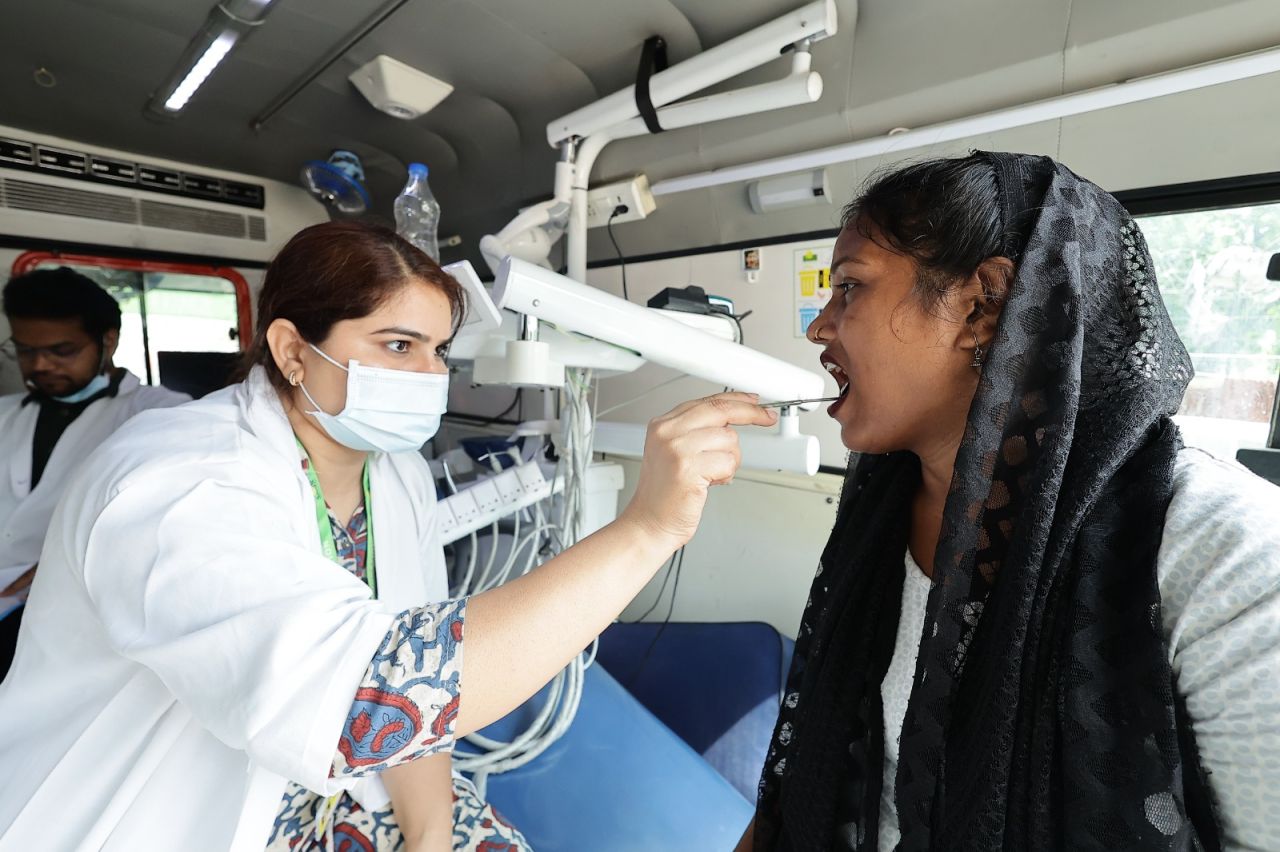
Mobile health units are one way to bridge this gap. By taking care to people’s doorsteps, these vans overcome distance, cost and awareness barriers. Smile Foundation’s Smile on Wheels Mobile Oral Healthcare Unit – funded by Haleon (maker of Sensodyne) – is an innovative example. Launched in late 2022 by GSK (now Haleon) CSR, four fully equipped dental vans now crisscross Delhi-NCR (serving Delhi, Gurugram and Noida) and even Agra, carrying dentists and equipment directly into slums and villages. Each van is staffed by a dentist, technician and coordinator, and offers a comprehensive package of care: free dental check-ups, fillings and basic treatments, free medicines and referrals, lab tests (when needed) and even oral cancer screening.
Importantly, the vans also double as classrooms – the teams run health education sessions, teach brushing techniques, and distribute toothbrushes, and they operate a School Oral Health Programme. Once a week they visit nearby government schools to give awareness talks on oral hygiene followed by free check-ups and fluoride treatments for children. In this way the dental project blends treatment and prevention, coupling curative services with a steady campaign of education and outreach.
The impact has been impressive. In its first year the four vans aimed to reach 72,000 beneficiaries; by the latest report they had served tens of thousands. In 2023–24 alone about 48,000 people received dental care and education from the vans(for perspective, a year earlier the programme had reached 34,000 people across 50 villages). These numbers are growing. Altogether, since launch the Smile on Wheels initiative has now touched well over 175,000 lives with free check-ups, medicines, oral-cancer screening and school camps – a scale few grass-roots dental programmes can match.
For many families, the van is literally a lifeline. Patients who once endured tooth pain silently now get treatment. As Smile Foundation co-founder Santanu Mishra says: “
This pilot project is a step towards addressing dental healthcare in India… We are hoping to bridge the gaps in dental healthcare delivery and provide quality services at the grassroots to ensure oral healthcare for all.”
Frontline dentists on the vans report dramatic results. A Smile on Wheels practitioner notes that in one day’s camp the team might find dozens of untreated cavities, gum disease or precancerous lesions and immediately provide care or referrals. “We see mothers relieved that their child’s cavity is filled on the spot, and elders grateful that someone finally screened them for oral cancer,” says Dr Kumar* of Smile on Wheels.* (Official data bears this out: one field study found that among high-risk waste workers, 33% screened positive for potentially malignant oral lesions – far above the population average).
By catching problems early, the mobile units can often treat decay with a simple filling or extraction, instead of allowing it to turn into painful abscesses. They also identify and refer advanced cases; Smile Foundation has set up links so patients with, say, oral pre-cancer (leukoplakia) can get follow-up at hospitals. In short, each visit combines curative care (fillings, cleanings, oral medicine) with preventive action (education, fluoride applications, cessation counselling for tobacco users) to maximize impact.
The public health insight here is clear: expanding dental care requires both innovation and community engagement. In India’s slum communities, people often skip dental care due to cost or lost wages. The Smile on Wheels vans mitigate these by being free and local, even giving out medicines on-site. They also leverage the trust of schools and community workers to deliver messages on diet and hygiene. A regular IEC (Information, Education and Communication) campaign is key; clinics can treat only one patient at a time, but education (group talks, brochures, posters) multiplies effect. Early feedback shows healthier habits creeping in – for example, after a van visit many schoolchildren report brushing twice a day and avoiding sweets. In data terms, the Smile Foundation reports that 75–80% of their beneficiaries are women and children – a sign that mobile clinics are reaching those most often side-lined from care.
Behind this success of the dental project is strong support from Haleon. Sensodyne-maker Haleon (spun off from GSK) underwrites the mobile clinics as part of its CSR commitment to everyday health for everyone. Head of CSR Shanu Saksena explains:
“There’s a synergic relationship between oral health and overall wellness… Taking actions to support communities to be healthy is reinforcing our commitment that better everyday health should be within reach for everyone.”
In practice, this means Haleon funds van operation, supplies equipment and part-funds medications. The public-private partnership model is instructive: corporate support lets an NGO scale quickly, while the NGO’s outreach expertise ensures the investment reaches those in need. Smile on Wheels shows how brand-driven health campaigns (like those by Sensodyne/Haleon) can dovetail with social objectives, bolstering national health goals like Ayushman Bharat and the Sustainable Development Goal of universal health.
What More Needs to be Done for Dental Projects?
Despite these gains, the need remains vast. Hundreds of millions in India still lack basic dental screening or advice. Mobile clinics can’t cover everyone, so the model should inspire wider action. As more healthcare providers deploy telemedicine, portable X-ray units, or AI-based screening tools (as Smile Foundation is piloting), the hope is to multiply outreach. The experience in Delhi, Gurugram, Agra and beyond underscores that accessibility is half the battle. When children smile again after a free filling, or a laborer learns that tobacco might have caused her mouth ulcer, it proves that combining treatment with education truly changes lives.
In the end, the Smile on Wheels initiative is about more than clean teeth – it’s about equity and dignity. By bringing dental care into the streets and schools of India, it is literally meeting patients where they are.
With Haleon’s backing and the Smile Foundation’s grassroots work, mobile dentistry is not just a stopgap – it’s driving India toward healthier, more confident smiles across all communities through this very impactful dental project.