
Corporate Social Responsibility (CSR) in India has come a long way since it was formalised under the Companies Act, 2013. Today, nearly every major company speaks of women empowerment as a priority area in their CSR portfolio. From micro-enterprise development to digital literacy drives, the corporate narrative around empowering women has grown both louder and broader.
Despite the proliferation of projects, India’s female labour force participation remains below 30%, rural women continue to carry unpaid care burdens and gender disparities in education and health persist. The issue is not a lack of intent, but of design. Too many CSR initiatives treat empowerment as a deliverable rather than a process — a set of measurable outputs rather than a sustained shift in power and agency.
The question, then, is not whether corporations are investing in women—but whether they are doing so in ways that lead to long-term transformation.
The Shift to Capacity
The most effective CSR models for women empowerment are those that move beyond charity-driven interventions — what could be called ‘relief CSR’ —to capacity-based CSR that strengthens systems, skills and self-belief.
Charity models, while useful in emergencies, often provide short-term benefits: a sewing machine, a skills course or a stipend that helps women temporarily. But without access to markets, mobility, decision-making and continued mentorship, these gains seldom translate into lasting change.
The most transformative models, in contrast, focus on building agency, not just income. They empower women to make informed choices—about their work, their health, their families and their futures.
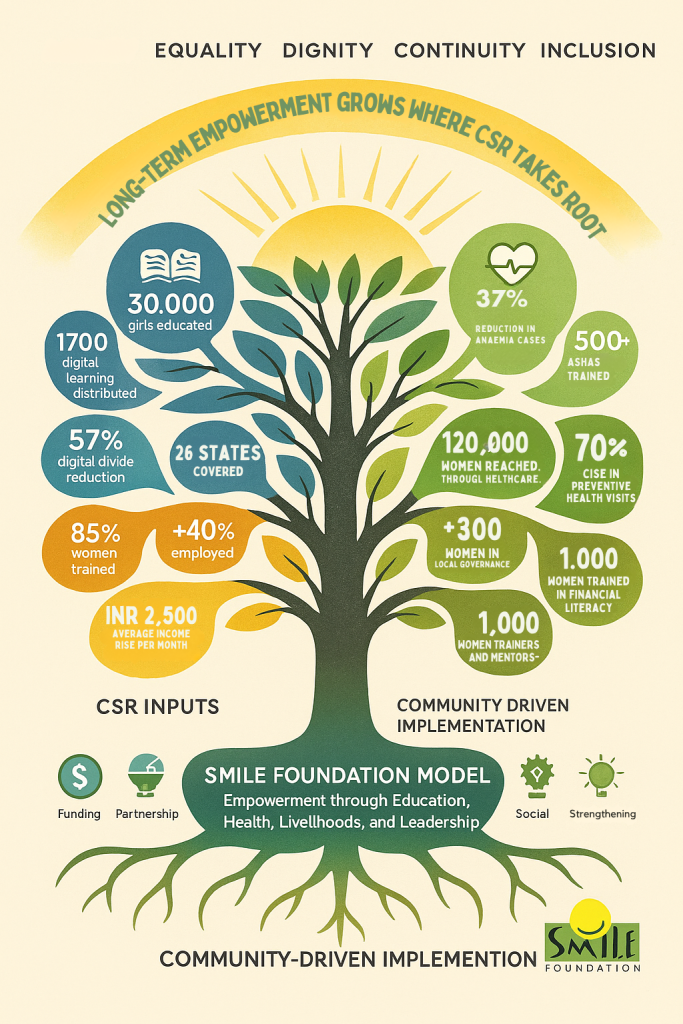
As Smile Foundation’s women-centric initiatives demonstrate, empowerment is not a linear journey but a layered one. A woman’s ability to earn or lead depends as much on her health, education and social support systems as it does on technical skills. Smile’s approach — combining education, livelihood and healthcare under one umbrella of community-driven development offers a blueprint for how CSR can sustain empowerment beyond project timelines.
The Four Pillars of Sustainable CSR for Women Empowerment
From Smile Foundation’s experience and the broader evolution of India’s CSR ecosystem, four critical pillars emerge for building long-term empowerment models.
1. Education as the foundation of agency
True empowerment begins in the classroom — not in the boardroom or the marketplace. Girls who complete secondary education are more likely to delay marriage, participate in the workforce and make autonomous health decisions.
However, CSR investments in education often focus narrowly on infrastructure—building toilets, distributing books or donating smartboards. While these are important, empowerment requires continuity and mentorship, not just facilities.
Through its Mission Education programme, Smile Foundation works with underprivileged children, especially girls, to ensure holistic learning that includes academic support, life skills and community engagement. Teachers, many of them local women, serve as mentors and role models, creating a multiplier effect within communities.
For example, in rural Madhya Pradesh, Smile’s digital classrooms have not only improved attendance among girls but also inspired parents to see education as a pathway to independence rather than a burden. This shift in perception, slow but steady, is the first step towards lasting empowerment.
Education-focused CSR that integrates female teacher recruitment, parental engagement and local leadership thus builds an ecosystem that outlives project cycles.
2. Livelihoods that go beyond employability
CSR programmes often equate women’s empowerment with vocational training. Stitching, candle-making or beautician courses dominate the landscape, but the challenge lies in sustainability. Many women trained under such schemes struggle to find consistent income because local markets are saturated or supply chains are male-dominated.
The most effective CSR models therefore extend support beyond training connecting women to microcredit, cooperatives or market linkages.
Smile Foundation’s livelihood projects under Smile Twin e-Learning Programme (STeP) follow this integrated approach. Women are trained not only in employable skills — retail management, IT, customer service — but also in soft skills like financial literacy, communication and digital awareness. Crucially, the programme links trainees with employers and local enterprises, ensuring real economic mobility.
In Delhi’s Seemapuri, for instance, STeP graduates have moved from informal work to full-time employment in retail chains and healthcare companies, often becoming primary earners in their households. For many, this is the first taste of financial independence, and with it, dignity.
Long-term livelihood CSR must view women as entrepreneurs and decision-makers, not just as beneficiaries. It must equip them to navigate both the workplace and the world.
3. Health and nutrition: The invisible enabler
Women’s empowerment cannot be sustained without women’s health. Yet, health remains the most underfunded area in corporate philanthropy. While companies fund skill training or education, they rarely address the foundational barriers — malnutrition, reproductive health issues or lack of access to preventive care that keep women from thriving.
Smile Foundation’s Smile on Wheels programme — mobile healthcare units serving remote communities addresses this gap head-on. Many of its frontline health volunteers are women, often trained as community mobilisers or ASHA-like workers. They deliver primary care and health education at the doorstep, freeing women from the time and cost of travelling to faraway clinics.
In Uttar Pradesh, for example, Smile’s mobile health initiative has improved maternal health outcomes and reduced anaemia prevalence through consistent follow-up and counselling. These health interventions indirectly support empowerment by ensuring that women are well enough to participate in education and livelihood programmes.
CSR models that integrate healthcare, nutrition and sanitation into empowerment projects create stronger, more resilient outcomes because a woman’s ability to lead depends first on her ability to live well.
4. Community and family inclusion
Empowerment is a collective negotiation. A woman’s progress is often constrained, or supported, by her immediate ecosystem: her family, her peers, her village.
The most enduring CSR models recognise this social complexity and invest in community sensitisation. Smile Foundation’s projects consistently engage men, local leaders and parents to shift attitudes around women’s work and mobility.
In Rajasthan, for instance, Smile’s livelihood initiative involved fathers in counselling sessions that explained the economic and social benefits of women’s employment. Over time, these conversations have changed how families perceive working daughters or wives — not as transgressors, but contributors.
This community-based approach aligns with what development practitioners call normative change. When CSR programmes invest in changing mindsets, they ensure that empowerment doesn’t collapse once funding stops.
The long view: Empowerment as a continuum
What distinguishes impactful CSR from performative CSR is time horizon. Empowerment is not achieved in six months or even two years — it unfolds across generations. A girl who receives support today may only fully exercise her agency a decade later, when she chooses her career, delays marriage or educates her daughter differently.
That’s why long-term CSR models build continuity and convergence. Instead of isolated interventions, they create interconnected pathways — education leading to employment, employment supported by health, health reinforced by community awareness.
Smile Foundation’s work exemplifies this continuum. A girl who begins her journey in a Smile Mission Education centre may later benefit from digital training under STeP, access healthcare through Smile on Wheels and participate in community workshops on leadership or financial planning. The organisation’s multi-sector model allows women to evolve, not just survive.
This approach mirrors the UN Sustainable Development Goals’ (SDGs) principle of interdependence where quality education (SDG 4), gender equality (SDG 5), good health (SDG 3) and decent work (SDG 8) reinforce each other.
Corporates designing CSR strategies would do well to internalise this logic: empowerment is an ecosystem outcome.
What doesn’t Work and Why
While success stories abound, many CSR initiatives still fall short of their transformative potential. Common pitfalls include:
1. Tokenism and short project cycles
Too often, companies launch short-term empowerment programmes tied to financial years rather than community needs. Once budgets reset, so does the project. Without sustained engagement, progress reverses.
2. Lack of localisation
A one-size-fits-all model rarely works. Women’s realities differ vastly between urban slums, tribal areas and semi-rural communities. Programmes that fail to adapt to local norms, languages or aspirations struggle to gain trust.
3. Ignoring unpaid work
Many empowerment programmes overlook the enormous burden of unpaid labour that women carry — caregiving, cooking, cleaning, water collection. Without addressing this time poverty, even the best training or employment opportunity can falter.
4. Measuring outputs, not outcomes
Counting beneficiaries or training sessions may look impressive in reports, but real empowerment is reflected in agency — the ability to make and act upon decisions. CSR models must therefore adopt metrics that capture behavioural and attitudinal change.
5. Missing the emotional dimension
Women need confidence, not just capital. Successful models invest in self-esteem, leadership skills and peer networks that sustain women long after projects end.
Corporate Lessons from the Field
Several lessons stand out from CSR experiences across India, reinforced by Smile Foundation’s on-ground work:
1. Build from within
Empowerment is most sustainable when it grows from local leadership. Hiring and training community women as educators, facilitators or health workers ensures continuity and cultural alignment. Smile Foundation’s practice of recruiting from within the community strengthens trust and ownership.
2. Invest in multi-year programmes
Short projects rarely produce deep change. Long-term CSR commitments — spanning five to ten years — allow organisations to evolve with the community and adapt strategies as realities shift.
3. Forge partnerships
No single entity can address gender inequality alone. Collaborations between corporates, NGOs and government schemes (like NRLM or ICDS) amplify reach and reduce duplication.
4. Prioritise mentorship
For women entering work or leadership roles for the first time, mentorship provides guidance and emotional resilience. Corporate volunteers can play a vital role here, bridging professional expertise with grassroots ambition.
5. Focus on intergenerational impact
CSR models that support both mothers and daughters—through health, education and livelihoods create enduring shifts. Smile Foundation’s initiatives often involve entire families, ensuring that empowerment is not temporary but hereditary.