

Key takeaways
- Annual reports and impact reports serve different purposes: Annual reports document activities and organisational performance, while impact reports examine whether those activities created meaningful change.
- Outputs are not the same as outcomes: The number of people trained or villages reached does not necessarily show whether a programme improved people’s lives.
- A theory of change connects activities to impact: Impact reporting should make clear how an intervention is expected to produce longer-term outcomes and whether the evidence supports that pathway.
- Numbers need context: Disaggregated data, participant stories, interviews and other qualitative evidence can reveal who benefited, who was left out and why results differed.
- Impact reporting should enable learning: A strong report does not hide missed targets or unintended consequences. It uses evidence to help NGOs, donors and CSR teams decide what to improve, scale or rethink.
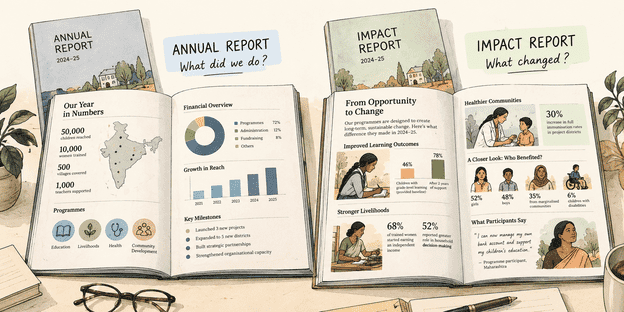
A non-profit can end the year with an impressive list of numbers: 50,000 children taught, 10,000 women trained, 500 villages covered, 1,000 teachers supported. Its annual report may have photographs from the field, testimonials from beneficiaries, a neat account of how much money was raised and spent. And on paper, it can look like a year of considerable achievement. But there is a question those numbers do not necessarily answer: what actually changed?
That is the gap an impact report is supposed to fill. An annual report tells the story of an organisation’s year with a focus on its programmes, finances, activities, milestones and institutional developments. An impact report, in contrast, should go a step further and examine whether those activities produced the social or environmental change the organisation set out to create. This distinction is increasingly important in India’s development sector, where donors, CSR funders and communities are asking not only where money went, but what it achieved.
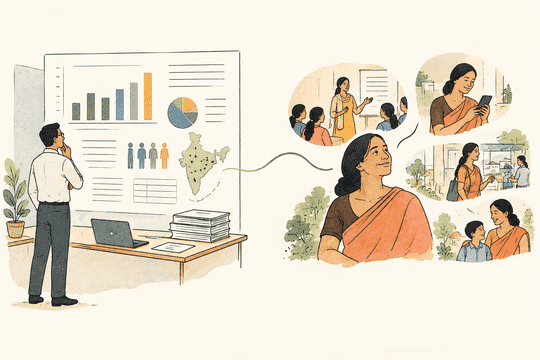
A glimpse of ‘what changed’
The easiest way to understand the difference between these two reports is through the distinction between outputs, outcomes and impact. Suppose an organisation runs a programme teaching digital skills to women. An annual report might focus on numbers like 2,000 women attended training, 100 workshops were conducted, 50 trainers were engaged, etc. These are outputs: they tell us what the organisation did.
An impact report should thus ask what happened next. The report needs to answer questions like: How many women actually acquired the intended skills? How many began using digital banking independently? Did their access to financial services increase? Did their income or economic decision-making change? Did the programme work equally well for younger and older participants? What happened to those who dropped out?
The distinction matters because a large output does not automatically translate into a meaningful outcome. As The Bridgespan Group notes, organisations need to track inputs, outputs and intermediate outcomes if they want to understand not merely whether a programme was delivered, but how and for whom it is producing results.An impact report, therefore, should not simply contain more numbers than an annual report. It should simply contain different kinds of answers.
The theory behind the numbers
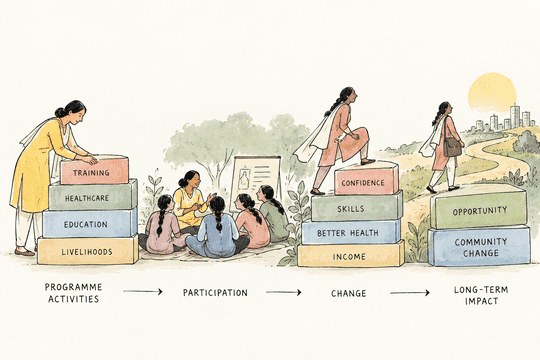
A good impact report should begin by making the organisation’s ‘theory of change’ visible. In simple terms, the theory of change framework denotes the pathway for an organization to achieve long term goals. In that sense, the impact report informs if the organisation is headed in the right direction towards desired outcomes or not.
To illustrate the same: every social programme contains an implicit argument: if we do X, it will lead to Y, which will eventually contribute to Z. A school might believe that providing remedial classes will improve attendance and foundational learning, which in turn will improve children’s long-term educational outcomes. A livelihoods programme might assume that vocational training, combined with market access and financial support, will increase women’s income and economic independence. Therefore, an impact report should make this chain explicit and then ask whether the evidence supports it.
This is important because otherwise reporting can become a collection of disconnected achievements. Ten thousand people trained tells us very little if training was not followed by employment, income generation or another intended outcome. Similarly, distributing 1,00,000 textbooks is an important activity, but the impact question is whether children actually used them and whether learning improved. Impact measurement is thus key for any social sector organisation. It refers to the process of understanding how much progress an organisation has made towards its intended outcomes, and is useful as it helps organisations learn and improve their strategies.
A mechanism of review
An annual report tends to present an organisation at the level of aggregate achievement. An impact report should be much more interested in distribution. If a programme says it improved school attendance by 15 percent, an impact report should ask: among whom? Did attendance improve equally for girls and boys? Did children from poorer households benefit as much as others? Were children with disabilities included? Did the programme reach those most at risk of dropping out? This is where disaggregated data becomes important. Age, gender, geography, socioeconomic background and other relevant characteristics come into play as they can reveal patterns that disappear inside a single headline number.
The same principle applies to geography. A national programme may report that it reached 100 districts, but an impact report should help readers understand whether results varied between regions. A health intervention might work particularly well in areas where frontline health workers were already strong but produce weaker results elsewhere. That difference is not an embarrassment to hide but it is information about how the programme works, and what the next steps would be like. Community-driven impact is often highly contextual. While practitioners use different combinations of quantitative measures, community self-assessments and storytelling because social change cannot always be reduced to a single metric.
The people behind the data
An impact report essentially gives one qualitative evidence alongside statistics, and in the process elevates numbers to real people. While numbers tell us that a programme achieved an outcome; interviews, focus groups, case studies and participant narratives can help explain why.
Imagine an organisation reporting that women who completed a financial-literacy programme became more likely to use bank accounts. The statistic establishes a pattern. A conversation with participants might reveal that the real turning point was not the financial-literacy module itself but learning how to use a smartphone, having a woman facilitator or receiving support from a peer group. Conversely, qualitative evidence can complicate a positive result. Participants might report that they completed training but could not apply what they learnt because they lacked internet access, family support or employment opportunities.
This combination of evidence is particularly important in development work, where the people being counted are not simply programme beneficiaries but individuals living within complex social systems. This is why it is recommended that organizations balance quantitative data with qualitative information such as interviews and open-ended surveys because the two reveal different dimensions of change.
To look back and evolve
Perhaps the biggest difference between a promotional annual report and a genuinely useful impact report is its willingness to discuss failure, limitations and unintended consequences. An annual report is often designed to communicate confidence in an organisation. An impact report thus needs to create room for uncertainty, and also address questions like: What targets were missed? Which intervention produced weaker results than expected? Did participation fall after the first few months? Were there groups who did not benefit? Did the programme create an unintended burden for communities? What assumptions turned out to be wrong?
It is about both transparency and learning. If a nonprofit discovers that its vocational training programme has high enrollment but low post-training employment, the finding can change the programme itself. This allows them to figure if the curriculum needs to change or employers need to be involved or if the programme is measuring enrolment rather than completion, etc.
Impact measurement in turn becomes valuable when such findings feed back into decisions, helping organisations refine strategy, improve programmes and make better resource-allocation decisions.
Towards a valuable future
This distinction between annual report and impact report has also acquired institutional importance in India. Under the Companies (CSR Policy) Rules, certain companies are required to undertake independent impact assessments of specified CSR projects. The rules require companies with an average CSR obligation of at least ₹10 crore in the preceding three financial years to undertake impact assessment of CSR projects with outlays of ₹1 crore or more, subject to the conditions specified in the rules. The resulting impact assessment reports are to be placed before the board and annexed to the annual CSR report.
The Ministry of Corporate Affairs has explained the purpose in straightforward terms: impact assessment is intended to assess the social impact of CSR projects and provide feedback that can help companies make better decisions about deploying CSR funds. This represents an important conceptual shift. CSR reporting is not supposed to end with simple numbers but in fact, answer the harder question of whether that spending had a tangible impact or not.
Ultimately, the test of an impact report is not how glossy it looks or how many indicators it contains. It is whether a reader can use it to make a better decision. The report should provide key stakeholders context, and in turn, the scope to find answers. A donor should be able to understand whether continuing to fund a programme makes sense and what conditions might improve it. A CSR team should be able to decide whether to scale, modify or discontinue an intervention.
An NGO should be able to identify where its theory of change is working and where it needs revision. Most importantly, communities should be able to see whether the organisation’s claims correspond with their lived experiences. This is why an impact report should not be just an annual report with more charts.
The annual report tells us what an organisation was, did and spent during the year. An impact report should make us wrestle with more difficult questions. The strongest impact report, therefore, be the one willing to show the distance between an intervention and the change it hoped to create; and to explain honestly what happened along the way.
FAQs
1. What is the difference between an annual report and an impact report?
An annual report generally presents an organisation’s programmes, activities, finances and achievements during a year. An impact report goes further by examining whether those activities produced the intended social or environmental outcomes.
2. Why aren’t programme outputs enough to demonstrate impact?
Outputs show what an organisation did, such as how many people attended training or how many workshops were conducted. They do not necessarily show what happened as a result. An impact report needs to examine whether the intended changes actually occurred.
3. What is a theory of change in impact reporting?
A theory of change explains the pathway through which an organisation expects its activities to contribute to longer-term goals. An impact report can use this framework to examine whether the evidence supports the assumptions connecting an intervention to its intended outcomes.
4. Why is qualitative information important in an impact report?
Statistics can show that a particular outcome occurred, while interviews, focus groups, case studies and participant narratives can help explain why it happened. Qualitative evidence can also reveal barriers, unintended consequences or experiences that headline numbers might miss.
5. Should an impact report include programmes that did not succeed?
Yes. A useful impact report should make space for missed targets, weaker results, groups that did not benefit and unintended consequences. Acknowledging these findings can help organisations improve programmes and make better decisions about resources.
6. Why does disaggregated data matter in impact reporting?
A single headline number can hide important differences. Breaking data down by factors such as age, gender, geography and socioeconomic background can help organisations understand who benefited, who may have been excluded and where a programme worked differently.
7. Why is impact assessment becoming important for CSR in India?
Under India’s CSR framework, certain companies are required to undertake independent impact assessments for specified CSR projects, subject to prescribed conditions. The purpose is to assess social impact and provide feedback that can inform decisions about the deployment of CSR funds.