
DISASTER RESPONSE | ASSAM FLOODS 2026
The rivers have fallen. Families are returning to homes under three feet of silt, to dead wells and to fields that will not produce this season. What happened in Upper Assam, why this flood was different and what recovery actually requires.
A raft made of banana trunks
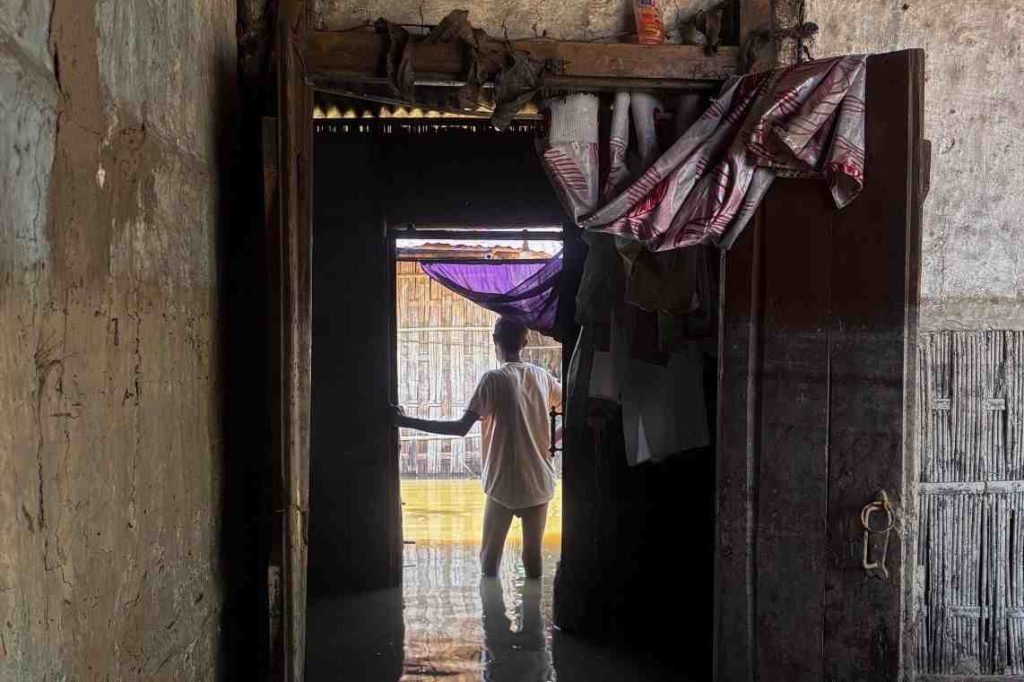
Well past midnight on 19 July, as floodwater pushed through Charing village in Assam’s Sivasagar district, Bornali Baruah and her husband faced a problem with no good answer. His mother, Lokada Duarah, is 97 and almost bedridden. Their account, reported by the BBC, has become one of the defining images of this flood. There was no boat, no rescue team and no neighbour free to help, because everyone in the village was busy saving themselves.
So they lashed banana trunks into a raft, lifted her onto it and walked. The water was three to four feet deep and the current strong enough that the three of them held hands and steadied themselves with sticks. An hour later they reached a shelter camp on the national highway. Behind them, the water rose to about five feet inside their house.
Baruah is 40 and has lived in Charing since birth. Her family has been there for generations. She had heard stories of a great flood in 1950, long before she was born, but nothing like this had happened in her lifetime. Her house is not on a riverbank: the Brahmaputra is roughly 20km away, the Dikhow 12km, the Jhanji 10km, the Mitong 5km.
She had left journalism in 2016 for animal husbandry, and by 2019 had been named Assam’s best livestock farmer. Her farm carried around 300 goats, 500 ducks and 1,000 chickens, plus fish. Sixty goats survived. She also lost 300 ducks, 300 chickens, much of the fish, her feed-making machine, furniture, vehicles, laptops and the family’s books. None of the livestock was insured, and she says no insurance product exists locally for goats in the first place.
| “We will have to learn to coexist with the floods.” — Bornali Baruah, Charing village |
What the numbers tell about Assam Floods 2026
Baruah’s village is one of 456 recorded as flood-affected. The Assam State Disaster Management Authority’s bulletin of 9 August lists ten districts and 28 revenue circles hit, with Golaghat (145 villages) and Sivasagar (110) worst affected by that measure. Around 119,000 hectares of cropland went under.
| Indicator | Figure | Source and date |
| Confirmed deaths, Assam | 100 | ASDMA / AP, 10 August 2026 |
| Confirmed deaths, Nagaland | 13 | Nagaland government, late July |
| Districts affected | 10 | ASDMA bulletin, 9 August |
| Villages affected | 456 | ASDMA bulletin, 9 August |
| Worst-hit by villages | Golaghat (145), Sivasagar (110) | ASDMA bulletin, 9 August |
| Cropland submerged | ~119,000 hectares | ASDMA bulletin, 9 August |
| People still in relief camps | 8,000+ in 52 camps | ASDMA bulletin, 9 August |
| People displaced since July | 700,000+ | Associated Press, 10 August |
| Interim state relief per family | ₹15,000 (+₹10,000 in two districts) | Assam CM announcement, August |
Figures compiled from ASDMA bulletins, state government announcements and Associated Press reporting. Note that camp figures move daily and that some agencies quote cumulative displacement while ASDMA quotes people currently sheltered, which is why totals differ between outlets.
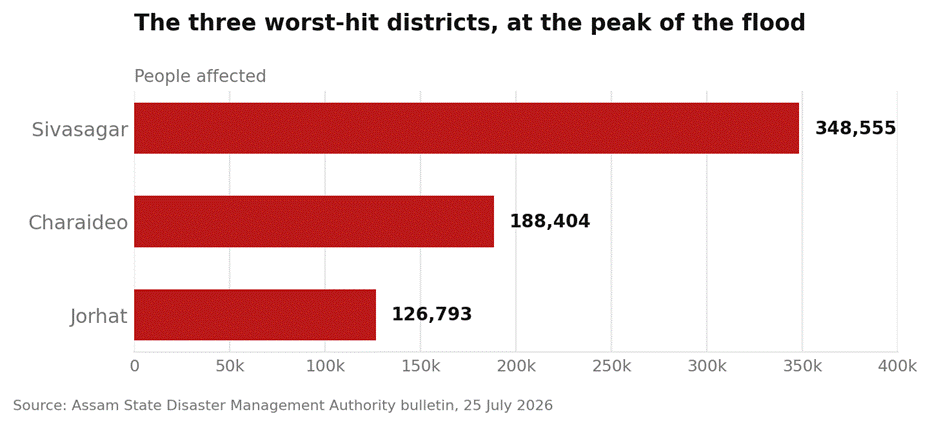
At the peak, Sivasagar alone accounted for more people affected than Charaideo and Jorhat combined.
The toll rose slowly and then kept rising. Four deaths were confirmed on 20 July. By 24 July it had passed 60, with fourteen deaths recorded in a single 24-hour period. It reached 75 by the end of the month and 100 by 10 August. Nagaland, where the rain fell first, reported 13 more.
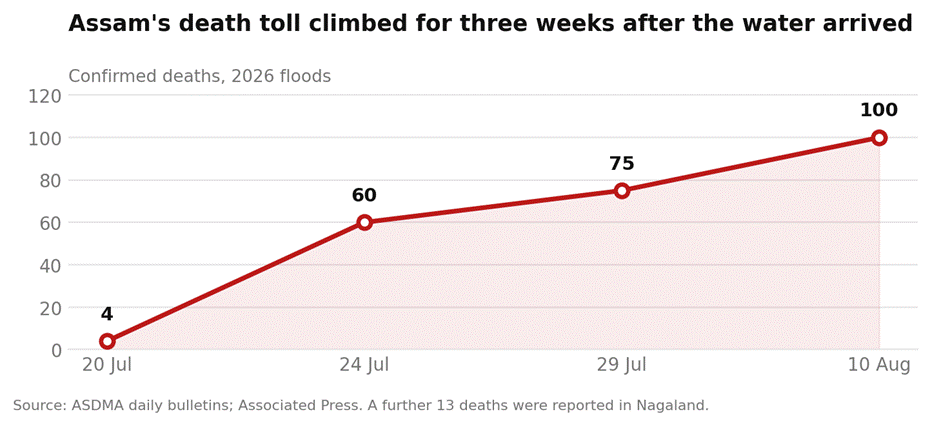
Deaths were still being confirmed weeks after the water arrived, as bodies were recovered from silt and remote villages became reachable.
One caution for anyone reading coverage of this disaster: the displacement figures do not agree. ASDMA counted just over 8,000 people in 52 camps on 9 August, while wire reporting the following day described nearly 300,000 people having passed through camps and 49,000 still in them. These are almost certainly different measures, current occupancy against cumulative shelter, rather than a contradiction. But it means a headline number on its own tells you very little and it is worth checking what any given figure is actually counting before repeating it.
Why the water reached places it never had
The Brahmaputra floods every year. Assam’s floodplain holds some 28 million people and the river ranks among the world’s top five for both water discharge and sediment load, much of it carried down from Tibet. What has changed, according to Dhrubajyoti Sahariah, professor of geography and director of the Centre for Brahmaputra Studies at Gauhati University, is that the frequency, intensity and severity of flooding now sit well outside historical norms.
The immediate trigger this time was upstream. Heavy rain fell over Mon, Mokokchung and Wokha in Nagaland on 19 July, swelling south-bank tributaries including the Dikhow, Disang and Dhansiri, which then spilled into Assam. Chief Minister Himanta Biswa Sarma attributed the surge partly to a cloudburst in Nagaland. The India Meteorological Department disputed that, which is precisely where the argument about causes opens up.
Sahariah points to settlement on active floodplains, forest clearance, hill-cutting and mining raising sediment loads, and roads and bridges built without properly accounting for the region’s hydrology. Mirza Zulfiqur Rahman, a researcher on the Brahmaputra basin, makes a related argument: wetland degradation and infrastructure have obstructed natural drainage on both banks and in building for economic connectivity the region broke its ecological connectivity.
Politics enters here too. Congress MLA Debabrata Saikia has called the disaster man-made, blaming unfilled open-cast coal pits in Nagaland and unregulated sand and stone mining along the Dikhow, and noting that a task force ordered by the Gauhati High Court after his 2019 petition has not been formed. A local administrator in Naginimora, one of the worst-hit Nagaland towns, rejects the mining link and attributes the flooding to torrential rain and low-lying ground. Both are interested parties, and no independent assessment has yet settled it.
Sahariah’s prescription is structural rather than partisan: basin-scale planning. Many tributaries rise in neighbouring hill states while flood control is planned almost entirely within Assam, which leaves the state managing a river system whose upstream it does not govern.
What survivors need now
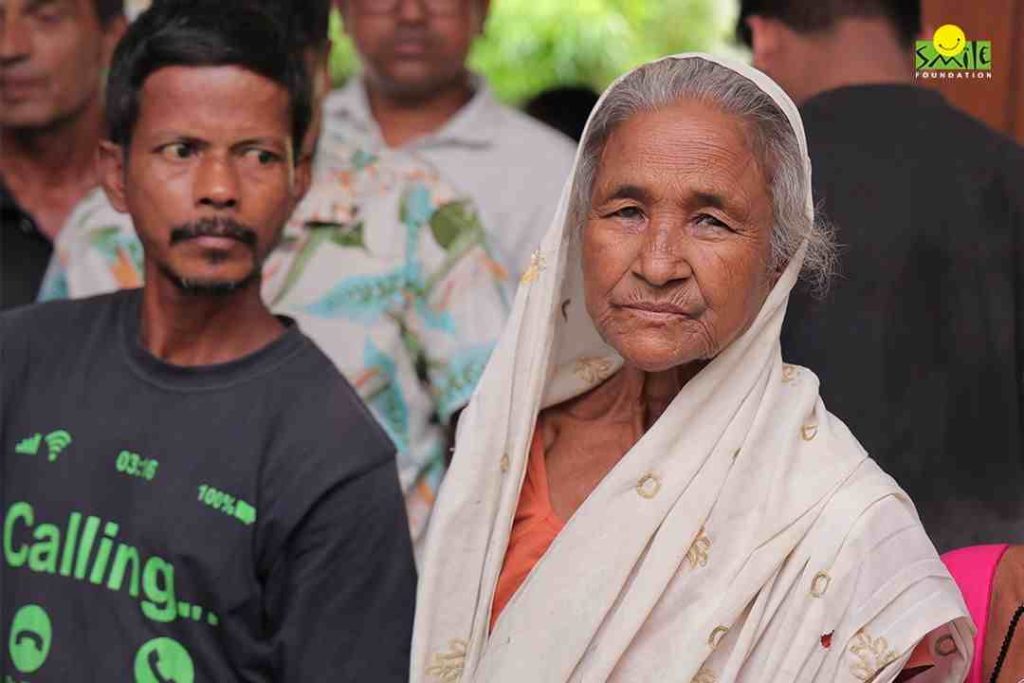
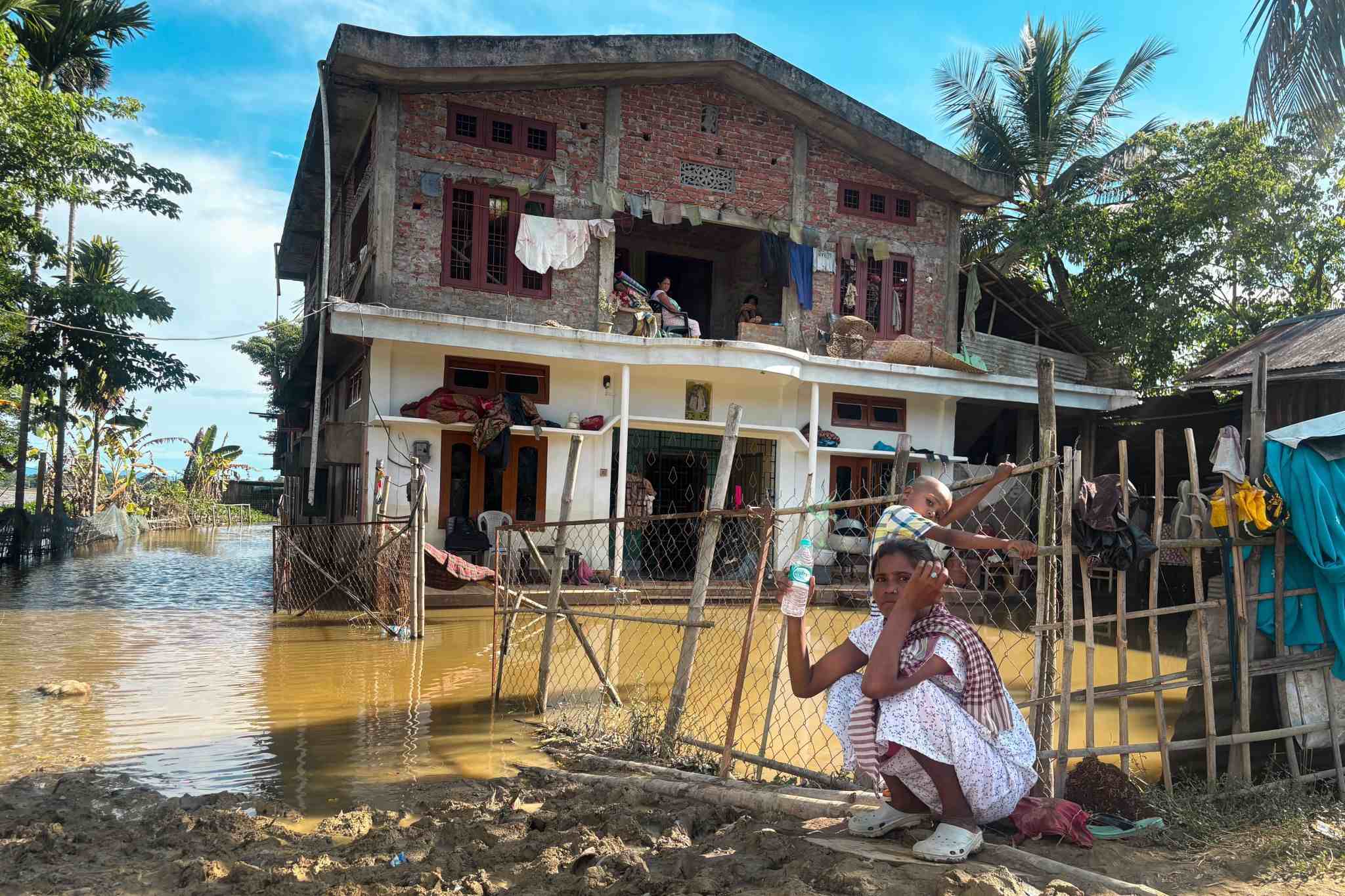
The emergency phase is largely over. What replaces it is slower and less photogenic. Water has receded across much of the affected area, but families are returning to houses buried under two to three feet of silt, to dead wells and to fields that will not produce this season.
Livestock losses are the sharpest economic wound. In Nepalikhuti, a Sivasagar village where residents took refuge on rooftops and in a two-storey building, around 5,000 cattle are reported swept away in a community that depends on dairy. Health risks have shifted too: a doctor at Demow Model Hospital who treated snakebite cases by phone during the flood has since seen roughly 150 patients with insect bites, driven by the mud left behind.
Conditions in the camps were hard in the first fortnight. Baruah’s family spent ten days in one, and for five of those there was no electricity or mobile signal, so she could not even charge a phone. The government kit contained rice, lentils and cooking oil. What filled the gaps was other people: a young woman she had never met helped with food, cleaning and looking after her surviving goats, and another took on treating the animals that fell ill.
| Need | Why it matters now | Roughly what it costs |
| Safe drinking water | Wells and tubewells sit under silt and floodwater; contamination drives diarrhoeal illness | ₹500–1,500 per family for filters or purification tablets |
| Dry rations | Stored grain was submerged; the July harvest is gone in flooded blocks | ₹1,500–2,500 per family for a two-week kit |
| Hygiene and dignity kits | Women and girls in camps lack sanitary supplies and privacy | ₹600–1,200 per kit |
| Shelter materials | Tarpaulin, roofing sheets and rope for homes stripped to the frame | ₹3,000–8,000 per household |
| Livestock support | Fodder, veterinary care and restocking for dairy and goat farmers | ₹5,000–25,000 per household |
| Silt clearance | Two to three feet of silt is blocking returns even where water has gone | Labour and tool costs, highly variable |
Cost ranges are indicative, based on the relief kits Indian agencies have been distributing in Assam this monsoon. Actual costs vary by district and by supplier.
How Smile Foundation is responding
Smile Foundation‘s disaster response in Assam is designed to complement the state-led effort rather than run parallel to it. The state has announced ₹15,000 in interim relief per affected family, with a further ₹10,000 for households in Sivasagar and Charaideo and a waiver on July electricity bills up to 300 units in those two districts. Around 50,000 people had been paid interim compensation by 10 August. That matters and it is nowhere near the cost of rebuilding a dairy herd or a goat farm.
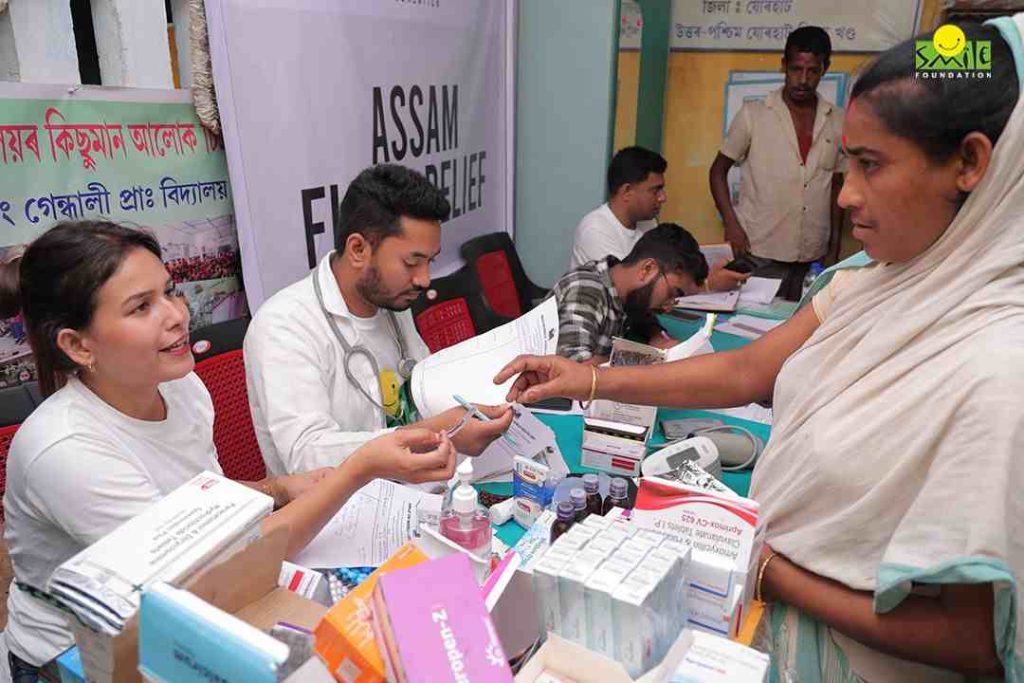
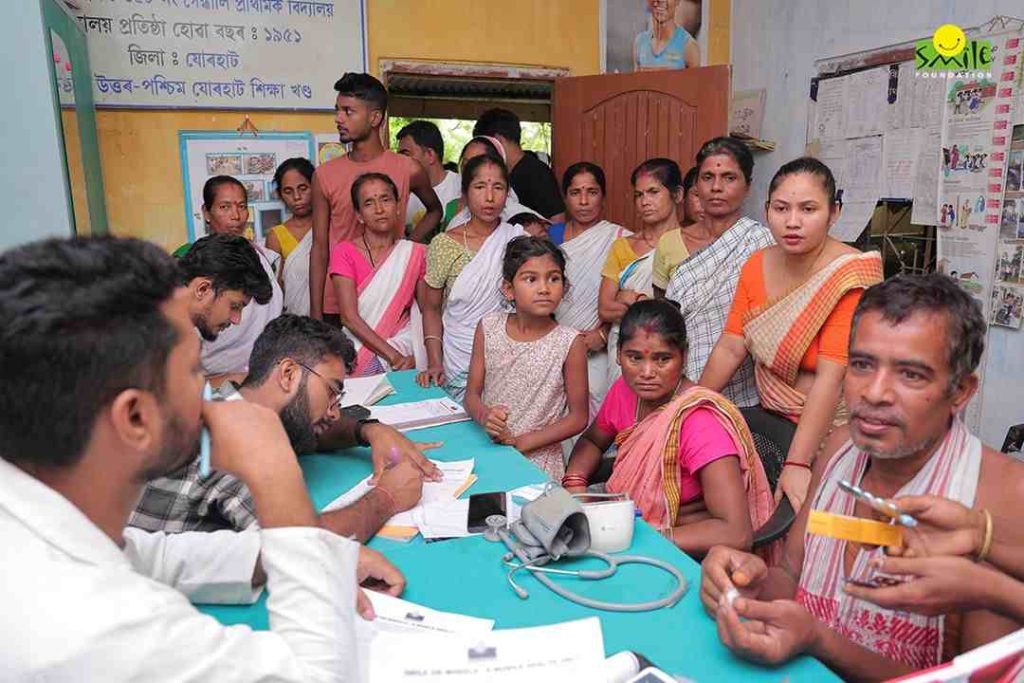
The immediate focus of our work is on the essentials that determine whether a household stays healthy through the weeks after the water goes: emergency rations, safe drinking water and sanitation, mobile healthcare reaching camps and returning families, and hygiene and dignity kits for women and girls. The longer arc is rehabilitation, because a family that survives the fortnight but loses its livelihood has not recovered.
Support the Assam flood response Your contribution funds emergency rations, clean drinking water, mobile healthcare and rehabilitation for families in Upper Assam.
Donate here.
Five checks before you give
- Give money, not goods, unless an organisation has publicly asked for material. Cash lets local teams buy what is actually short, and it does not clog logistics with unsorted clothing.
- Check the appeal is dated for this flood. Assam floods most years and older appeal pages from 2022 and 2024 still circulate on social media long after those campaigns closed.
- Confirm 80G registration if you are an Indian taxpayer and FCRA registration if you are sending money from abroad. Foreign contributions to an organisation without FCRA clearance are not lawful.
- Prefer organisations already working in the affected districts. Sivasagar, Charaideo, Golaghat, Jorhat and Dhemaji are where the need is concentrated and an organisation with existing local partners can move faster than one arriving cold.
- Consider giving for recovery, not just relief. Food kits matter in week one; fodder, seed, silt clearance and livestock replacement determine whether a family is still solvent in a year.
Baruah has returned to Charing and is staying with a neighbour while she waits to move back in. She does not intend to leave. Moving away requires economic and social resources her family does not have, so instead she is planning: raise the foundation of the house, build a platform to retreat to, stock food and drinking water in advance. She rejects the label of climate refugee. If the family regains its economic and mental strength, she says, life will return to what it was.
FAQs
1. How many people died in the Assam floods 2026?
The confirmed toll in Assam reached 100 on 10 August 2026, according to the state disaster management authority. A further 13 deaths were reported in neighbouring Nagaland, where the heavy rain fell first. The toll rose steadily for three weeks as bodies were recovered from silt and remote villages became reachable.
2. Which districts were worst affected?
Ten districts and 456 villages were recorded as affected in the 9 August bulletin. Golaghat had the most affected villages (145), followed by Sivasagar (110). By population, Sivasagar was hit hardest, with over 348,000 people affected at the peak, ahead of Charaideo and Jorhat.
3. Why did the flood reach villages that had never flooded before?
Heavy rain upstream in Nagaland on 19 July swelled south-bank tributaries of the Brahmaputra. Researchers point to longer-term factors too: settlement on active floodplains, forest clearance, mining raising sediment loads, wetland loss and roads and embankments built without fully accounting for drainage. Assam’s chief minister cited a cloudburst; the India Meteorological Department disputed that.
4. Is the emergency over now that the water has receded?
No. Families are returning to homes buried under two to three feet of silt, contaminated wells and roughly 119,000 hectares of submerged cropland. Health risks shift rather than end — one hospital in the area reported around 150 insect-bite cases after the water went. Recovery runs for months.
5. What does a donation to Assam flood relief actually pay for?
In the current phase: dry rations, water purification, hygiene and dignity kits, tarpaulin and roofing, veterinary care and fodder, and silt clearance. Cash is more useful than donated goods, because local teams can buy what is actually short instead of sorting unsolicited clothing.
6. How is Smile Foundation responding in Assam?
Smile Foundation is mobilising its healthcare resources to support flood-affected communities across Assam. Our medical teams are providing primary healthcare services, essential medicines, health consultations and referrals where required, alongside the distribution of hygiene kits and ready-to-eat food to families in need.
Reporting in this article is drawn from the Assam State Disaster Management Authority’s daily bulletins (25 July and 9 August 2026), the Associated Press, BBC News and Mongabay-India. The accounts of Bornali Baruah and other residents are their reporting, not ours, and are used with attribution. Figures were current at the time of writing and change daily.