
IN THIS ESSAY:
- Empathy is a foundational life skill that shapes child development, emotional intelligence and responsible citizenship beyond academic success.
- Children learn empathy through observation and experience, making classrooms, families and communities equally important learning environments.
- Empathy in education challenges stereotypes, promotes gender equality, inclusion and respect for diverse perspectives from an early age.
- Compassion extends beyond people to animals, nature and communities, nurturing socially responsible and environmentally conscious children.
- Smile Foundation’s Child for Child programme transforms empathy into action by encouraging collaborative learning, community engagement and child-led change.
“Education is not only about preparing children for examinations. It is about preparing them for humanity.”

Empathy often begins with observation. Children notice differences long before they understand them.
A young boy leans over the railing of a metro station, quietly watching another child balancing on a tightrope across a busy road. They appear to be the same age, yet they inhabit two very different worlds. One is enjoying his summer vacation outing with his family; the other is performing to earn a living.
Neither child says a word.
Yet, in that silent moment, a powerful question begins to take shape:
“What would life feel like if I were him?”
That simple act of wondering marks the beginning of empathy.
Long before children learn mathematics, science or grammar, they begin learning how to understand people. They observe expressions, notice differences, recognise emotions and slowly make sense of the world around them. These early experiences are fundamental to child development, shaping how children respond to inequality, kindness, inclusion and fairness throughout their lives.
Child Development Begins Beyond the Classroom
Empathy is often mistaken for kindness alone. In reality, it is a developmental life skill that grows through everyday experiences. Conversations with friends, collaborative play, storytelling, observing emotions and reflecting on different perspectives all contribute to healthy child development.
Children are not born understanding another person’s experiences. They develop this ability gradually through interactions with parents, teachers and peers. Every classroom discussion, playground disagreement and shared activity becomes an opportunity to strengthen empathy in education.
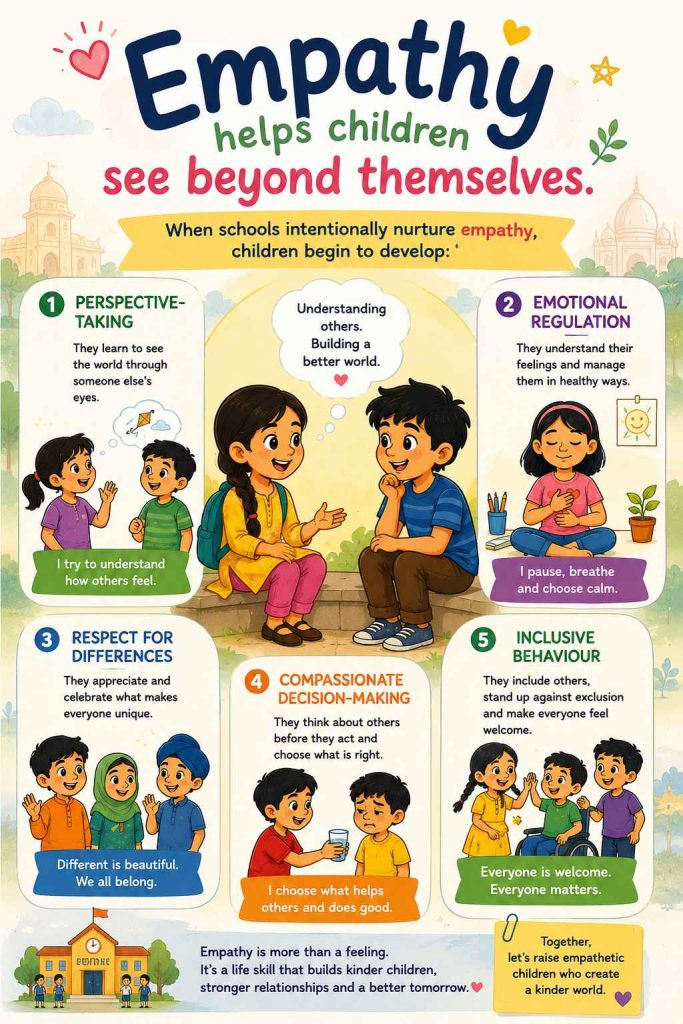
These qualities extend far beyond classroom relationships. They prepare children to become responsible citizens, collaborative leaders and compassionate members of society.
Children Learn More by Watching Than by Being Told
Children are extraordinary observers.
They notice who is left out during playtime.
They notice who receives help.
They also notice who cleans the classroom, who drives the school bus, who struggles to keep up and who is celebrated.
Every observation becomes an invisible lesson.
Without guidance, these moments may reinforce assumptions. With thoughtful conversations, however, they become opportunities for reflection.
Instead of simply teaching children what is right, schools can encourage them to ask deeper questions.
“How do you think your friend felt?”
“What would you do if you were in that situation?”
These conversations help children move beyond judgement towards understanding. Empathy is rarely taught through instruction alone; it develops through experience, reflection and meaningful relationships.
Empathy in Education Builds Equality
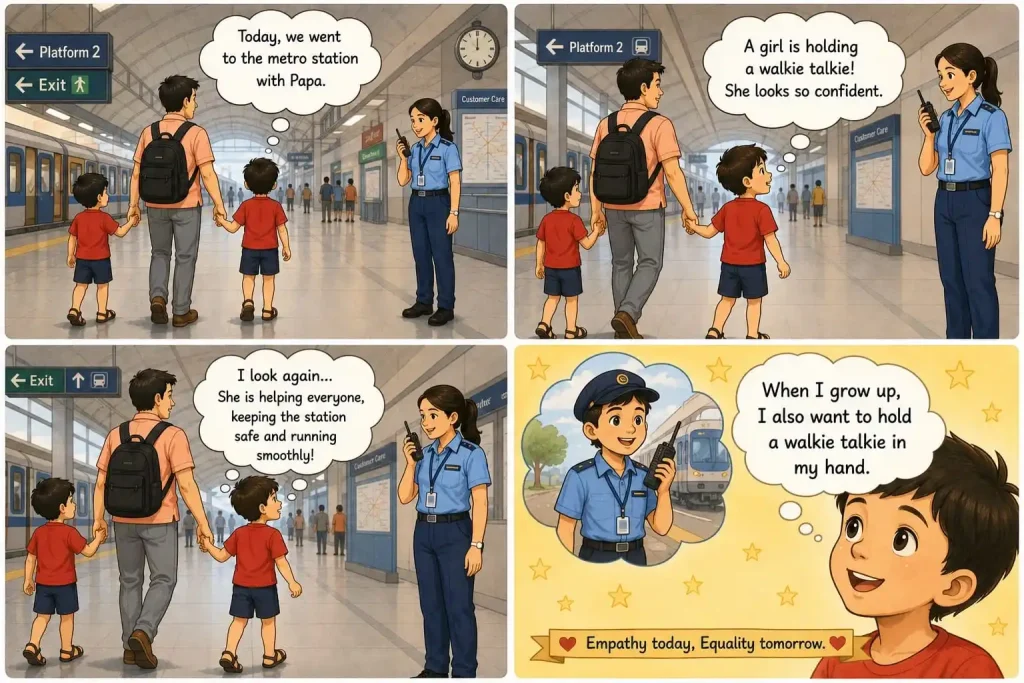
It was an ordinary metro commute day for two sons with their father, until something extraordinary caught the little boy’s attention.
Walking alongside them was a woman in a metro station uniform, confidently coordinating the platform. Every few moments, the static buzz of her walkie-talkie came alive as she guided passengers, responded to updates and kept the station running smoothly.
Though his father gently hurried him towards the arriving train, the little boy could not take his eyes off her. With every message that crackled through the walkie-talkie, his curiosity grew and his admiration deepened.
His thoughts that day were never, “Girls cannot do this.”
Instead, his eyes sparked with aspiration- “When I grow up, I want to hold a walkie talkie too”
In that moment he saw confidence. He saw leadership. He saw someone solving problems and helping hundreds of people every day.
“Children rarely begin with stereotypes; they begin with observation”.
They watch the world with curiosity, absorbing what they see long before they understand the labels society assigns. Every such moment becomes an opportunity to shape their perspective—not through instruction, but through experience.
When children are encouraged to see people for their abilities rather than their gender, empathy becomes the foundation for equality. They learn that leadership is not defined by who someone is, but by what they are capable of doing.
Biases are rarely innate; they are learned through repeated social messaging.
Compassion Rarely Stops with People

Children often discover empathy long before they can define it.
A game shared on the playground teaches cooperation.
Resolving a disagreement teaches patience.
Flying a kite together teaches trust.
Play remains one of the most effective environments for child development, encouraging children to understand different personalities, communicate respectfully and celebrate one another’s successes.
These seemingly ordinary experiences quietly build emotional intelligence and social confidence.
As children learn to work together, they become comfortable with classmates from different cultures, languages and backgrounds. Inclusion becomes a habit rather than a policy.
Compassion Extends Beyond People

Compassion learned in childhood often extends from people to animals and the environment.
The way a child treats an animal often reflects how they understand vulnerability.
A child who gently offers water to a thirsty stray dog is learning far more than kindness towards animals.
- They are learning responsibility.
- They are recognising that another living being has needs.
- They are discovering that compassion requires action.
Research consistently suggests that children who demonstrate empathy towards animals often display stronger prosocial behaviours towards people as well, making compassion a habit that is rarely selective.
When children understand that every living being deserves dignity and care, they begin seeing the world through a broader moral lens.
Schools can nurture this understanding through activities such as nature walks, animal welfare discussions, environmental projects and community service initiatives.
These experiences encourage children to recognise that every act of kindness, however small, contributes to a more compassionate world.
The Child for Child programme by Smile Foundation builds on these very principles. It transforms schools into spaces where children become active participants in each other’s learning journeys.
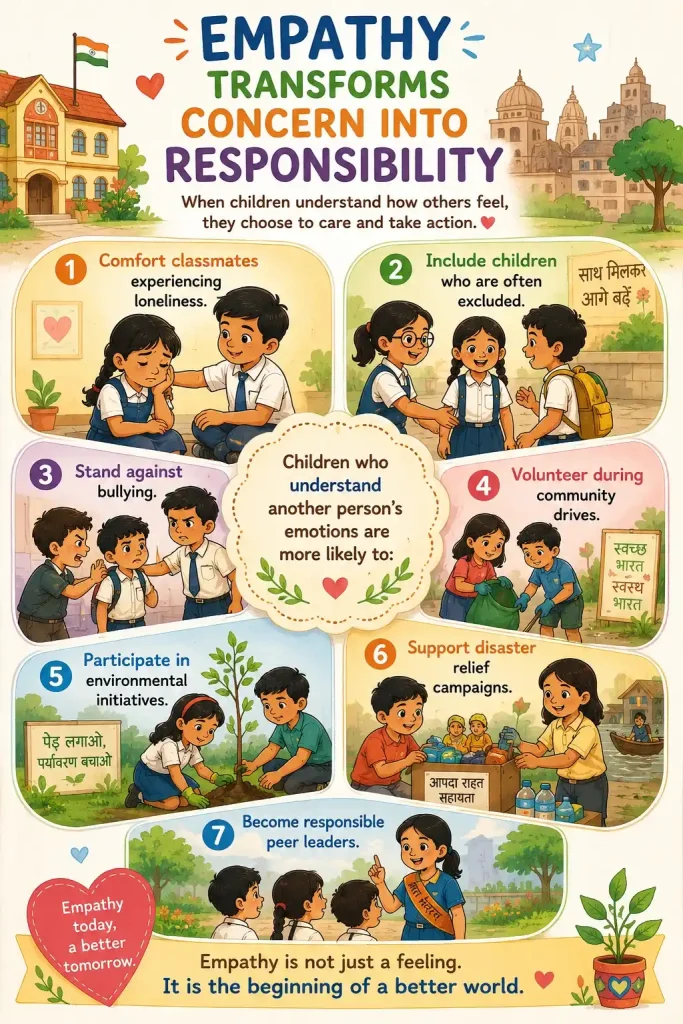
This progression from understanding to action—is where schools create future changemakers.
Creating Schools Where Empathy Thrives with Smile
Empathy cannot be cultivated through a single value education lesson. It grows through consistent experiences that become part of a child’s everyday learning journey. This is where Child for Child, Smile Foundation’s flagship school engagement programme, transforms empathy in education from a concept into a lived experience.
Built on the belief that children are powerful agents of change, the programme creates opportunities for them to learn with and from one another. Through storytelling, reflective conversations, collaborative projects and experiential learning, children are encouraged to understand different realities, appreciate diverse perspectives and translate compassion into meaningful action.

Children learn far more from what adults consistently demonstrate than from what they occasionally say.
Every interaction becomes a lesson.
Every classroom becomes a community.
Every teacher becomes a role model.
Redefining What Success Looks Like
Schools proudly celebrate examination results, athletic achievements and university admissions.
These accomplishments deserve recognition.
Yet perhaps there are equally important questions every school should ask.
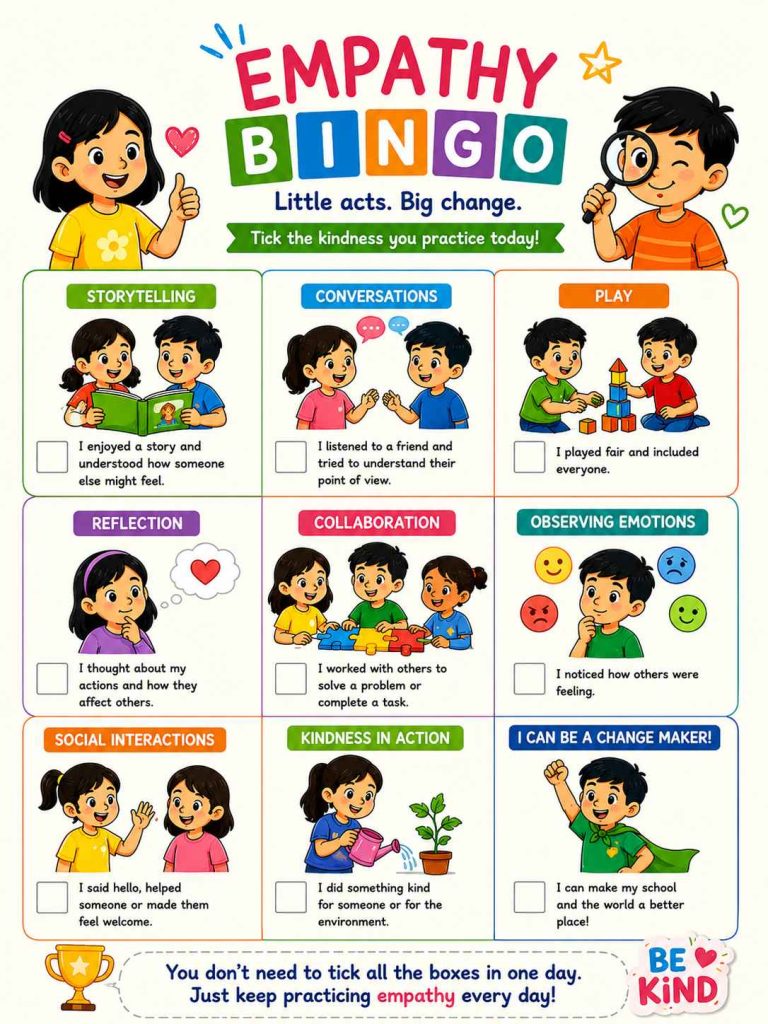
These are not distractions from education.
They are its highest purpose.
In a rapidly changing world shaped by artificial intelligence, technological advancement and global interconnectedness, empathy remains one uniquely human capability that will define responsible leadership.
Children who learn to understand others today will become the doctors who treat patients with dignity, the entrepreneurs who build inclusive workplaces, the scientists who innovate responsibly, the policymakers who design equitable systems and the teachers who inspire future generations.
When schools intentionally create opportunities for children to observe, question, understand and act, they do far more than educate young minds. They help build a generation capable of seeing humanity before difference.
In the end, academic success may determine what children achieve.
Empathy will determine who they become.
SOURCES:
Frequently Asked Questions (FAQs)
1. Why is empathy important in child education?
Empathy helps children understand others’ emotions, develop positive relationships, improve communication skills and become responsible citizens. It is as essential to child development as academic learning.
2. How can schools teach empathy to children?
Schools can foster empathy through storytelling, reflective discussions, collaborative activities, community service, inclusive classrooms and experiential learning that encourages children to understand different perspectives.
3. What role does empathy play in child development?
Empathy strengthens emotional intelligence, problem-solving, teamwork and resilience. It helps children build meaningful relationships and make compassionate decisions throughout life.
4. Why should empathy be part of the school curriculum?
Empathy creates inclusive learning environments, reduces bullying, promotes respect for diversity and prepares children for responsible leadership in an interconnected world.
5. How does empathy promote equality in education?
By encouraging children to appreciate abilities rather than stereotypes, empathy helps break social and gender biases while promoting inclusion, fairness and equal opportunities.
6. What is the Child for Child programme by Smile Foundation?
Child for Child is Smile Foundation’s flagship school engagement programme that encourages children to become active changemakers through empathy, collaboration, community participation and experiential learning.
7. How can parents encourage empathy at home?
Parents can model compassionate behaviour, discuss emotions openly, encourage perspective-taking, involve children in acts of kindness and create opportunities for community engagement.
8. How does empathy prepare children for the future?
Alongside academic excellence, empathy equips children with emotional intelligence, collaboration, ethical decision-making and leadership skills needed to thrive in the future workplace and society.