
Quick Summary
- Entrepreneurship development equips individuals with the skills, knowledge and confidence to start and grow businesses.
- Women entrepreneurs contribute significantly to economic growth but continue to face barriers related to finance, markets, skills and mobility.
- Effective entrepreneurship development programmes combine training, mentorship, financial literacy, market access and business support.
- Digital tools, government schemes, and ecosystem linkages are expanding opportunities for women-led enterprises.
- Investing in women entrepreneurs creates ripple effects across families, communities and local economies.
Why Entrepreneurship Development Matters More Than Ever
India could add USD 0.7 trillion to its GDP. The barrier is not ambition — it is access.
Women entrepreneurs reinvest up to 90% of their income back into their families and communities. The evidence for their economic multiplier effect is overwhelming. And yet in India, women account for only 20% of all MSMEs, and the majority of those operate informally, on a micro scale, in low-return sectors.
The McKinsey Global Institute has estimated that closing India’s gender gap in workforce participation could add USD 0.7 trillion to the country’s GDP by 2025. That number represents millions of women who have the drive and the ideas but not the credit history, the digital skills, the market access or the mentorship to turn potential into a sustainable business.
Despite significant policy advances — Skill India, PMKVY, MUDRA Yojana, Stand-Up India and Startup India — systemic barriers persist, especially for women from rural, low-income and marginalised backgrounds. These aren’t individual failures but structural gaps that require structural solutions.
Six barriers Smile Foundation is working to dismantle
The solution
A funnel-based, four-year-tested model that takes women from mobilisation to market
Since 2005, Smile Foundation’s Swabhiman programme has been building the infrastructure for women’s economic empowerment — reaching over 1,90,000 women across rural villages and urban slums in 26 states. Two complementary programmes now sit at the heart of this work: the Livelihood and Enterprise Development Program (LEDP) and the Women Entrepreneurship Development Program (WEDP).
Both follow a structured, funnel-based approach — beginning with community outreach, moving through intensive training, and culminating in seed-funded enterprise launches with sustained mentorship. The model is not a single intervention but an integrated system. It recognises that a woman who receives entrepreneurship training without access to capital will stall. A woman who receives capital without market linkages will plateau. Only when all the pieces connect does a micro-enterprise become sustainable.
“The programme promotes self-reliance and long-term economic empowerment of women through inclusive and sustainable enterprise development.”
From aspiration to enterprise.
A structured pathway designed to help women move from ideas to sustainable businesses.
Community Mob
Identifying and enrolling aspiring women entrepreneurs through grassroots networks.
Training
Business planning, financial literacy, digital skills and market readiness.
Enterprise Setup
Seed capital support and access to MUDRA, PMEGP and Startup India.
Market Linkages
Connecting women to trade fairs, buyers and digital marketplaces.
Mentorship & Incubation
Ongoing support, peer learning and business growth guidance.
Programme components
What each phase of the programme delivers
Six building blocks. One entrepreneurship ecosystem.
Target and outcomes
Who benefits — and what success looks like
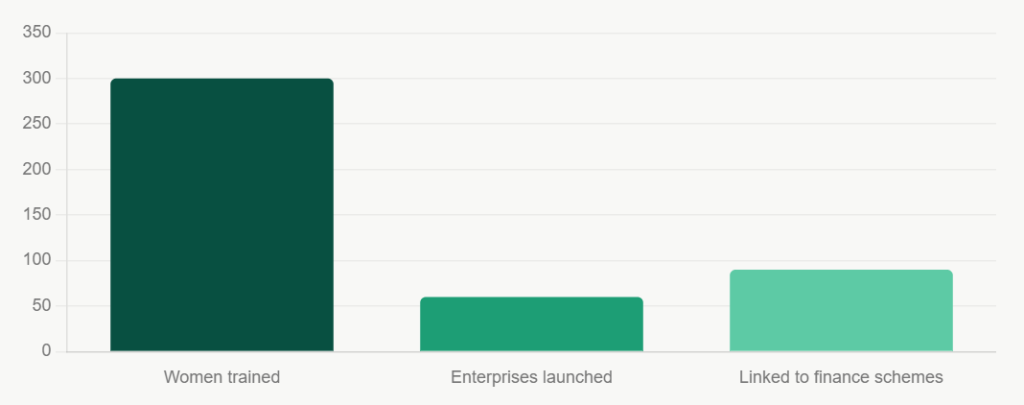
Each programme cycle directly reaches 300 women from low-income and marginalised communities, with an indirect reach of 1,500+ household members and community stakeholders. The outcomes are defined, tracked, and reported — not aspirational.
What success looks like.
Why this matters
Economic independence is not a women’s issue. It is an economic imperative.
The case for investing in women’s entrepreneurship is both moral and economic. When women control income, they spend it differently — on children’s nutrition, on healthcare, on education. The multiplier effects are documented across decades of development research. India’s MSME sector, which employs over 110 million people, cannot reach its potential while 80% of its enterprises are led by men alone.
LEDP and WEDP are not standalone training programmes. They are an integrated ecosystem — one that addresses capital, skills, market access, mentorship, and digital literacy in a single, sustained engagement. The funnel model is deliberate: not every woman who enters the programme will launch an enterprise, but every woman will emerge more financially literate, more digitally capable, and more connected to formal support systems than when she entered.
That shift — from economic invisibility to recognised participation — is itself transformative. And for the 60 women in each cycle who do launch enterprises, the potential ripple effects into their households and communities make every investment in this programme not just a social good, but a sound one.
“SSP is not only creating industry-ready engineers, but also empowering a generation of leaders who will break down barriers and pave the way for others to follow.”
Transforming lives through education, healthcare, livelihoods and women empowerment.
Smile Foundation was set up in 2002 by a group of professionals in New Delhi, India. Today, it directly benefits over 15 lakh children and their families every year through integrated interventions across education, healthcare, livelihood, and women empowerment.
Working in more than 2,000 villages and urban communities across 26 states, the organisation continues to strengthen pathways to sustainable development for underserved populations.
Frequently Asked Questions (FAQs)
1. What is entrepreneurship development?
Entrepreneurship development is the process of building entrepreneurial skills, knowledge, and capabilities to help individuals start, manage and grow successful businesses.
2. Why is entrepreneurship development important for women?
It helps women achieve financial independence, access income opportunities, strengthen leadership skills and contribute to household and community development.
3. What skills are taught in entrepreneurship development programmes?
Common areas include business planning, financial literacy, digital marketing, market research, enterprise management and customer engagement.
4. How does entrepreneurship development contribute to economic growth?
It creates new businesses, generates employment, increases incomes and stimulates local economic activity.
5. What are the biggest challenges faced by women entrepreneurs?
Key challenges include limited access to finance, low financial literacy, restricted market access, digital barriers and social or cultural constraints.