

India is home to one of the largest youth populations in the world. But is also doing enough for the skill development of its youth?
This demographic advantage has the potential to drive economic growth, innovation and social progress for decades to come. Yet for millions of young people, particularly those from economically vulnerable backgrounds, the transition from education to employment remains uncertain.
The challenge is not a lack of ambition.
It is often a lack of access.
Many young people complete school or college only to discover that employers require skills they have never been taught. Others struggle with limited exposure to workplace environments, poor digital literacy, weak communication skills or the absence of professional networks. The result is a persistent gap between education and employability.
Addressing this challenge requires more than job creation. It requires preparing young people with the skills, confidence and support needed to succeed in an increasingly competitive labour market.
This is where Smile Foundation’s Smile Twin E-Learning Programme (STeP) has been making a difference.
Designed to bridge the gap between education and employment, STeP provides vocational training, employability skills and placement support to underserved youth, helping them transition into formal employment and sustainable careers.
A recent impact assessment reveals how the programme is transforming lives across Delhi, Bengaluru, Pune, Kolkata, Hyderabad and Mumbai.
From First Job to Financial Independence
One of the most striking findings from the assessment is the number of participants entering formal employment for the first time.
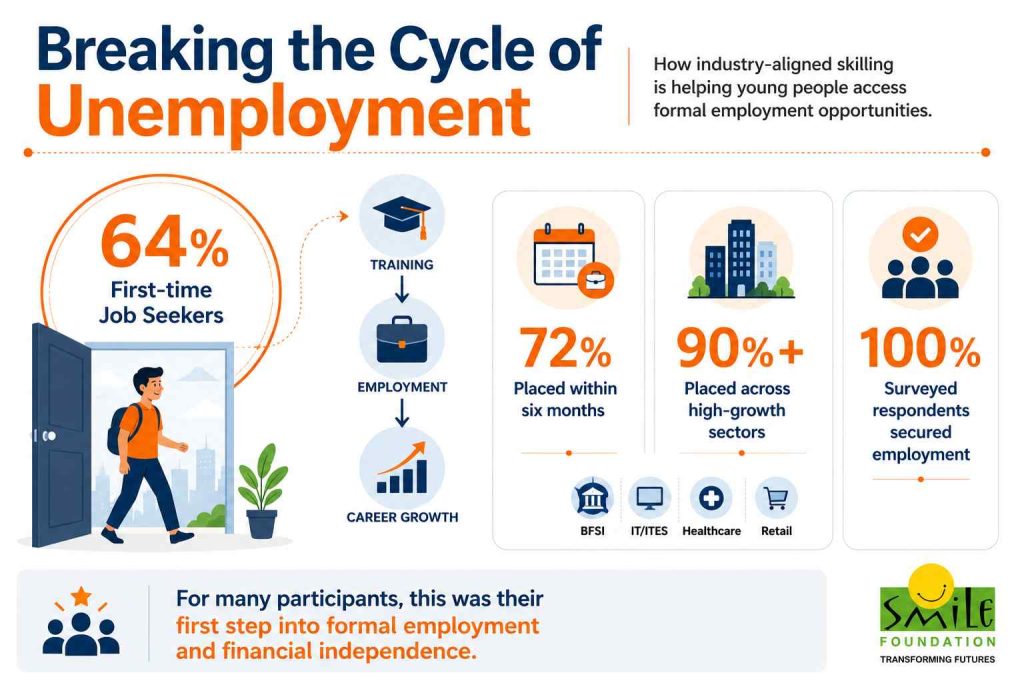
Among surveyed participants, 64% had never held a formal job before enrolling in STeP.
Many came from households where financial instability was a daily reality. Some had completed their education but remained unemployed. Others were engaged in informal work with irregular income and limited growth opportunities.
For these young people, securing a formal job represented more than employment.
It represented dignity, independence and a pathway towards a different future.
The skill development programme’s impact on employment outcomes has been significant.
Among respondents surveyed as part of the assessment:
- All reported securing employment after training.
- More than 90% were placed in sectors such as Retail, BFSI, IT/ITES and Healthcare.
- 72% secured employment within six months of completing training.
- All placements were aligned with the sector in which participants received training.
These findings indicate a strong alignment between training content and labour market demand.
Rather than preparing participants for generic employment, STeP focuses on equipping them with skills that employers actively seek.
This alignment is one of the programme’s greatest strengths.
When Income Changes, Families Change
Employment outcomes tell only part of the story.
The real measure of impact often lies in what happens after young people begin earning.
Before joining the programme, many participants reported little or no personal income. The most common response during the assessment was an income of zero, reflecting widespread unemployment among participants before training.
After placement, the average monthly income increased dramatically.
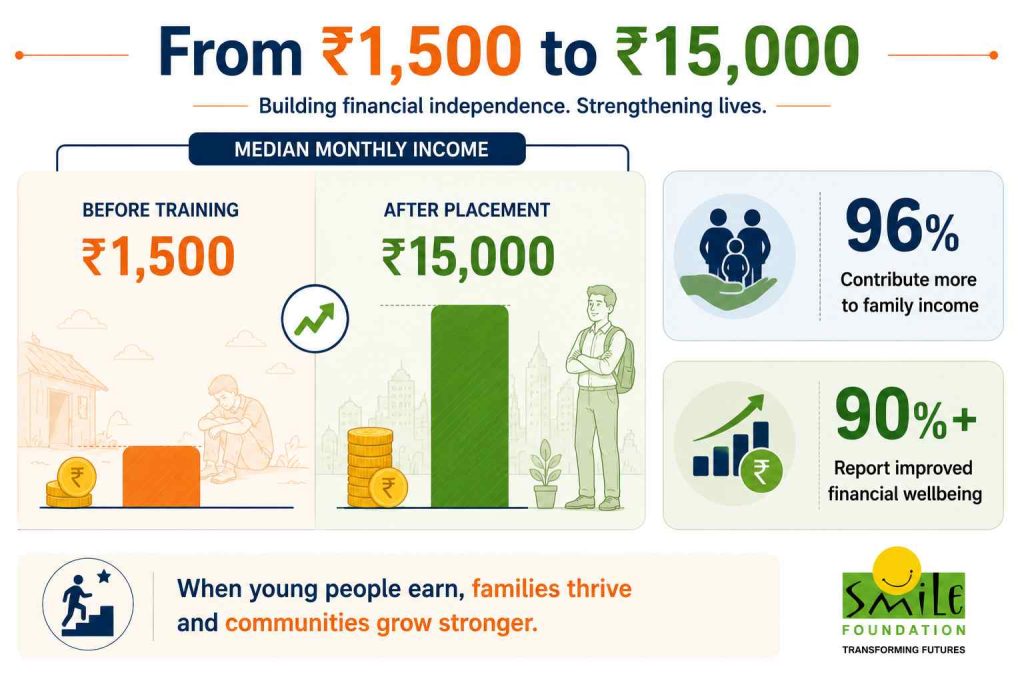
Participants reported moving from average earnings of approximately ₹4,170 before training to an average monthly income of ₹14,227 after placement.
The median monthly income increased from ₹1,500 to ₹15,000.
For many families, this income represented a transformative shift.
Young people who were once dependent on their parents became contributors to household expenses. Some began supporting siblings’ education. Others started saving for the first time in their lives.
The assessment found that:
- More than 90% reported an improvement in their financial situation.
- 96% now contribute more to family income.
- Household income increased substantially after participants secured employment.
These outcomes demonstrate how skill development programmes can generate ripple effects that extend beyond individual beneficiaries.
When one young person gains stable employment, entire households benefit.
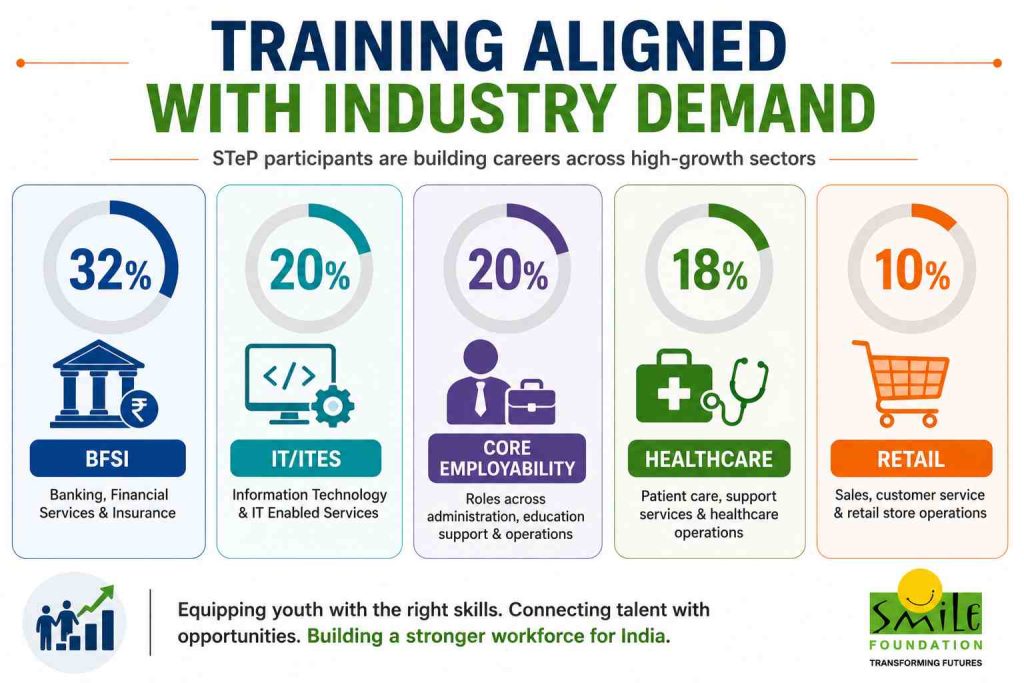
Creating Opportunities Across Multiple Sectors through Skill Development
The Indian economy requires skilled workers across a diverse range of industries.
Recognising this reality, STeP offers skill development training aligned with sectors that continue to generate employment opportunities.
The assessment found that participants secured jobs across multiple industries:
BFSI (Banking, Financial Services and Insurance)
32% of placements
Participants entered roles such as:
- Relationship Officers
- Banking Sales Executives
- Loan Processing Associates
- Insurance Advisors
These positions often offered clear career progression pathways and competitive starting salaries.
IT/ITES
20% of placements
Participants secured roles including:
- Data Entry Operators
- Technical Support Executives
- Customer Service Associates
- BPO Professionals
Digital skills training proved especially valuable in helping youth access opportunities in this rapidly growing sector.
Healthcare
18% of placements
Participants became:
- General Duty Assistants
- Patient Care Assistants
- Medical Receptionists
- Hospital Support Staff
For many, these roles offered stable employment while contributing to community wellbeing.
Retail
10% of placements
Retail trainees found opportunities as:
- Sales Associates
- Store Executives
- Customer Service Representatives
These positions often served as entry points into organised retail careers.
Core Employability Roles
20% of placements
Participants also secured positions in administration, education support and office operations, demonstrating the value of transferable employability skills.
Women Are Succeeding on Equal Terms
One of the most encouraging findings from the assessment relates to gender inclusion.
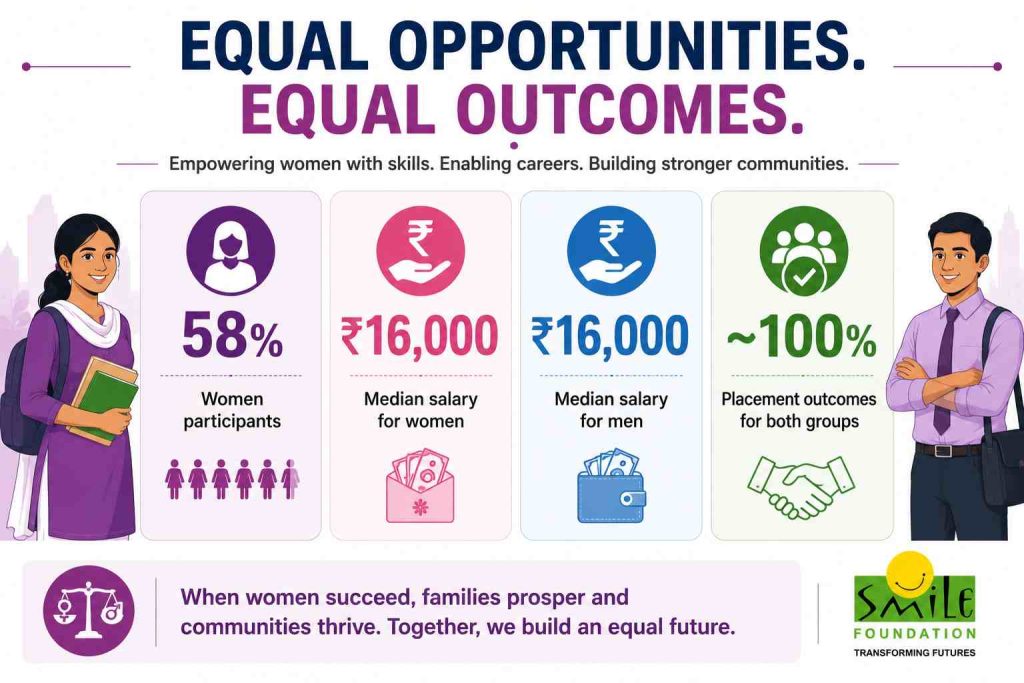
Women represented 58% of surveyed participants.
In many communities, women continue to face barriers to workforce participation, including social expectations, safety concerns and limited access to professional opportunities.
Yet the findings reveal that women participating in STeP achieved outcomes comparable to men.
Female participants:
- Secured employment at rates similar to men.
- Reported comparable salary levels.
- Demonstrated strong confidence and career aspirations.
The median starting salary for both women and men was ₹16,000 per month.
Beyond financial outcomes, women reported greater self-confidence and increased support from their families.
In several cases, participants described how employment changed perceptions within their households and communities.
Families that were initially hesitant about women pursuing careers became proud advocates after witnessing their success.
This highlights the broader social impact of livelihood programmes.
When women gain access to meaningful employment, the benefits extend far beyond income.
Beyond Technical Skill Development: Building Confidence and Career Awareness
Employers increasingly recognise that technical knowledge alone is not enough.
Communication, teamwork, professionalism and adaptability have become essential workplace skills.
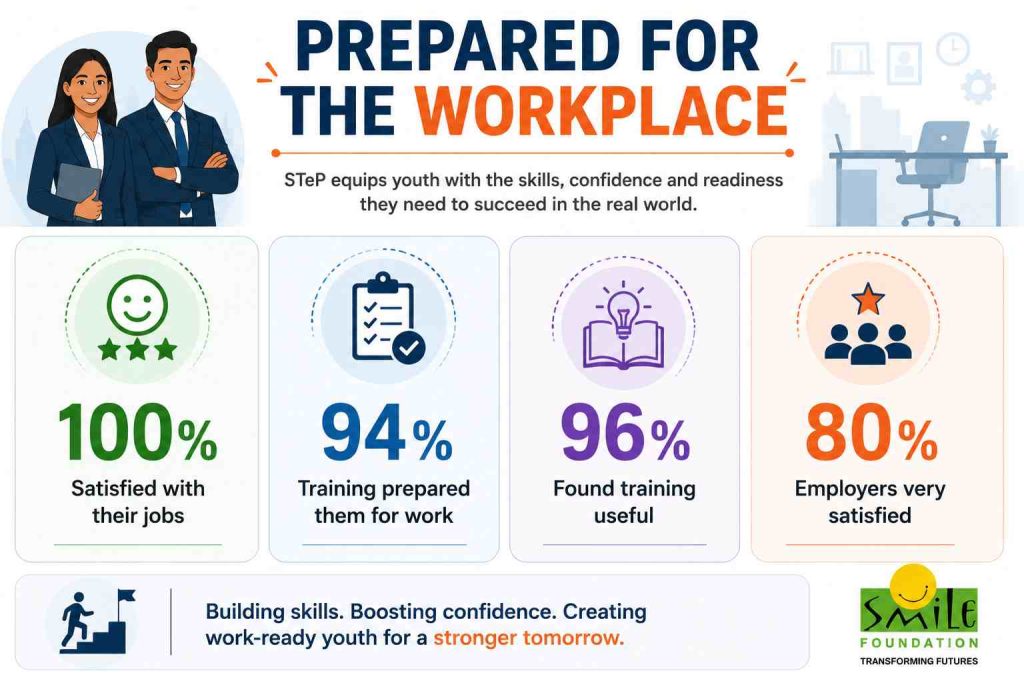
The assessment suggests that STeP has been particularly successful in developing these capabilities.
Participants reported significant improvements in:
- Communication skills
- Workplace readiness
- Confidence
- Professional behaviour
- Career planning
Among surveyed participants:
- 94% agreed that training provided the skills required for their current jobs.
- 96% described the training as useful or very useful.
- 76% reported becoming significantly more aware of career progression opportunities.
Many participants entered the programme focused solely on finding a job.
They left with a clearer understanding of how to build a career.
This shift—from immediate employment to long-term career planning—is one of the most important indicators of sustainable impact.
The Stories Behind the Statistics
Numbers are important.
But they become meaningful when viewed through the experiences of the people behind them.
Maheswari from Hyderabad joined the BFSI training programme after struggling to find employment despite completing her degree. Coming from a family facing financial hardship, she felt immense pressure to contribute financially.
Following training, she secured a position as a Personal Loan Processor and now earns ₹17,500 per month.
Similarly, Mary Harshitha from Bengaluru enrolled in the BFSI programme after losing her father and facing significant financial challenges. The training equipped her with technical knowledge, communication skills and confidence. She now works as a Customer Service Executive, earning ₹15,000 per month and supporting her family.
For Gouwthami, another participant from Hyderabad, the programme provided a pathway out of unemployment. Today, she earns ₹18,750 per month as an Associate and has achieved financial independence.
While each journey is unique, their stories share common themes: resilience, opportunity and transformation.
Looking Ahead
The assessment confirms that STeP is generating meaningful outcomes for young people across multiple dimensions.
Participants are securing jobs, increasing their incomes, contributing to their families and developing the confidence needed to pursue long-term career growth.
At the same time, the findings point towards opportunities for further strengthening the skill development programme.
Recommendations include:
- Expanding advanced digital skills training
- Increasing hands-on learning opportunities
- Strengthening interview preparation
- Establishing alumni mentorship networks
- Deepening employer partnerships
- Expanding outreach to underserved rural communities
As India’s economy continues to evolve, the need for industry-aligned skilling initiatives will only grow.
The challenge is not merely preparing young people for their first job.
It is helping them build careers that create long-term economic mobility.
The experience of STeP demonstrates what is possible when skill development is paired with industry relevance, mentorship and placement support.
For thousands of young people, the journey from unemployment to opportunity begins with a single chance to learn.
And when that opportunity is available, the impact extends far beyond one individual.
It strengthens families, communities and the future workforce of India.