Summary
- Cinema creates emotional connections that help children safely process complex feelings, relationships and social issues
- Psychologists link film viewing to “elevation” and “admiration” — emotional responses that can inspire real-world reflection and behaviour change
- Meaningful cinema introduces children to empathy, diversity and difficult conversations around mental health, inequality and identity
- SIFFCY brings purposeful global cinema to classrooms across India, pairing screenings with workshops and discussions that encourage critical thinking
- With the right guidance, age-appropriate films support children’s emotional growth, mental well-being and social awareness
Have you ever experienced that rush of adrenaline while watching an intense scene with your favourite star, doing something that could change the world? Or felt that wave of emotion when something wonderful happens? And then, a movie leaves you in tears when something heartbreaking unfolds on screen. Even though these moments aren’t yours to experience, they have a remarkable way of making you feel deeply connected to them. That’s the incredible magic of cinema.
“3 Idiots” took a bold stand against India’s obsession with grades, academic stress and traditional definitions of success, inspiring a whole generation to rethink what passion, creativity and individuality really mean. “Chak De! India” shattered stereotypes surrounding women’s sports, regional divides and leadership, evolving into so much more than just a sports drama. “Taare Zameen Par” transformed the dialogue about learning disabilities and parenting, urging schools and families to look beyond grades and acknowledge the emotional challenges children face. These films resonated because they forged an emotional connection before delivering their messages.
For children and young audiences, this influence runs even deeper. That belief lies at the heart of SIFFCY, the Smile International Film Festival for Children and Youth, an initiative by Smile Foundation that uses meaningful cinema to educate, engage and empower young minds across India. (Watch to know more – https://www.smilefoundationindia.org/siffcy/#showreel)
The Psychology of Cinema
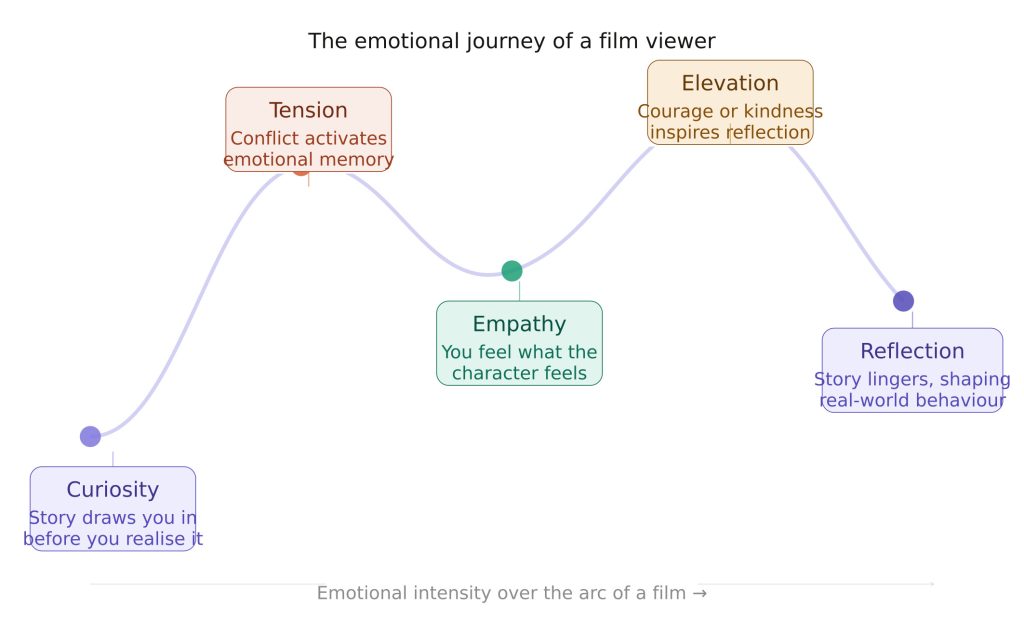
There is a reason people cry during films, cheer for fictional characters or carry scenes in their memory for years. Good storytelling creates an emotional connection. The audio-visual and narrative strategies employed in film fictions allow us to experience emotions intensely and, also, safely. Our responses are shaped by how fictional and carefully made the stories on the screen feel. What happens before our eyes does not pose a threat to us. Our reactions depend on how obviously fictional and carefully crafted the stories on the screen seem. What we see does not threaten us and does not require us to act.
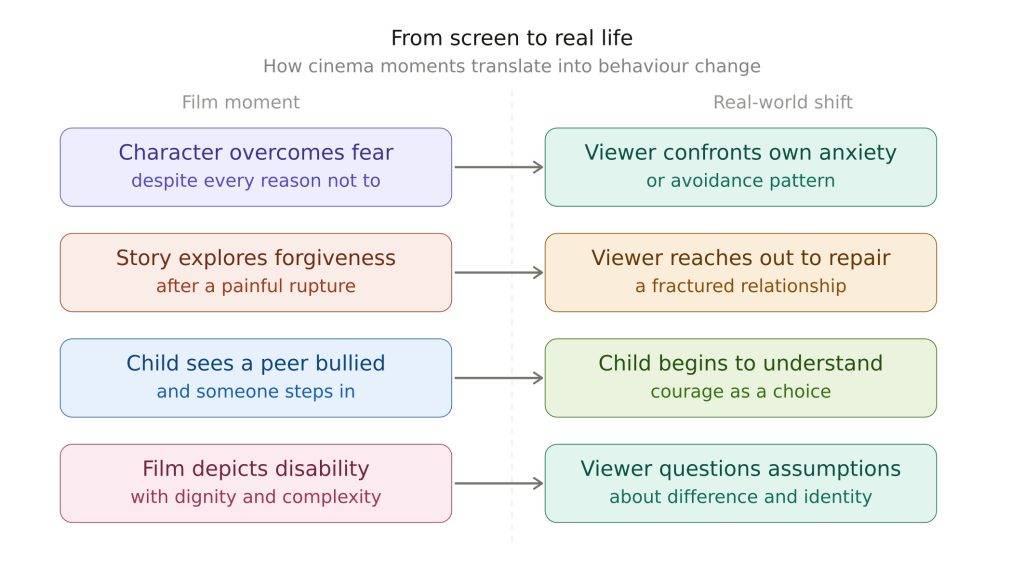
Further, psychologists also describe human response through concepts like “elevation” and “admiration.” When viewers witness acts of courage, kindness, sacrifice or resilience on screen, they often feel emotionally moved and inspired to reflect on their own behaviour. That emotional reaction can shape real-world action. They may be able to acquire an alternative viewpoint on an essential, controversial or difficult issue through the medium of film. There might be a change in their opinions, and they may even attempt to influence others positively.
For instance, someone watches a story about forgiveness or about dealing with a misunderstanding and reaches out to a friend or family member. Another viewer sees a character overcome fear and decides to confront their own anxiety. A child watches someone stand up against bullying and begins to understand courage differently.
This becomes especially powerful for children because they are still learning how to process emotions, relationships, conflict and identity. Stories help them navigate these experiences safely.
Cinema and Mental Health
Don’t many of us unwind and relax while watching movies? Movies can do more than entertain; they can support mental health by giving people a break from daily worries. A good film can lift your mood, ease stress and give your mind a break from daily pressure. Watching with someone you care about can also strengthen your connection and spark meaningful conversation. Comedies can make viewers laugh and feel happier, emotional films can help release feelings, and thrillers can create excitement that’s, in a way, safe and distant. Watching movies also improves mood, offers comfort and helps people feel refreshed.
Why Meaningful Cinema Matters More Today
Children today consume more visual content than any previous generation. Unfortunately, volume does not equal value. Much of today’s digital content is designed for speed, distraction and instant gratification, which pushes meaningful storytelling aside. Children need stories that slow them down, make them think, expose them to lives, struggles, cultures and emotions beyond their immediate surroundings.
A thoughtful film can introduce children to empathy without sounding preachy. It can start conversations around inequality, disability, mental health, gender, climate change, loneliness or social prejudice in a way that feels human and accessible.
This has long been part of SIFFCY’s vision. Smile Foundation uses the festival to bring global stories into classrooms and communities across India through SIFFCY@Schools. From Bengaluru and Goa to Ludhiana, Nagpur, Jalandhar and smaller towns across the country, children gain access to cinema that broadens perspectives and encourages compassion.
Films Often Start Conversations Society Avoids
Some subjects remain difficult to discuss openly. Race, poverty, violence, bias, social inequality and mental health are issues that are at the forefront today. Cinema can open the door to those conversations. People may struggle to speak directly about painful or pressing issues, but they can begin by discussing a character, a scene or a story. That emotional distance creates safety. This is one reason films continue to shape public discourse across the world. For children, shared viewing experiences can also build collective understanding. When students watch films together, ask questions together and reflect together, they begin to see perspectives beyond their own lives.
More Than Entertainment
Not every film has the power to change a life, but some truly do. Sometimes the transformation is dramatic, while other times it’s just a subtle shift in perspective, a new question that lingers or a moment of reflection that resonates deeply. That’s why we should pay more attention to meaningful cinema, especially for younger audiences who are growing up in a world full of distractions.
Kids need stories that challenge them, inspire them and help them grasp the complexities of humanity in a meaningful way. At the same time, too much screen time or exposure to violent or disturbing content can affect mood, sleep and attention. With the right guidance, kids can watch age-appropriate films that entertain, teach, and even support emotional growth.
Movies on screen shape attitudes, influence behaviour, spark conversations and sometimes leave behind ideas that stay with people for years.
SIFFCY treats cinema as a tool for emotional growth and social awareness. Alongside screenings, SIFFCY hosts workshops, discussions, masterclasses and interactive sessions that encourage children to think critically about what they watch. The conversations matter as much as the films themselves. Through SIFFCY, Smile Foundation continues to champion that idea. By bringing meaningful global cinema to children across India, the festival is nurturing emotionally aware, socially conscious and empathetic future citizens.
Sources:
- https://greatergood.berkeley.edu/article/item/can_movies_help_you_become_a_better_person
- https://www.researchgate.net/publication/386388201_Role_of_Films_in_Societal_Change
- https://psychcentral.com/blog/how-watching-movies-can-benefit-our-mental-health#benefits
- https://www.smilefoundationindia.org/workshops-events/12th-siffcy-crossing-borders-through-cinema-connecting-childhoods/
- https://pmc.ncbi.nlm.nih.gov/articles/PMC10965617/
FAQs
1. How does cinema affect children’s emotional development?
Films help children safely explore emotions, build empathy and understand perspectives beyond their own lived experiences.
2. Can watching movies support mental health?
Yes. Meaningful films can ease stress, lift mood and spark conversations that support emotional well-being in both children and adults.
3. What is SIFFCY?
SIFFCY is Smile Foundation’s international film festival for children and youth, using purposeful cinema to educate and empower young audiences across India.
4. Why does meaningful cinema matter for children today?
Children consume more visual content than ever, but much of it prioritises speed over substance. Thoughtful films slow children down and help them think more deeply.
5. How does SIFFCY use cinema beyond entertainment?
SIFFCY pairs film screenings with workshops, masterclasses and discussions, encouraging children to think critically about what they watch and connect it to the world around them.