On Mother’s Day, we reach for flowers and gratitude. But somewhere between the sentiment and the system, we keep losing the actual woman — exhausted, resilient and still waiting for something more than applause.

IN THIS ESSAY
- Why the myth of effortless motherhood does real harm and who pays the price
- The postpartum reality most women experience and almost no one talks about honestly
- Invisible labour, mental load and the structural invisibility of care work
- Motherhood across India’s stark socio-economic divide and what that gap costs
- The paradox of impossible love: joy that coexists with grief, exhaustion and loss of self
- Why development programmes must treat maternal health as infrastructure
- Redefining womanhood beyond the maternal — the women who choose differently
- What a better Mother’s Day actually looks like
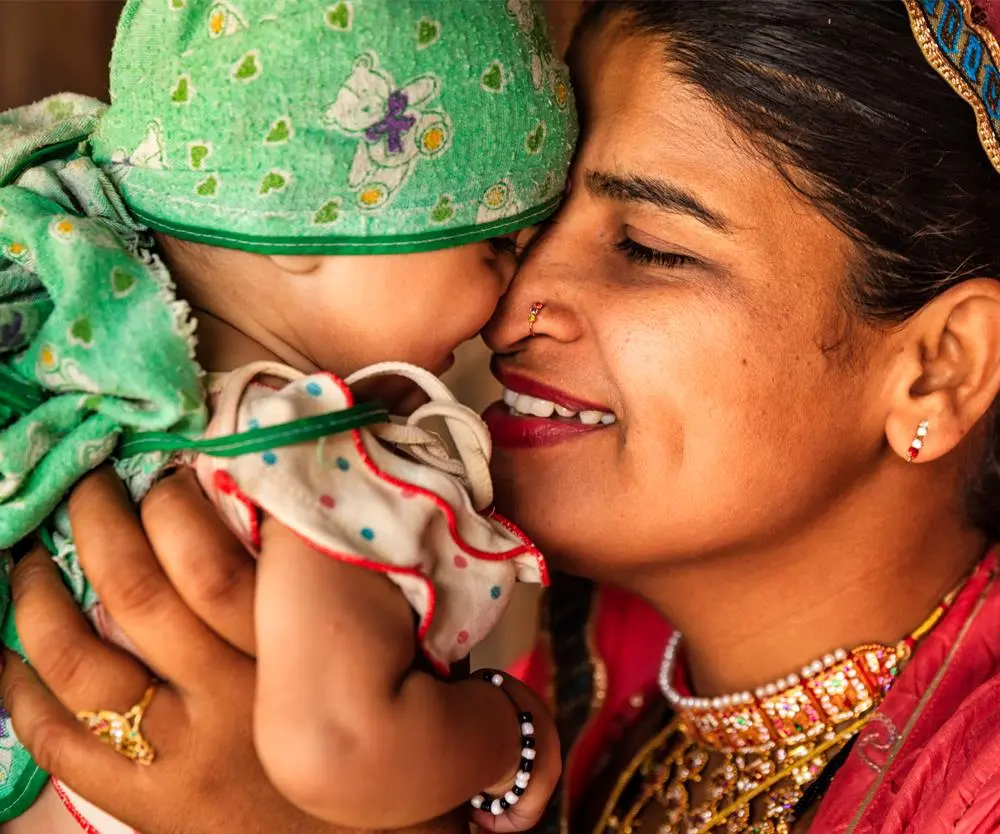
There is a photograph that exists in some version in nearly every Indian family album. A woman — young, usually — holding a newborn. She is smiling. She looks, in the photograph, like someone who has just arrived somewhere. Complete. Purposeful. At peace with a decision the universe made for her.
What the photograph does not show: the forty-eight hours before it was taken. The labour that didn’t progress the way anyone said it would. The stitches that made sitting painful for three weeks. The engorgement. The milk that came in too fast and then, for some women, too slow. The night feeds at 2am and 4am and 6am, when the line between exhaustion and hallucination starts to blur. The moment — and almost every new mother has this moment, though few say it aloud — when she looked at the baby and felt, instead of the promised flood of transcendent love, something closer to a flat, bewildered numbness. And the shame that followed. Because she had been told this was supposed to feel like everything.
Mother’s Day, which falls this year on the 10th of May, is built around the photograph. It is not built around what came before it or what has accumulated in the years since.
The first weeks, honestly
Postpartum depression affects an estimated one in five new mothers globally. In India, studies suggest the figure may be higher, closer to one in three in some populations, driven by nutritional depletion, lack of rest, absent support systems and the social expectation that a new mother should be visibly joyful at exactly the moment her body is doing its most demanding reconstruction work.
But the conversation almost never gets that far, because it requires first acknowledging the thing nobody wants to say: that the early weeks of motherhood are, for many women, frightening. Not because they don’t love their child. But because the self they knew — the one with her own rhythms, preferences, private thoughts, career ambitions, a body she recognised — has temporarily dissolved and nobody told her this would happen, or that it was allowed to feel like grief.
“The self she knew has temporarily dissolved, and nobody told her this would happen — or that it was allowed to feel like grief.”
What postpartum reality actually involves, for most women, is a negotiation no one has named for her. It involves the physical: a body that has just done something seismic, now expected to immediately function as a feeding apparatus. It involves the relational: a partnership that changes shape overnight, often without either person knowing quite how to talk about it. And it involves the existential — the disorienting question of who she is now, if not who she was before.
We should be talking about this more plainly. We are not.
The labour that doesn’t count
There is a category of work that economists call unpaid care work. It includes cooking, cleaning, childcare, eldercare, managing appointments, remembering which child needs which form signed by which date, tracking when the paracetamol runs out, noticing when the school shoes are too small. In India, on average, women do 2.6 times more unpaid care work than men, even when both are employed.
This is not a small statistic. It is the architecture of everyday life — invisible, uncounted, and almost entirely borne by women. The mental load — the cognitive work of managing a household — is a particular form of exhaustion that is hard to explain to someone who doesn’t carry it, because it never switches off. It is not work that ends when you stop doing it. It is work that continues in the background of every other thing you do: while you are on a work call, while you are trying to sleep, while you are sitting at your own mother’s table, presumably being celebrated.
What makes this especially acute in India is the near-complete absence of policy infrastructure around care. Maternity leave, where it exists and is actually enforced, covers the newborn period. It does not cover the decade that follows. Creches, after-school care, publicly funded support for new mothers: these remain patchy at best. The assumption, embedded in both policy and culture, is that this work will be done by women, voluntarily, for love. Which it is. But love does not explain why the work is exclusively hers. And it doesn’t explain why, when the work is counted, the woman doing it is not.
The impossible delight


And yet. And yet.
There is also this: the specific, undefended joy of a child’s first word, spoken into the quiet of a morning. The way a toddler reaches for your hand in a crowd not because they are afraid, exactly, but because you are the most solid thing they know. The unreasonable pride of watching someone you made become a person, with their own opinions and preferences and fierce small certainties about the world.
Motherhood is not only its difficulties. It is also this — an attachment so particular and so physical that it defies neat description. Women who would not describe themselves as sentimental find themselves standing outside closed bedroom doors, not wanting to wake their child, just listening to them breathe. This is not romance. It is something older and stranger, something that happens in the body before it happens in the mind.
The honest account of motherhood holds both of these things without resolving them. The exhaustion and the delight are not contradictions. They are the same experience, differently lit.
Which mothers are we talking about?
There is the mother who delivers in a private hospital in South Delhi, with an anaesthetist on standby, a lactation consultant on call the next morning and a cook at home to handle the first two months. Her postpartum difficulties are real. But they exist inside a net of support.
Then there is the woman in a village in Rajasthan or rural Jharkhand who walks four kilometres to reach the nearest health sub-centre, delivers without skilled attendance, returns to agricultural labour within days because stopping work means the family doesn’t eat and has never in her life had a conversation about her own nutritional needs — only about her baby’s. Her maternal mortality risk is not a metaphor. It is a statistic India is still working, urgently, to change.
These two women share the name “mother.” Their experiences share almost nothing else.
Anaemia affects more than half of all pregnant women in India. It is the single largest contributor to maternal mortality in the country, and it is almost entirely preventable with iron supplementation, dietary diversification and the kind of routine antenatal care that remains inaccessible or underfunded in too many districts. Stunting affects one in three Indian children — a direct consequence of maternal malnutrition before and during pregnancy. Girls who grow up malnourished become women who are malnourished in pregnancy, and the cycle, without intervention, continues.
And then there is menstrual health — the entry point to everything else. A girl who misses school every month because of pain and inadequate sanitation or because menstruation is still treated in her home as a condition requiring quarantine, is a girl whose educational trajectory is being shaped not by her ability but by a gap in basic infrastructure. Menstrual health is not a niche women’s issue. It is an education issue, a labour market issue and a maternal health issue because the girl who drops out at fourteen is, often, the woman who has her first child at seventeen.
“Menstrual health is not a niche women’s issue. It is an education issue, a labour market issue and a maternal health issue all at once.”
Programmes like those run by Smile Foundation work at exactly this intersection, combining nutrition counselling, maternal health outreach, menstrual hygiene support and community health education through initiatives like Swabhiman, which has reached hundreds of thousands of women and adolescent girls in underserved communities. The work is not glamorous. It is the work of going house to house, of training ANMs and ASHAs, of sitting with a woman who has never been asked about her own health and asking. It is the work of building the kind of trust that means she actually comes to the antenatal appointment this time.
This is what development work looks like when it takes maternal health seriously — not as a vertical programme, but as the load-bearing column of everything else.
Mothers at the centre of everything
There is evidence — consistent, replicated, difficult to argue with — that a child’s health outcomes are more strongly predicted by the mother’s education level than by almost any other single variable. That when women control household income, nutritional outcomes for children improve. That maternal mental health directly affects child development in the first three years of life. That communities where women are mobile, educated and participating in local governance are more resilient to health shocks and economic disruption.
What this means, practically, is that investing in mothers is not a sentimental choice. It is an infrastructural one. The return on every rupee spent on maternal nutrition, safe delivery, postpartum support, girls’ education, is not measured in gratitude. It is measured in the next generation’s health, cognitive development and life expectancy.
We spend a great deal of time celebrating mothers. We spend considerably less time building the systems that would make motherhood survivable, dignified and genuinely chosen.
The women who choose differently
It is worth naming, plainly and without qualification: there are women who do not want to become mothers. This number is growing — in India as everywhere else — as education levels rise, as women enter the workforce later and in larger numbers, as the cultural equation between womanhood and motherhood slowly, haltingly begins to loosen.
These women are not incomplete. They are not making a mistake they will regret. They are exercising an agency that previous generations of women were not permitted and they deserve to do so without the particular social pressure that comes from relatives at weddings, from medical professionals who ask why not instead of listening to the answer, from a cultural narrative that still treats childlessness in women as a condition rather than a decision.
Expanding the definition of womanhood to include women who are not mothers is not a threat to mothers. It is a form of respect for the actual range of human lives, and for the fact that a society in which motherhood is the only available script is not one in which motherhood is truly free.
What should actually change
A Mother’s Day that meant something would not look like cards and brunches. It would look like universal maternity entitlements enforced across the informal sector, where most women in India actually work. It would look like nutrition supplementation that reaches the last mile — the pregnant woman in the flood-prone hamlet who is not on anyone’s list. It would look like postpartum mental health screening embedded in routine antenatal care, rather than treated as an afterthought or a luxury. It would look like ASHA workers paid properly for the work they do — women who are, themselves, the mothers of India’s public health system and who are still largely unrecognised for it.
It would look like asking: what does this woman need? Not as a mother. As a person.
If you want to do something real this Mother’s Day
Here are some ways to turn sentiment into action
- Support maternal health programmes — donate to organisations like Smile Foundation that work on nutrition, safe delivery and community health outreach in underserved communities
- Sponsor a girl’s education, especially at the secondary level, where dropout rates spike and early marriage begins because the girl who stays in school becomes the woman with more choices
- Visit and support children in care homes or orphanages — not as a gesture, but as a sustained relationship that gives a child what the state cannot adequately provide
- Start a fundraiser for a maternal health or menstrual hygiene programme — even small amounts, when pooled, fund the kind of community outreach that changes a family’s trajectory
- If you are an employer: examine your own policies — who gets flexible work, who gets genuine parental leave, whether your workplace makes it possible for women to continue existing as full people after they become mothers
- Talk about postpartum mental health in your community — honestly, without euphemism — because the woman who knows she is allowed to struggle is the woman who might actually ask for help
None of these are simple. All of them are more useful than a bouquet.
The woman in the photograph is still there, years after it was taken. She is older. She carries more than she did. She has learned things about herself, her own resilience, her own capacity for a love she did not know she had — that she could not have known before. She has also lost things: sleep, certainly, and time, and some particular version of herself that existed before she became responsible for another person.
What she wants — if we ask her, which we mostly don’t — is not more gratitude. It is for the world her child is growing into to be one that takes care of the people who take care of everyone else. For the systems that support her to be as serious as the expectations placed on her. For her labour to be seen, counted and matched with something other than a single Sunday in May.
She is not asking to be celebrated. She is asking to be seen.
That is the harder gift. And the more honest one.
This essay was written in recognition of Mother’s Day 2026. Smile Foundation works across health, education, gender equality and livelihoods in underserved communities across India with a particular focus on women’s and girls’ health, maternal nutrition and menstrual hygiene. To learn more or support their programmes, visit smilefoundationindia.org.