
Summary
- India’s CSR mandate under Section 135 channels over ₹27,000 crore annually into social development but the quality of outcomes depends less on how much is spent than on who implements it; there is always the question of “How to choose NGO for CSR?”
- Partner selection is the single most consequential CSR decision a company makes, yet it is frequently done under time pressure, without adequate due diligence, and against the wrong criteria
- The most common mistakes in NGO selection are choosing based on visibility rather than capability, prioritising compliance ease over impact depth, and treating NGO relationships as vendor arrangements rather than strategic partnerships
- In 2026, ESG integration and outcome-based reporting expectations mean that choosing an NGO for CSR is no longer just an operational decision but a reputational and governance one
- The right NGO partner brings implementation capacity, community trust, programme design expertise, geographic reach and the measurement systems that allow companies to demonstrate genuine impact
- Smile Foundation’s model operating across education, healthcare, skilling and women’s empowerment in 27 states, with over 400 corporate partners illustrates what a credible, integrated CSR implementation partnership looks like at scale
The Partner Problem
India’s CSR ecosystem has matured significantly since Section 135 of the Companies Act 2013 made social investment a legal obligation for eligible companies. Compliance rates have improved. Budgets have grown. The infrastructure of corporate giving — CSR committees, annual policies, MCA portal disclosures — is now broadly in place.
And yet, a persistent gap remains between what India’s collective CSR budget is capable of achieving and what it actually produces. Schools are built but not equipped. Health camps are conducted but not followed up. Skilling programmes certify graduates who cannot find employment. Women’s empowerment initiatives train without connecting to economic opportunity.
The root cause of most of these failures is not a lack of resources or genuine commitment. It is partner selection — the decision about which NGO to work with, made too quickly, against incomplete information, without a clear framework for what good implementation actually requires.
When companies struggle to deploy their CSR budgets effectively, the question most commonly asked is: what should we fund? The more useful question is: who should we trust to do it? The answer to the second question determines the answer to the first.
This guide is designed to help CSR heads, sustainability leaders and corporate decision-makers develop a rigorous, practical approach to choosing the right NGO for CSR — one that produces impact proportionate to investment, accountability proportionate to commitment and a partnership capable of compounding in value over time.
The option to choose NGO for CSR Matters More Than Ever
The stakes in NGO selection have risen considerably in recent years, driven by three converging pressures.
The first is regulatory. The Companies (CSR Policy) Amendment Rules 2021 tightened the framework around unspent funds, mandatory reporting, and increasingly impact verification. The era of activity-based CSR reporting is giving way to outcome-based accountability. Companies that cannot demonstrate what changed as a result of their CSR investment, not just what was funded, are facing growing scrutiny from regulators and civil society alike.
The second is ESG. Institutional investors, global rating agencies and corporate governance frameworks are integrating social impact quality into their ESG assessments with increasing sophistication. A CSR programme that produces impressive spend figures but limited verified outcomes is not an ESG asset. It is a liability and the companies whose NGO partners cannot provide the outcome data to substantiate their impact claims are discovering this in uncomfortable ways.
The third is reputational. In an environment where CSR activities are publicly disclosed, where NGO governance failures make headlines and where community organisations increasingly have the voice and the platforms to share their experiences of corporate partnerships, the choice of NGO partner carries reputational weight that it did not a decade ago. A company associated with an NGO that misuses funds, inflates numbers or delivers poor-quality programmes absorbs that reputational damage directly.
Choosing an NGO for CSR has always mattered. In 2026, it is a governance decision, not just a programme one.
The 2026 CSR Reality: What Companies Need from NGO Partners
The expectations that CSR leaders bring to NGO partnerships have evolved substantially and the gap between what most companies say they need and what they actually evaluate when selecting partners remains significant.
Scale and credibility are threshold requirements. An NGO that has successfully managed small, localised programmes is not necessarily equipped to absorb a ₹2 crore multi-district CSR investment and deliver it with the programme quality and administrative rigour that corporate partnerships require. The ability to scale, that is, to maintain programme depth while extending geographic reach, is a specific organisational capability, and one that should be assessed directly rather than assumed from reputation.
Data and reporting capability is no longer optional. CSR leaders need partners who can provide baseline data, track outcome indicators through the programme cycle, and produce reports that are verifiable, comparable, and useful for internal decision-making and external disclosure. This requires investment in monitoring and evaluation systems that many smaller NGOs have not yet built. The presence or absence of these systems is one of the most reliable indicators of implementation quality.
Multi-sector expertise matters for companies that want their CSR investment to address interconnected development challenges rather than isolated symptoms. An education programme that does not account for the health and nutritional barriers to learning, or a skilling programme that does not address market linkage, will consistently underperform. NGOs that operate credibly across multiple programme areas like education, health, livelihood and women’s empowerment are better positioned to design interventions that reflect how development challenges actually work.
Geographic reach determines whether a company can direct its CSR investment toward the communities that need it most, rather than those that are most convenient to serve. The aspiration to fund programmes in underserved districts requires an implementation partner with actual presence — community relationships, staff and operational infrastructure — in those geographies.
The Core Framework: How to Choose an NGO for CSR
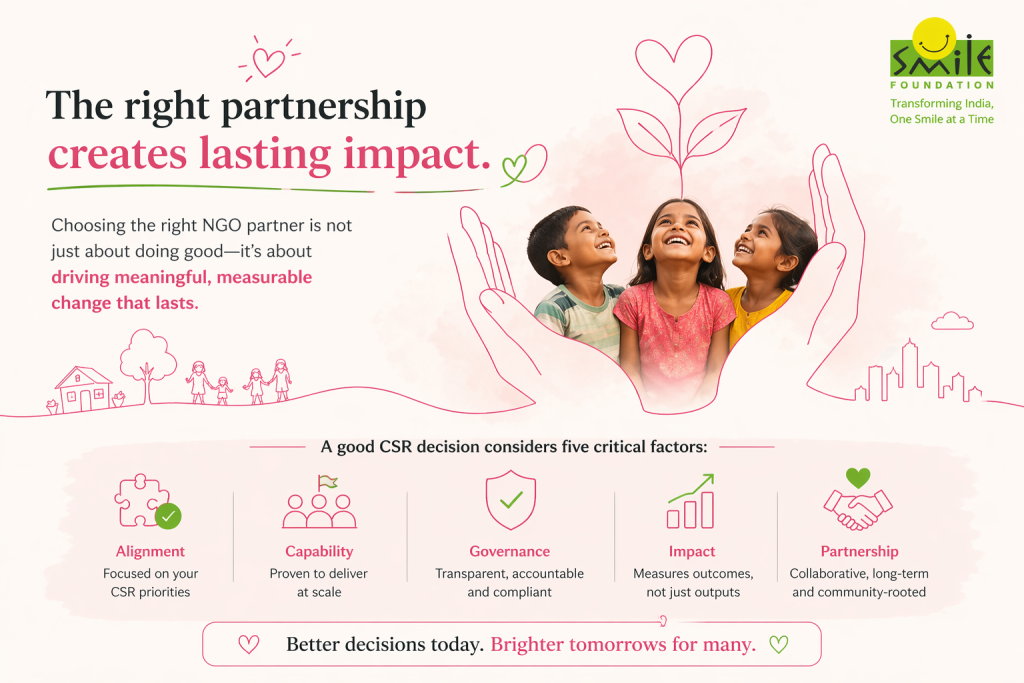
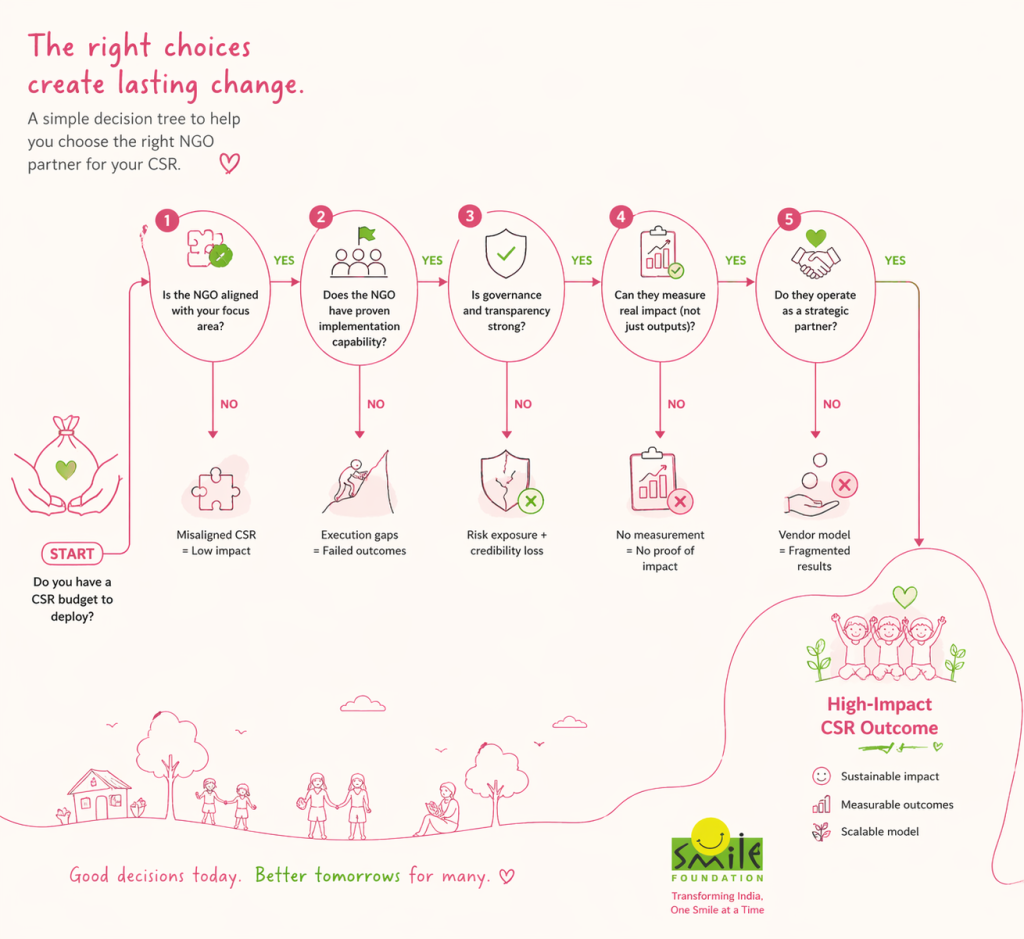
The decision to choose an NGO for CSR should be approached with the same analytical rigour that companies bring to any significant procurement or investment decision. The following framework addresses the dimensions that most reliably predict implementation quality and impact outcomes.
Alignment with CSR Goals
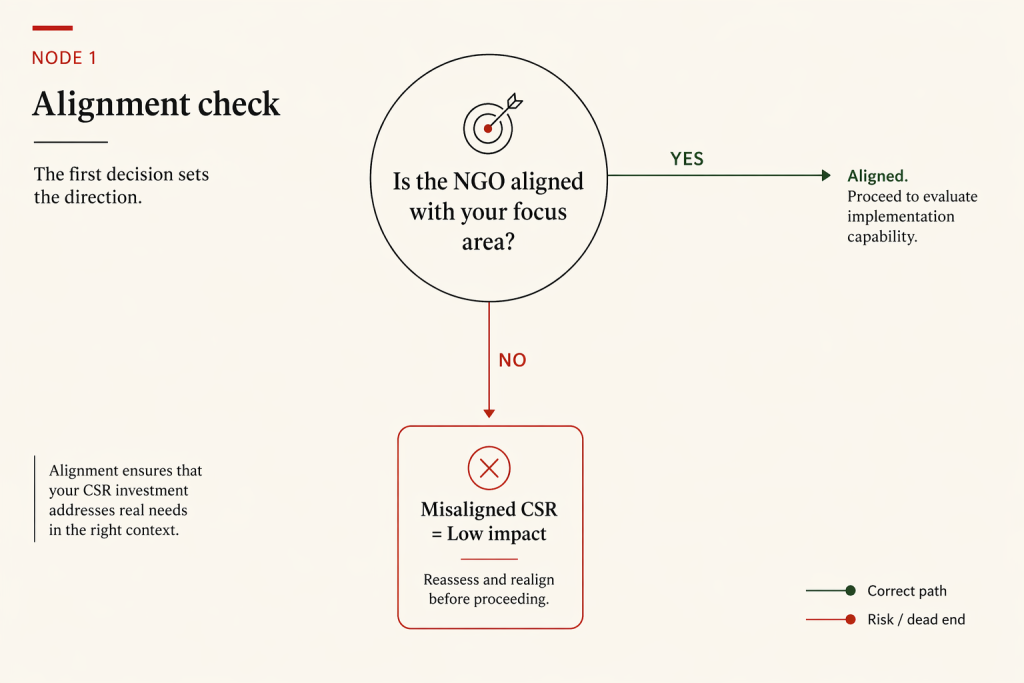
The starting point is straightforward but frequently skipped: does the NGO’s programme expertise align with the development challenges your company is trying to address? Sector alignment — in education, healthcare, women’s empowerment, skilling, or environmental sustainability — is not just a question of what the NGO says it does. It is a question of what it has evidence of doing well, in contexts comparable to the ones your CSR programme will operate in.
Beyond sector, consider time horizon. Some NGOs are structured for rapid-deployment, one-year interventions. Others have built programme models designed for sustained, multi-year engagement that compounds in depth and reach over time. If your company intends to make a genuine, long-term CSR commitment — as the evidence strongly suggests you should — you need a partner whose programme model is compatible with that intention.
Implementation Capability
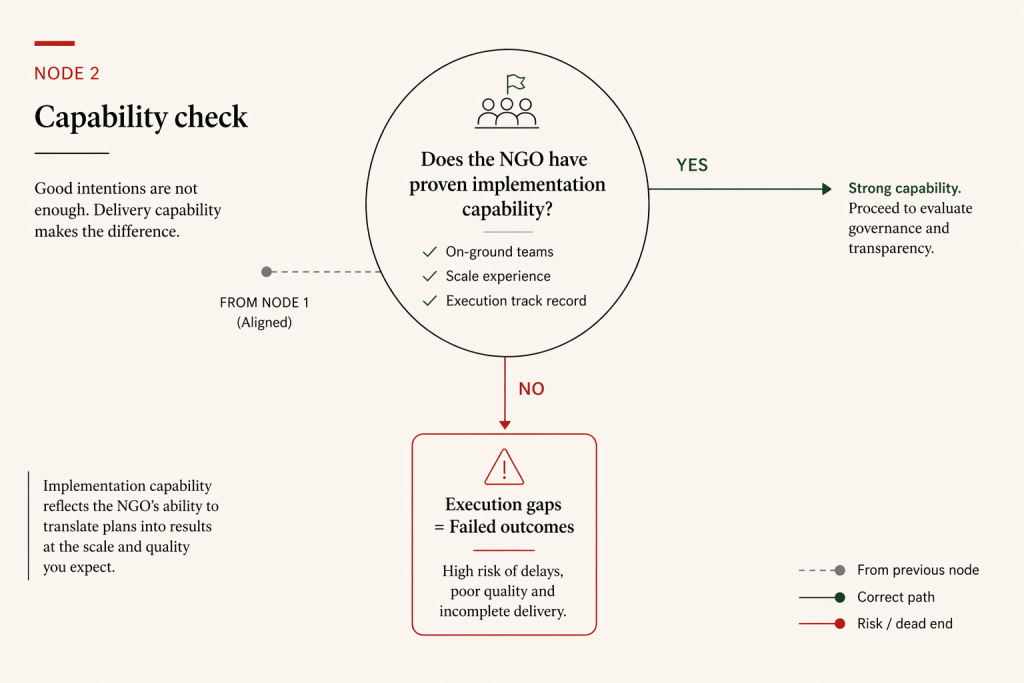
On-ground implementation capability is where the gap between NGO presentation and NGO performance is most commonly found. The questions to ask are specific: How many full-time staff does the NGO have in the geographies where the programme will operate? What is their relationship with local communities, local government, and other development actors? How have they managed programmes of comparable scale and complexity previously, and what do the outcomes show?
Site visits — to existing programme locations, not just head offices — are among the most reliable sources of evidence about implementation quality. What you observe in a functioning programme tells you more than any proposal document can.
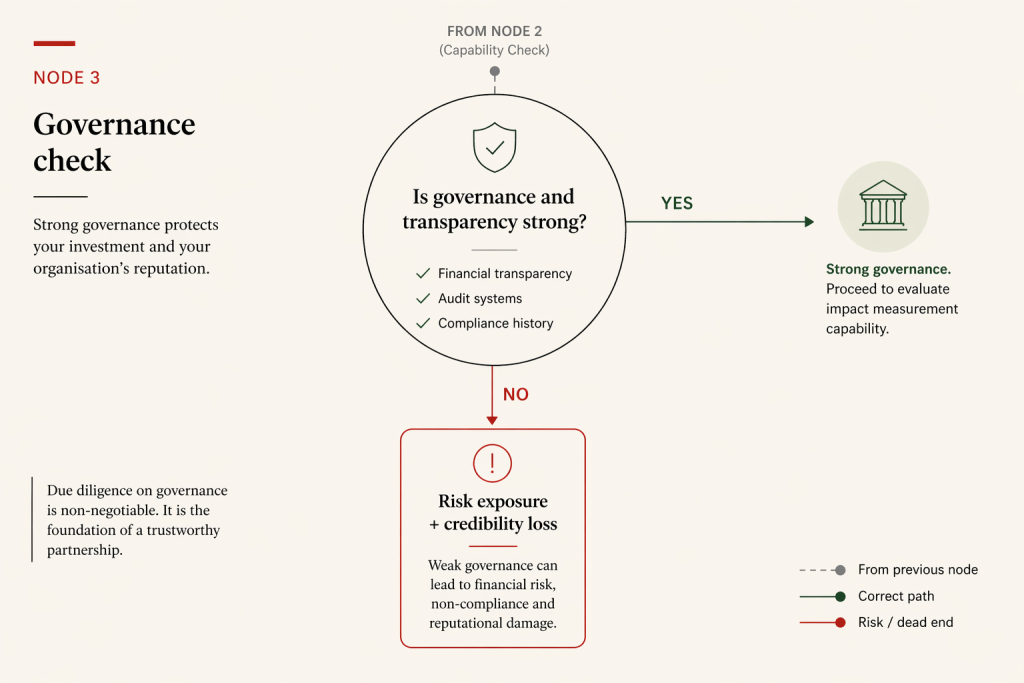
Financial Transparency and Compliance
CSR eligibility requires NGOs to meet specific registration and governance criteria. Section 135 and the CSR Rules specify the types of entities through which CSR funds can be channelled, and companies are directly responsible for ensuring that their implementation partners meet these requirements. The MCA portal and NGO-DARPAN — the Government of India’s database of NGOs — provide baseline information, but direct verification of registration status, audit history and financial governance is essential.
Look beyond compliance to the quality of financial management. Audited accounts, internal controls, fund segregation practices and the transparency of financial reporting to existing donors are all indicators of the fiduciary rigour with which your CSR investment will be managed.
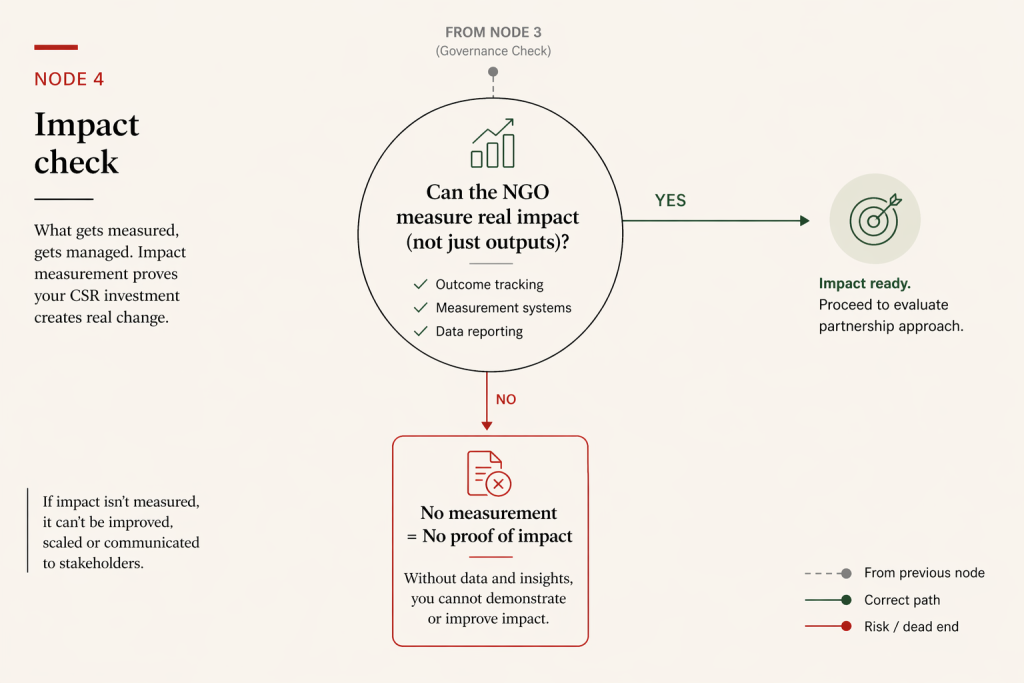
Impact Measurement Systems
The presence of a genuine impact measurement framework — not just an output tracking spreadsheet — is one of the clearest signals of NGO maturity. Ask to see the tools used to establish baselines, the indicators tracked through the programme cycle and the methodology used to attribute outcomes to programme activities.
The distinction between output, outcome and impact measurement is worth understanding clearly. Outputs are what was delivered — workshops held, people reached, infrastructure built. Outcomes are what changed as a result — learning levels, health indicators, income, employment. Impact is the portion of that change attributable to the programme rather than other factors. Most NGOs measure outputs. Fewer measure outcomes. Fewer still have the systems to attribute impact rigorously. The quality of measurement capability directly determines whether your CSR investment can be defended, improved and built upon.
Community Connect
Development programmes that are designed without deep community understanding and implemented without genuine community trust consistently underperform relative to those that are rooted in authentic relationships with the people they are designed to serve. This is not a soft criterion. It is a practical one.
An NGO with strong community connect can mobilise participation that an outsider cannot. It understands local dynamics, cultural sensitivities, and the practical barriers that keep people from engaging with development programmes. It has the credibility to navigate local political and institutional contexts in ways that ensure programme continuity. And it has the feedback loops, both formal and informal, that allow programme design to be responsive to what communities actually need rather than what they are assumed to need.
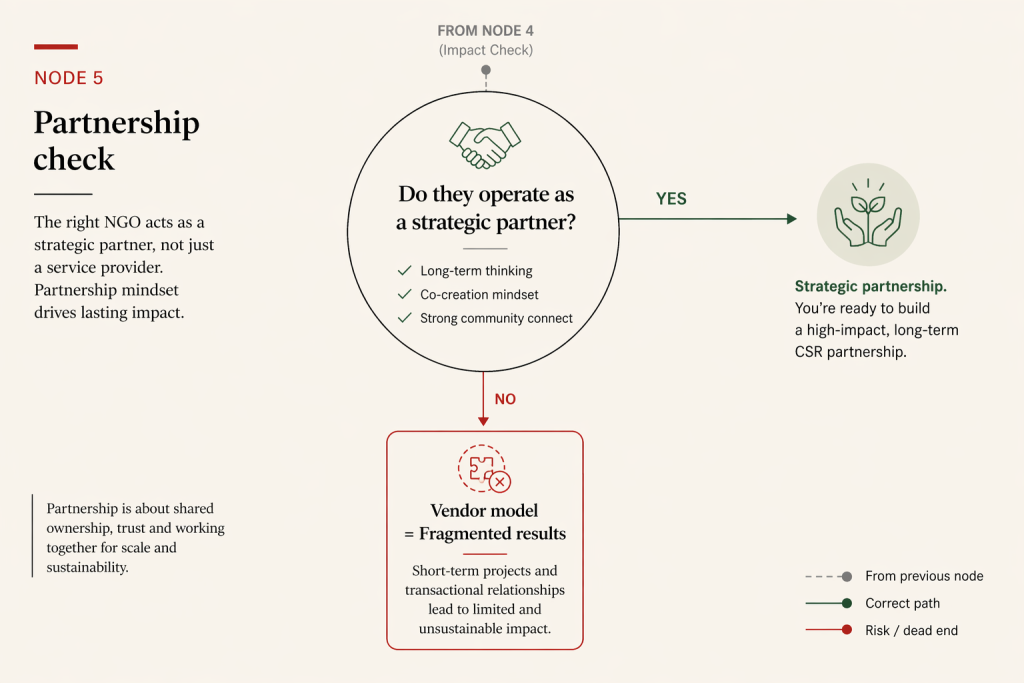
Partnership Approach
The final and most consequential dimension is the hardest to evaluate from a proposal: does the NGO approach CSR partnerships as co-creation or as contract execution?
The difference matters enormously. An NGO that treats corporate partners as funders to be managed will design programmes to specification, report against agreed metrics, and deliver what was commissioned — no more and no less. An NGO that approaches partnerships as co-creation will bring its programme expertise and community knowledge to the design process, challenge assumptions that are likely to produce poor outcomes, share accountability for results, and invest in the relationship as a long-term asset rather than a transactional arrangement.
The latter produces better outcomes, more honest reporting, and a partnership that actually improves over time. Identifying which approach an NGO takes requires direct conversation — about how they engage corporate partners in programme design, how they handle situations where implementation is not going to plan, and what they understand their accountability to be.
Common Mistakes Companies Make When Choosing NGOs
The most persistent mistakes in NGO selection share a common root: insufficient time and rigour devoted to the decision.
Choosing based on visibility rather than capability is perhaps the most widespread. Large, nationally recognised NGOs are not automatically the best implementation partners for every programme type or geography. Name recognition is a function of communications and fundraising investment, not necessarily of programme quality. The NGO with the highest-profile events calendar may have less relevant expertise and weaker outcomes data than a less visible organisation with deep specialisation in the area you care about.
The one-time funding approach — treating CSR as a series of annual grants to different organisations rather than sustained investment in a small number of trusted partners — is another common failure mode. Development outcomes do not emerge from a single year of funded activity. They require continuity, trust-building, iterative learning and the kind of sustained engagement that annual grant cycles cannot support.
Ignoring measurement systems during partner selection and then expecting outcome data at the end of the programme cycle is a pattern that reliably produces disappointment. Measurement capability must be assessed before partnership, built into programme design from the beginning and resourced adequately — it is not a free service that NGOs provide on request.
Fragmenting CSR investment across a large number of small NGOs in search of geographic coverage or sectoral diversity may appear strategic but typically produces shallow engagement with each partner and insufficient scale for any single programme to achieve meaningful outcomes.
The Case for Strategic NGO Partnerships
The organisations best positioned to help companies choose an NGO for CSR effectively — and to deliver on the promise of genuine impact — are those that have built the organisational infrastructure to operate at scale, across sectors, in the geographies where development need is greatest.
Smile Foundation’s model illustrates what this looks like in practice. Working with over 400 corporate partners across 27 states, the organisation operates across education through Mission Education, healthcare through the Smile on Wheels mobile health programme, skilling and livelihood initiatives and women’s empowerment — not as parallel silos but as an integrated development system designed to address the interconnected dimensions of deprivation.
For corporate partners, the practical implication is that a single implementation relationship can address multiple CSR goals coherently, with consistent reporting standards and accountability frameworks across programme areas. The alternative — managing separate relationships with separate NGOs for each programme area — introduces coordination complexity and fragmentation that typically reduces both efficiency and impact.
Smile Foundation’s corporate partnerships are built on multi-year commitments, co-designed programme goals and outcome-based reporting that allows companies to demonstrate to their Boards, investors, and regulators not just that the CSR budget was spent, but that it produced verified, meaningful change in the communities it was intended to serve.
A Practical Checklist for CSR Leaders: 2026
Before committing to an NGO partnership, CSR leaders should be able to answer the following questions affirmatively:
- Does the NGO’s sector expertise directly match our CSR programme goals, and is that expertise backed by verifiable outcome data from comparable programmes?
- Does the NGO have full-time operational presence — not just network relationships — in the geographies where we intend to invest?
- Is the NGO registered under the relevant provisions for CSR implementation, with clean audit records and transparent financial governance?
- Does the NGO have a genuine impact measurement framework with baselines, outcome indicators and a clear attribution methodology?
- Can the NGO provide references from existing corporate partners who have worked with them for more than one year, and are those partners willing to speak candidly about programme quality?
- Is the NGO’s programme model designed for multi-year engagement and is the organisation structured to sustain programmes through funding cycle changes and personnel transitions?
- Does the NGO demonstrate a genuine partnership orientation — contributing to programme design, sharing accountability for outcomes and communicating proactively when challenges arise?
- Is the NGO’s leadership and governance structure stable, transparent and free from conflicts of interest that could affect fund management?
- Does the NGO have the administrative capacity — financial management, HR systems, legal compliance — to manage a corporate partnership at the scale you are considering?
- And finally: does the NGO’s theory of change reflect a genuine understanding of how the development challenges you are addressing actually work — including their interconnections with other dimensions of deprivation?
The Future of CSR Partnerships in India
The trajectory of CSR in India is moving, gradually but consistently, from project funding toward ecosystem building. The most forward-looking corporate CSR strategies are no longer asking which activities to fund. They are asking which systems to invest in, which communities to commit to over time and which implementation partners have the depth and credibility to co-create lasting change.
This shift has significant implications for how companies choose an NGO for CSR. The criteria that matter most are no longer primarily about scale and visibility. They are about programme depth, measurement rigour, community trust and the quality of the partnership relationship itself. The NGOs that will be most valuable as the framework evolves are those that can function as strategic partners — bringing not just implementation capacity but programme design intelligence, community insight, and the kind of honest accountability that helps companies improve their CSR investment over time.
The regulatory direction reinforces this. Outcome-based reporting, third-party impact verification and the integration of CSR into ESG accountability frameworks are all pointing toward a future in which the quality of NGO partnerships is as visible, and as consequential, as the size of the CSR budget.
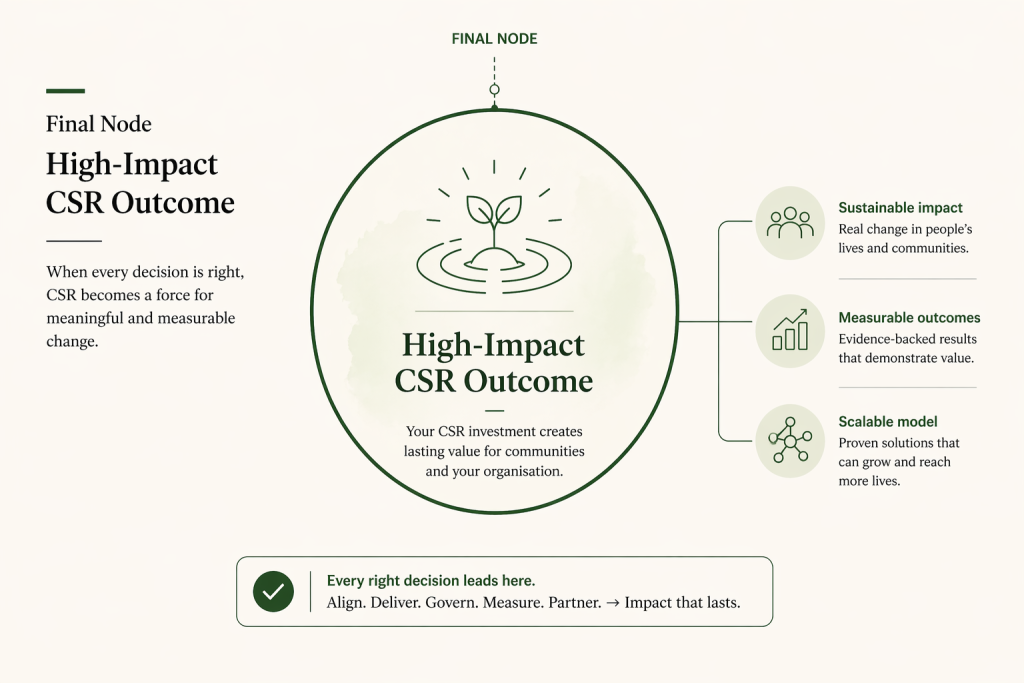
The Difference Between Spending and Creating
India’s CSR mandate ensures that the money flows. What it cannot ensure, and what only good partner selection can produce, is that the money matters.
Choosing the right NGO for CSR is not a procurement exercise to be completed under deadline pressure at the end of the financial year. It is a strategic decision that determines the quality of every outcome your CSR investment produces, the credibility of every impact claim your company makes, and the long-term value of every rupee your CSR budget deploys.
The companies that will define the next phase of CSR in India are not those with the largest budgets. They are those with the strongest partnerships — built on rigour, sustained over time and accountable for outcomes that are real, verified and worth the investment they represent.
Frequently Asked Questions (FAQs)
How do companies choose NGO for CSR in India?
The most rigorous approach combines sector alignment assessment, implementation capability verification, financial transparency review and direct evaluation of impact measurement systems. Site visits to existing programmes, reference checks with current corporate partners and a clear framework of decision criteria — applied before time pressure forces a choice — consistently produce better partnership outcomes than reputation-based selection under deadline pressure.
What makes an NGO eligible for CSR funding in India?
Under the Companies (CSR Policy) Rules 2014, CSR funds can be channelled through registered trusts, registered societies, Section 8 companies and certain other entities that meet specific registration and governance criteria. The NGO must be registered for at least three years and have an established track record in its area of work. Companies can verify eligibility through NGO-DARPAN, the Government of India’s NGO registration database, and should conduct direct compliance verification before committing funds.
What should CSR leaders evaluate before partnering with an NGO?
The most important evaluation dimensions are sector expertise backed by outcome data, on-ground implementation presence in target geographies, financial transparency and governance quality, genuine impact measurement capability, community trust and last-mile delivery track record, partnership orientation and organisational stability. Each of these should be assessed through direct evidence — programme visits, outcome data, financial accounts and reference conversations — rather than proposals and presentations alone.
How should companies measure NGO impact in CSR programmes?
Impact measurement should be built into programme design from the beginning, not added at the end. It requires baseline data collection before programme activities begin, clear outcome indicators established in advance, regular monitoring through the programme cycle and end-line assessment that allows comparison with baseline. The most credible impact measurement also addresses attribution — the degree to which observed changes can be linked to the programme rather than other factors — and ideally involves third-party verification for larger programmes.
What are red flags when selecting an NGO for CSR?
Key red flags include: inability to provide audited accounts or evidence of clean financial governance; programme data that consists only of output counts with no outcome indicators; reluctance to allow site visits or reference checks; a track record of short-term, one-off programmes without evidence of sustained community engagement; governance structures that lack independence or transparency; and a partner orientation that is primarily focused on receiving funds rather than co-creating programmes and sharing accountability for results.
Why do long-term NGO partnerships produce better CSR outcomes?
Development outcomes require time to materialise — learning levels, health indicators, income and employment do not shift measurably in a single year of programme activity. Long-term partnerships allow for the community trust-building, iterative programme learning and sustained engagement that meaningful change requires. They also allow the relationship between corporate partner and NGO to develop — improving programme design, strengthening accountability and compounding the value of investment over time.
How can companies avoid choosing the wrong NGO for CSR?
The most reliable protection against poor partner selection is a structured, criteria-driven evaluation process applied with adequate time — ideally beginning six to nine months before the programme is intended to start. This allows for due diligence that would be impossible under year-end deadline pressure. Companies should also resist the temptation to select partners based on familiarity or visibility, and should invest in building implementation relationships over time rather than assembling them under pressure.
What is the difference between an NGO as a vendor and an NGO as a strategic partner?
A vendor NGO executes activities to specification, reports against agreed metrics and treats the corporate relationship as a transactional arrangement to be managed. A strategic partner NGO contributes to programme design from its programme expertise and community knowledge, shares accountability for outcomes rather than only for delivery, communicates proactively when challenges arise and invests in the relationship as a long-term asset. The latter produces better outcomes, more honest reporting and a partnership that genuinely improves over time.
How does Smile Foundation support companies in choosing and implementing CSR programmes?
Smile Foundation works with corporate partners to co-design programmes aligned with specific development goals, implement them across 27 states through established community and operational networks and track outcomes through rigorous monitoring and reporting systems. The organisation’s integrated model spanning education, healthcare, skilling and women’s empowerment allows corporate partners to address interconnected development challenges through a single, accountable partnership, with the transparency and outcome evidence that regulatory and ESG frameworks increasingly require.
Sources referenced: Companies Act 2013 (Section 135), Companies (CSR Policy) Rules 2014 and 2021 Amendments, Ministry of Corporate Affairs CSR Guidelines, NGO-DARPAN (Government of India NGO Registry), NITI Aayog Aspirational Districts Programme, Annual Status of Education Report (ASER) 2023, MCA CSR Dashboard.