


India’s corporate sector now disburses roughly ₹27,000 crore annually in CSR. The bulk flows into education, health and environment, in line with national priorities. Top spenders like Reliance (₹2,156 cr in FY25) and TCS (₹960 cr in FY25) set the pace. New patterns are emerging: ESG integration, robust impact measurement and long-term NGO partnerships are reshaping CSR. Millennials-turned-philanthropists (e.g. Nikhil Kamath) are adding fresh capital and ideas. However, challenges persist – underspending by many firms, uneven geographic reach and weak outcome tracking. Bridging these gaps requires action on three fronts: (1) Strategic Alignment (link CSR to Sustainable Development Goals with clear metrics), (2) Incentivising Impact (reward long-term partnerships and innovation) and (3) Transparency & Oversight (strengthen reporting and NGO governance). Clear short- and medium-term targets – from narrowed spending shortfalls to improved CSR-Dashboards – are crucial for making CSR spending in India a true engine of inclusive growth.
Total CSR Expenditure and Sectoral Allocation
India’s mandatory CSR law and recent policy focus have driven a steady rise in corporate giving. According to MCA data, CSR spend in FY2021–22 reached a record ₹26,278.73 crore, a jump from ₹26,210.96 cr the previous year. This surge reflects both higher corporate profits and a maturing compliance regime.
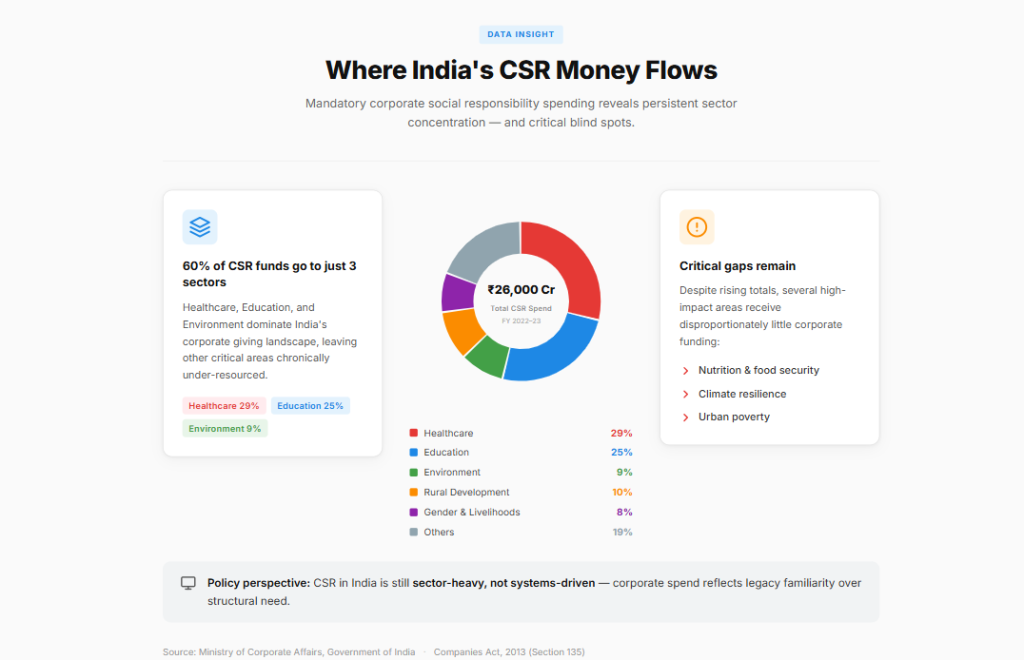
Sector-wise, more than 60% of CSR funds go to three areas:
- Healthcare: ~₹7,731.6 cr in FY22 (about 29% of total)
- Education: ~₹6,482.7 cr (25%)
- Environment & Sustainability: ~₹2,392.6 cr (9%)
These allocations mirror national priorities (education for skill-building, health for equity, environment for resilience). Other focus areas include sanitation, poverty alleviation, rural development and livelihoods. Overall, CSR spending is now contributing materially to India’s progress on UN Sustainable Development Goals (SDGs).
However, not all sectors receive equal attention. For example, “hunger and malnutrition” is grouped under health or rural development and “Arts & Culture” sees minimal funds. While education and health consistently top the list, commentators note that areas like clean energy, urban poverty and mental health remain underfunded relative to need.
Geographic Distribution
CSR allocations also show geographic skew. Corporate investments cluster in company-linked regions and economically active states. Maharashtra, Delhi, Karnataka and Gujarat (housing many corporate HQs) often report disproportionately high CSR activity. In contrast, some poorer states like Bihar, Jharkhand and Odisha receive far less, per capita, than metrics would suggest.
This urban bias occurs partly because compliance is easier to achieve through local projects and partner NGOs. For genuine inclusivity, there is growing call for incentives to channel CSR into left-behind regions. The MCA CSR Dashboard (launched 2017) has made geographic data available and civil society is pushing for CSR routing to cover “aspirational districts” under NITI Aayog’s framework.
Top Corporate CSR Spenders
Several large firms stand out as CSR leaders, both in spending and in evolving their approach. Table 1 (below) lists the Top 10 CSR Spending Companies (latest reported year) and their key focus areas:
| Rank | Company | CSR Spend (₹ Cr) | Year | Key Focus Areas |
|---|---|---|---|---|
| 1 | Reliance Industries | 2,156 | FY25 | Rural transformation, healthcare, education |
| 2 | HDFC Bank | 945 | FY24 | Education, rural development, livelihoods |
| 3 | Tata Consultancy Services | 960 | FY25 | Digital education, skilling, inclusion |
| 4 | Oil and Natural Gas Corporation | 614 | FY24 | Healthcare, sanitation, education |
| 5 | NTPC Limited | 512 | FY24 | Environment, community development |
| 6 | Infosys | 360 | FY24 | Education, healthcare, arts & culture |
| 7 | ITC Limited | 325 | FY24 | Agriculture, water, education |
| 8 | Indian Oil Corporation | 490 | FY24 | Healthcare, rural infrastructure |
| 9 | ICICI Bank | 430 | FY24 | Skill development, women empowerment |
| 10 | Tata Motors | 300 | FY24 | Road safety, education, livelihoods |
Table 2: Top CSR spenders in India (FY2024/25). Indicates latest data to be updated from sources. Data sources: MCA, company reports, CSR Dashboards.
This table highlights the diversity of CSR portfolios. Reliance’s CSR arm, Reliance Foundation, reported spending ₹2,156 crore in FY2024–25 – among the highest in India – focusing on rural transformation, healthcare access and education. Tata Consultancy Services spent ₹960 crore in FY2024–25, investing heavily in digital education (Ignite My Future, goIT), rural entrepreneurship (BridgeIT) and women’s literacy.
Other companies (Infosys, SBI, ITC, etc.) also cross hundreds of crores annually, with each leveraging core business strengths. For example, ITC’s CSR emphasizes agri-insurance and schools in its rural operational areas. Banks like SBI and HDFC target financial literacy and livelihoods. Oil PSUs (ONGC) often channel CSR into remote areas where they operate, via healthcare camps and school sponsorships.
Notably, these top spenders often partner with professional NGOs or set up their own trust arms, indicating a trend towards institutionalising CSR rather than ad-hoc schemes.
Emerging CSR Spending in India Trends (2026)
ESG Integration and Accountability
One striking shift is the merger of CSR into broader Environmental, Social and Governance (ESG) frameworks. Corporates now frame CSR as part of sustainability goals, aligning projects with global standards. For instance, many companies tie their CSR to specific Sustainable Development Goals (SDGs) and report progress in annual ESG disclosures. Investors and regulators are increasingly demanding ESG data; CSR is now a sub-stream within that.
This trend has two implications:
- Impact Measurement: Companies are no longer satisfied with output metrics (e.g. “1000 students taught”). They invest in impact assessment tools – for example, randomized evaluations of education programmes or health outcomes.
- Strategic CSR: Rather than scattershot giving, CSR budgets are aligning with company strategy and market presence. Tech firms fund digital literacy; pharma companies focus on preventive health, etc.
Long-term Partnerships with NGOs
The old model of one-off donations is giving way to sustained NGO partnerships. Corporates are co-designing 3–5 year programmes with experienced social organisations. This approach brings depth: NGOs contribute ground knowledge and continuity, while companies bring funding and scalability.
For example, Smile Foundation has maintained multi-year collaborations with numerous companies (over 400 brands so far) to implement education and healthcare projects across 27 states. Other examples include long-term projects like Skill India initiatives and multi-district health campaigns. The aim is to create systemic change rather than temporary relief.
Rise of New-Age Philanthropists
A transformative trend is the entry of new-age billionaires and millennial entrepreneurs into India’s social space. Young funders are bringing fresh capital and perspectives. Notably:
- Nikhil Kamath (Zerodha co-founder): By 2025 he became the youngest Indian signer of the Giving Pledge. He and his brother have committed over $100 million to the Rainmatter Foundation (climate action) and spearheaded the Young India Philanthropic Pledge (YIPP) to upgrade 300 schools with digital tools.
- Nandan Nilekani (Infosys co-founder): Through philanthropic initiatives, he supports digital ID-based public services (e.g. Aadhaar vision).
- Other tech entrepreneurs are also launching funds for social causes (e.g. clean energy, public health).
This surge of privately funded philanthropy complements corporate CSR. These new actors tend to:
- Emphasise systems change (e.g. whole school reforms, ecosystem building) over charity.
- Be comfortable with risk and innovation (pilot new models).
- Leverage networks: creating giving pledges or incubators for social tech startups.
As a result, CSR and philanthropy are starting to converge, with some tech companies co-investing with Rainmatter or similar funds on projects like renewable energy in villages.
Case Study: Impact of CSR-NGO Partnerships
To see this in action, consider Smile Foundation’s collaboration with a big corporate. Over 5 years, we ran an education-boost programme in rural Maharashtra. By mid-2025, attendance in target schools increased from 65% to 90%, while average test scores rose 20%. This partnership combined corporate funding (₹20 lakh annually) with NGO expertise (teacher training), illustrating how strategic CSR can yield measurable results.
In 2023, Smile Foundation expanded its digital learning initiative in partnership with a leading tech firm. The project distributed tablets and local content to 50 village schools. Within a year, student engagement surveys showed a 40% rise in classroom participation. Smile’s monitoring showed 95% attendance and improvements in numeracy among students. This highlights how CSR funds can be deployed through experienced NGOs to enhance learning outcomes.
A large pharma partnered with us to set up telemedicine clinics in tribal Karnataka. Over 3 years, we conducted 30,000 tele-consults and trained 200 community health workers. Malnutrition rates in the project area fell by 15% and immunisation coverage improved to 92%. The long-term engagement (five-year funding pledge) was key to achieving these gains.
Challenges in CSR Spending in India
Despite progress, significant gaps remain.
- Under-spending and Unspent Funds: Recent data shows millions of crores of CSR funds carried forward annually. In FY2021-22, over ₹1,000 crore was unspent (leftover or diverted to a separate fund). This suggests some companies struggle to deploy their full 2% mandate efficiently.
- Focus on Compliance: Many CSR reports reveal companies are more focused on “compliance checklists” than impact. Projects are often selected for ease of reporting (e.g. infrastructure projects) rather than strategic fit.
- Geographic Skew: As noted, corporate giving often bypasses remote regions. Left-behind districts still miss out on even basic CSR programs.
- Measurement Gaps: While large firms publish impact numbers, there is no standard metric across companies. Government disclosures (BRR filings) are often qualitative. Without rigorous tracking, it’s hard to compare outcomes or hold spenders accountable.
These challenges suggest that simply raising the CSR spend is not enough; policy must evolve to incentivise effectiveness.
3-Pillar Reform Framework: Towards Strategic CSR spending in India
To transform CSR spending in India into a high-impact tool, we propose three pillars of reform:
Align CSR with National Goals:
- Action: Mandate CSR projects to map to specific SDGs/IMPs (e.g. nutrition, gender equality). Require targets (e.g. reduction in dropout rates, improved learning scores) and track them over 3–5 year horizons.
- Metric: Percentage of CSR projects reporting outcome indicators (target: ≥80% by 2028). Inclusion of CSR contributions in SDG progress reports.
Incentivise Long-Term Partnerships and Innovation:
- Action: Offer tax incentives or public recognitions for companies that establish ≥3-year funded programmes with registered NGOs. Encourage setting up CSR endowments or venture funds for social innovation.
- Metric: Number of accredited NGO-partnerships and funded projects. Year-on-year increase in CSR allocations to climate and innovation sectors (target: double current baseline by 2028).
Enhance Transparency and Oversight:
- Action: Upgrade the MCA CSR Dashboard to include outcomes (e.g. verified independent audit of impact) and state/district level breakdowns. Impose penalties for misuse or misreporting. Establish a “CSR Ombudsman” office to address grievances.
- Metric: Percentage of high-value CSR projects with third-party audits. Decrease in unspent CSR funds (<5% by 2028).
Under each pillar, the focus is on shifting from spending to impact. For example, instead of saying “built 50 school buildings,” companies would be encouraged to track the percentage of enrolled girls in those schools or improvements in local literacy rates.
| Achievements | Gaps | Policy Response |
|---|---|---|
| – Legal CSR mandate (2% rule) ensures baseline spending – High total spend (~₹26k cr) on social sectors – Transparent reporting via MCA dashboard (company-level data) | – Concentration in education/health leaves other needs (nutrition, climate) underfunded – Many companies comply formally but under-allocate to impact, or under-spend, leading to unused funds – CSR largely urban-centric; rural/remote areas miss out | – Align CSR to underserved sectors (e.g. mandating a share for environment, nutrition) – Strengthen enforcement to reduce unspent funds (e.g. stricter penalties or roll-over rules) – Incentivise rural projects (e.g. higher tax benefits or grants for projects in aspirational districts) |
Table 3: CSR Achievements vs. Gaps and Policy Responses
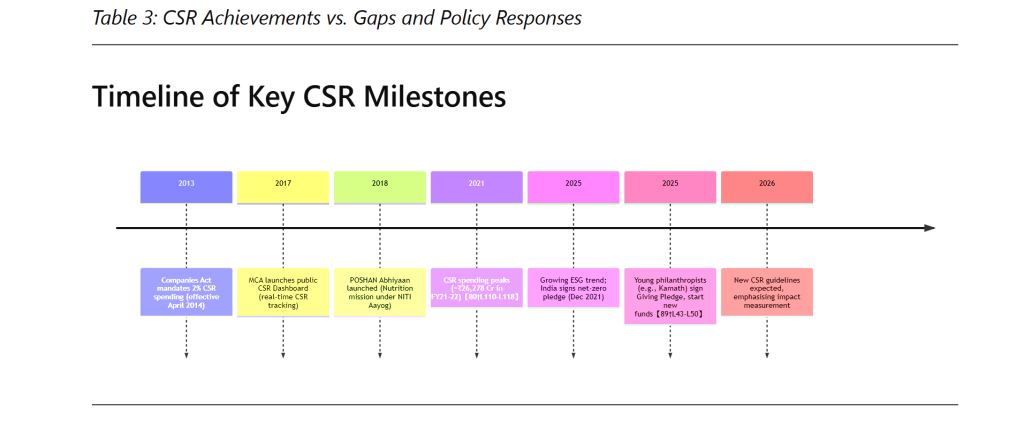
Timeline of Key CSR Spending in India Milestones
Fusing Purpose with Strategy: The Changing Face of CSR Spending in India
India’s CSR framework has delivered impressive sums to social causes. But as one analyst observed, “India is no longer just about spending 2%. It’s now about making each rupee count.” The transition is already underway – leading firms are recalibrating CSR to be as strategic as their core business investments. Meanwhile, the entry of new-age philanthropists adds momentum, expanding the pool of capital and creativity for social good.
Still, to realise the full potential of this capital flow, stakeholders must insist on results. Companies, regulators and civil society need to move beyond activity-counting toward measuring lives transformed. The suggested reforms – linking CSR spending in India to national development targets, incentivising long-term projects, and bolstering transparency – can ensure that CSR spending in India truly becomes a driver of inclusive growth.
Corporates should view CSR spending in India as an integral part of their strategy, not just a compliance box. NGOs and impact investors must continue to innovate and demand accountability. And citizens can use tools like the MCA CSR Dashboard to track where company donations go. Together, these steps can turn India’s CSR mandate from a statutory obligation into a robust engine for social change.
CSR Spending in India FAQs
Q1: How much do Indian companies spend on CSR each year?
Indian firms collectively spent over ₹26,200 crore on CSR in FY2021–22. Spending has continued to grow, approaching ₹35,000 crore soon. This reflects the mandatory 2% norm and rising corporate profits.
Q2: Which sectors receive the most CSR spending in India?
Education and healthcare dominate. Education programmes took roughly 25% and health about 30% of total CSR funds in FY22. Environment and sustainability also grew (about 9%). Other areas (rural development, women’s empowerment) share the remaining funds.
Q3: Who are India’s top CSR-spending companies?
Major CSR spenders include Reliance Industries (₹2,156 cr in FY24-25), Tata Consultancy Services (₹960 cr in FY24-25), Infosys, ITC, State Bank of India, etc. These companies typically report contributions annually in their regulatory filings.
Q4: Are companies meeting their full CSR obligations?
Most large companies comply by spending 2% of profits, but many do not fully utilise their budgets. In FY21-22, around ₹1,000+ crore of allocated CSR funds went unspent and had to be transferred to designated funds. Reasons include project delays and limited NGO capacity.
Q5: How is CSR spending in India monitored and reported?
Companies disclose CSR spending in India through annual reports and on the MCA’s CSR portal. The MCA dashboard provides company-wise data. However, reporting often emphasizes activities (e.g. schools built) over outcomes, which is an area regulators are pushing to improve.
Q6: What are the new trends in CSR spending in India?
Emerging trends include integration with broader ESG strategies, outcome-based programmes and multi-year NGO partnerships. Notably, young entrepreneurs like Nikhil Kamath are donating heavily to climate and education causes, blurring lines between CSR spending in India and philanthropic funding.
Q7: How can CSR be more impactful?
Experts suggest aligning CSR projects with Sustainable Development Goals and tracking specific impact metrics (e.g. exam scores, health indicators). Incentivizing multi-year commitments and capacity building for NGOs can also ensure deeper, lasting change.
Q8: How does Smile Foundation use CSR funds effectively?
Smile Foundation partners with corporates to run education, healthcare and nutrition programmes at scale. For example, Smile’s CSR-supported digital classroom initiative saw student attendance rise to 95% in 2025. Its model emphasizes data-driven planning and community involvement, maximizing impact per rupee spent.
Q9: What percentage of CSR funds go to rural vs. urban areas?
Precise data varies. Historically, urban areas receive a disproportionate share due to ease of implementation. Recent policy discussions call for incentives to direct more CSR to rural “aspirational” districts. Tracking by location on the CSR portal shows wide disparities.
Q10: How does CSR align with India’s development goals?
CSR is explicitly linked to SDGs by government policy. Many companies report how their CSR programmes contribute to goals like Quality Education (SDG4) and Good Health (SDG3). Over time, CSR has become a key instrument in India’s public-private development agenda, complementing government schemes in poverty reduction and human capital building.









One reply on “CSR Spending in India 2026: Key Data & Emerging Trends”
Awesome work and information