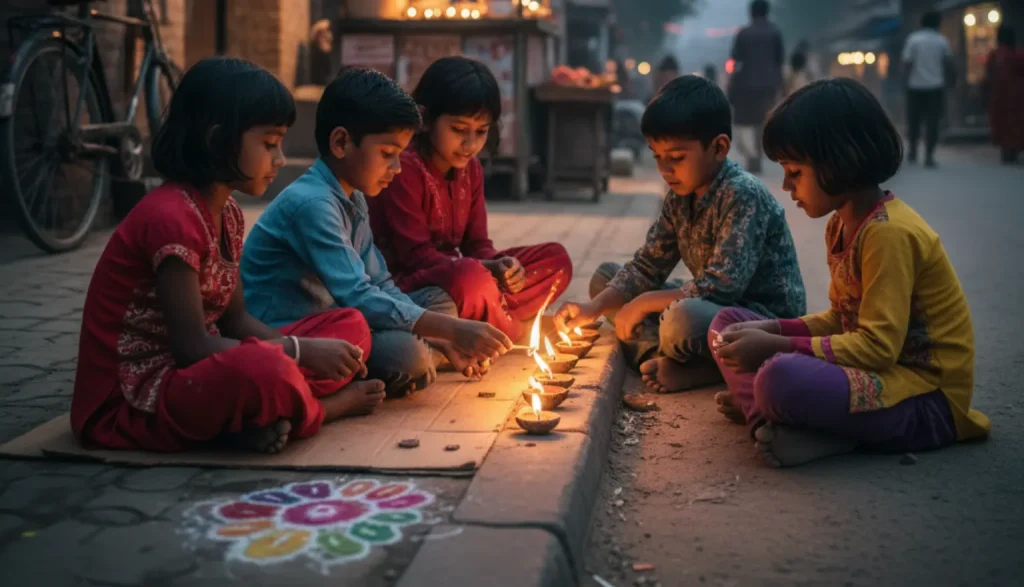
For generations, education has been defined by four walls, a blackboard, and a timetable.
But long before formal classrooms existed, learning happened outdoors. Children observed seasons change, watched insects build homes, understood soil through touch and recognised the rhythm of nature through experience.
Today, as childhood becomes increasingly screen-bound and urbanised, reconnecting children with nature is not a nostalgic idea. It is an educational necessity.
Nature’s classroom — learning in and through natural environments — is gaining renewed relevance in conversations around child development, mental health and experiential education.

The Science Behind Nature-Based Learning
Research across psychology, education and environmental studies consistently shows that time spent in natural environments supports holistic development.
Studies published in journals indicate that children exposed regularly to green spaces demonstrate improved attention spans and better emotional regulation. Nature exposure has also been linked to reduced stress levels and enhanced working memory.
In a world where children are increasingly exposed to digital stimuli, the calming effect of natural environments provides cognitive balance.
Nature does not rush learning. It allows it to unfold.
Learning That Is Seen, Felt and Remembered
When children read about ecosystems in textbooks, the concept remains abstract. When they observe a butterfly’s lifecycle, feel tree bark or study soil layers, the learning becomes embodied.
Experiential education strengthens retention.
Environmental education research shows that students who engage with biodiversity firsthand demonstrate stronger long-term interest in science subjects. They also show greater environmental stewardship as they grow older.
Nature-based learning is not limited to science. It builds observation skills, patience, collaboration and curiosity.
These are life skills, not just academic outcomes.
Mental Well-being and the Outdoor Advantage
The post-pandemic years have seen increased conversations around children’s mental health. Screen time has risen sharply. Physical activity levels have declined.
Outdoor learning offers an antidote.
Time in green spaces has been shown to reduce anxiety and improve mood among children. Unstructured exploration supports creativity. Shared outdoor activities strengthen peer relationships.
Nature’s classroom is not only about biodiversity. It is about balance.
Reimagining Education for a Changing World
India’s National Education Policy 2020 encourages experiential and multidisciplinary learning. Eco-clubs and school gardens are increasingly promoted. Yet implementation varies widely, especially in underserved communities.
For many children in urban low-income neighbourhoods, access to safe green spaces is limited. Exposure to biodiversity may be confined to textbook illustrations.
Bridging this gap is not simply about environmental awareness. It is about educational equity.
Every child deserves the opportunity to experience learning beyond walls.

Nature, Climate and Responsibility
As climate change becomes central to global discourse, environmental literacy is no longer optional.
Children who engage directly with natural ecosystems develop systems thinking more intuitively. They understand that soil health affects food, that biodiversity supports balance and that human behaviour shapes environmental outcomes.
Nature-based learning nurtures responsibility.
It helps children see themselves not as passive observers of environmental change, but as participants in shaping sustainable futures.
Integrating Nature into Educational Support
For organisations working in underserved communities, integrating nature into education programmes can amplify impact.
Outdoor learning experiences can:
- Strengthen science engagement
- Encourage teamwork and collaboration
- Improve school attendance
- Support physical and emotional well-being
- Foster curiosity and independent thinking
The goal is not to replace classroom learning, but to enrich it.
When theory meets experience, understanding deepens.
Nature’s Classroom: Students Experience Learning Beyond Walls
Students from Mumbai recently had an enriching exposure visit at the Bombay Natural History Society (BNHS). For many, it was their first opportunity to engage directly with structured environmental education outside a traditional classroom.
The day began with a visit to the zoo, where children observed biodiversity up close. Animals they had only seen in pictures became living, breathing examples of ecological systems.
The experience continued with guided exploration of the Botany and Zoology departments. Students engaged with scientific specimens, interacted with educators and explored the museum and sculpture sections that illustrated the interconnectedness of art, history and natural science.
For the children, learning shifted from memorising to observing.
They asked questions. They noticed patterns. They connected what they had studied in textbooks to what they saw before them.
The visit helped bridge the gap between theory and reality, encouraging a deeper interest in nature and science. It sparked conversations about conservation, ecosystems and the role individuals play in protecting the environment.
Moments like these reaffirm that education does not begin and end within school walls.
When children step into nature’s classroom, curiosity expands. Confidence grows. Understanding deepens.
A Future Rooted in Experience
In a rapidly urbanising and digitising world, children risk losing daily contact with the natural systems that sustain life.
Nature’s classroom offers reconnection.
It reminds us that learning is not only about information, but about relationship — with the environment, with community and with self.
For children navigating complex modern realities, the outdoors provides perspective.
And for education systems seeking to nurture well-rounded, resilient learners, integrating nature is not an extracurricular choice.
It is foundational.