In the late afternoons in Hoskote Taluk, when the sun lowers itself into a pale gold and the day’s louder obligations begin to soften, the hour of thread appears.
A woman reaches for a small steel tin. Inside it are balls of cotton, sometimes acrylic, sometimes something bought years ago in a weekly market. The slender, unassuming crochet hook rests against the rim. Her fingers move without rehearsal. A chain forms. Then another. A small pattern emerges, no larger than her palm.
For years, this was how crochet lived in these villages as a gesture of care and blessings in the form of a baby cap for a neighbour or a lace border for a sari blouse.

The Skill That Wasn’t Supposed to Be a Skill
Hoskote Taluk sits in Karnataka, close enough to Bengaluru to feel the hum of a growing city, yet distant enough that opportunity does not arrive uninvited. In many households, women’s days are full but hardly monetized. Cooking, tending livestock, supervising homework, seasonal agricultural labour bring to them whole lots of work but not income always.
When Smile Foundation began conversations across local panchayats, the questions were broad. What are the barriers to steady income? What resources already exist here? What do women know how to do?
The answers did not initially sound ambitious. Some mentioned tailoring, others embroidery, and a few, almost apologetically, mentioned crochet.
But when the team began to look closely, what surfaced was not hobby work. It was precision. Tight, even stitches. Complex motifs remembered from mothers and grandmothers. Finishes that suggested not hobby, but habit.
The skill had been there for decades, passed along in kitchens and courtyards, rarely stepping beyond them.

When a Question Changes the Scale of a Skill
Elsewhere in the world, crochet has periodically stepped into public consequence. During the Irish famine, lacework sustained families when little else did. In wartime Europe and America, women crocheted garments and supplies as part of national relief efforts. More recently, crochet has resurfaced in unexpected arenas like museum installations, climate activism and Olympic stadiums.
At the Tokyo Games, cameras repeatedly cut to Tom Daley, calmly knitting and crocheting in the stands between dives. The images travelled widely. A decorated athlete, yarn in hand, unbothered by stereotype. What had once been coded as domestic and feminine was suddenly athletic, public and unapologetic.
On film sets, Julia Roberts has spoken about crocheting between takes, using the repetition to steady herself in an industry built on speed. In high fashion, designers have reclaimed crochet as artisanal luxury; Indian actors such as Sonam Kapoor have worn hand-crafted textures on global red carpets, reframing what handmade can signify.
Crochet, in other words, has been rebranded.
In Hoskote, the women had not been waiting for that rebrand. But they were poised for it.
Naming Themselves
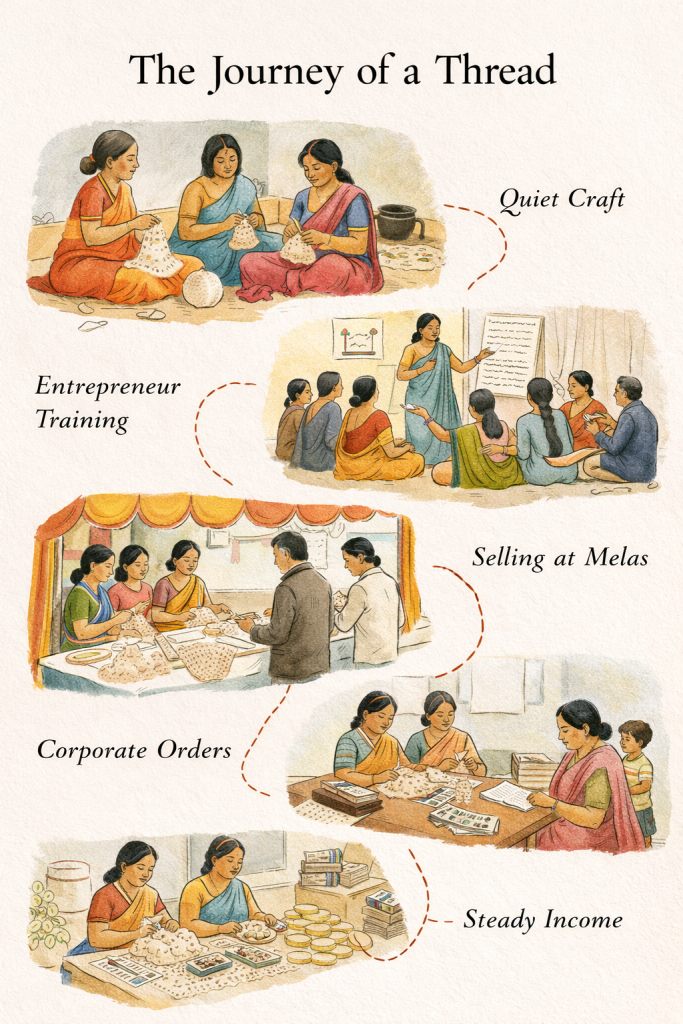
Through Smile Foundation’s Entrepreneurship Development Programme (EDP), a group of women began meeting not to exchange patterns, but to consider possibility. They formed a collective and named it Whispering Threads — a name that acknowledges both where they began and what they hoped to become. For women accustomed to describing crochet as “just something I do,” the language of enterprise required adjustment.
The early sessions were practical.
- Costing raw materials
- Understanding margins
- Calculating profit instead of guessing
- Learning how to speak about their work without apology
The name holds both history and intention. The work had been whispering for years, present but unheard beyond family circles. Now it would speak in markets, exhibitions and order books.
The EDP training did not attempt to replace craft with theory. It built structure around what already existed.
Technical training followed with learning more intricate patterns, contemporary colour palettes and product lines suited to urban buyers like
- Table runners with tight lace geometry
- Babywear designed for gifting markets
- Home décor pieces that could sit as easily in Bengaluru apartments as in village homes
Each member began earning between ₹4000 and ₹5000 per month to start. In cities, the figure might be shrugged at, but in households accustomed to fluctuating daily wages, it is steadiness. It is predictability and a buffer against shock.
But the more significant shift is harder to tabulate.
The First Public Display

At their first mela, the stall was arranged with care bordering on ritual. A clean cloth spread flat. Crochet pieces aligned with price tags attached — small declarations that this work had value.
Standing behind that table required a new posture. Customers asked questions. Some ran their fingers across lace edges. Some purchased, others hesitated. The women explained their process, negotiated and calculated totals without deferring to anyone else.
It was a crossing from private production to public exchange.
Soon, orders extended beyond local fairs. Exhibitions multiplied and corporate gifting inquiries followed, requiring coordination, quality checks and collective accountability. What had once been solitary handwork now moved through a small but disciplined supply chain.
The thread had entered circulation.
The Cultural Moment They Inhabit
It is difficult to ignore the timing. Across the world, there has been a return to tactile practices. During pandemic lockdowns, yarn sales surged globally as people sought structure and solace in repetitive motion. Crochet groups proliferated online. What had seemed quaint became therapeutic, even essential.
Celebrity visibility accelerated that shift. When global figures crochet openly, the craft sheds some of its inherited diminishment. It becomes gender-neutral, mindful and contemporary.
For rural collectives like Whispering Threads, this broader reappraisal is not superficial. Markets respond to cultural signals. When handmade gains cachet, artisans gain leverage.
The women of Hoskote Taluk did not engineer this global moment. But they are part of it.
What Endures
In the late afternoon, the rhythm continues much as it always did.
From afar, crochet can look repetitive. But anyone who has worked a pattern knows that a mistake in the early rows can distort everything that follows. It requires attention, correction and a large trunk of patience.
Livelihood is similar.
Support Women-Led Enterprise
Across India, skills like these remain unseen until someone chooses to see them. Through structured training, mentorship and market linkage, Smile Foundation works to transform existing strengths into sustainable livelihoods.
When women’s work is recognized and connected to opportunity, the results are lasting.
Support women-led entrepreneurship.
Help more whispering threads be heard.