India’s labour market does not resemble the diagrams often used to describe it. It is not neatly divided into formal and informal sectors, nor does it progress along predictable ladders from training to employment. Instead, it is mobile, fragmented and deeply shaped by proximity—to worksites, markets and opportunity.
More than 90 percent of India’s workforce operates in informal settings. These workers build homes, paint walls, lay tiles, wire buildings and keep cities functional. But they remain largely invisible in policy execution even if they are visualized in its imagination—uncredentialed, uninsured and excluded from conventional upskilling systems that assume stable jobs, fixed locations and the ability to step away from daily wages.
The question facing India today is whether upskilling systems are designed for the workforce that actually exists.
Over the last three years, Smile Foundation’s iTrain on Wheels initiative has offered a practical answer.

The core challenge: Upskilling without exclusion
Most upskilling programmes are built on assumptions that informal workers cannot meet. They require travel to centralised centres, time away from work, documentation and familiarity with institutional processes. For a daily-wage worker, these requirements are not inconveniences; they are barriers.
As a result, upskilling has often failed precisely where it is needed most.
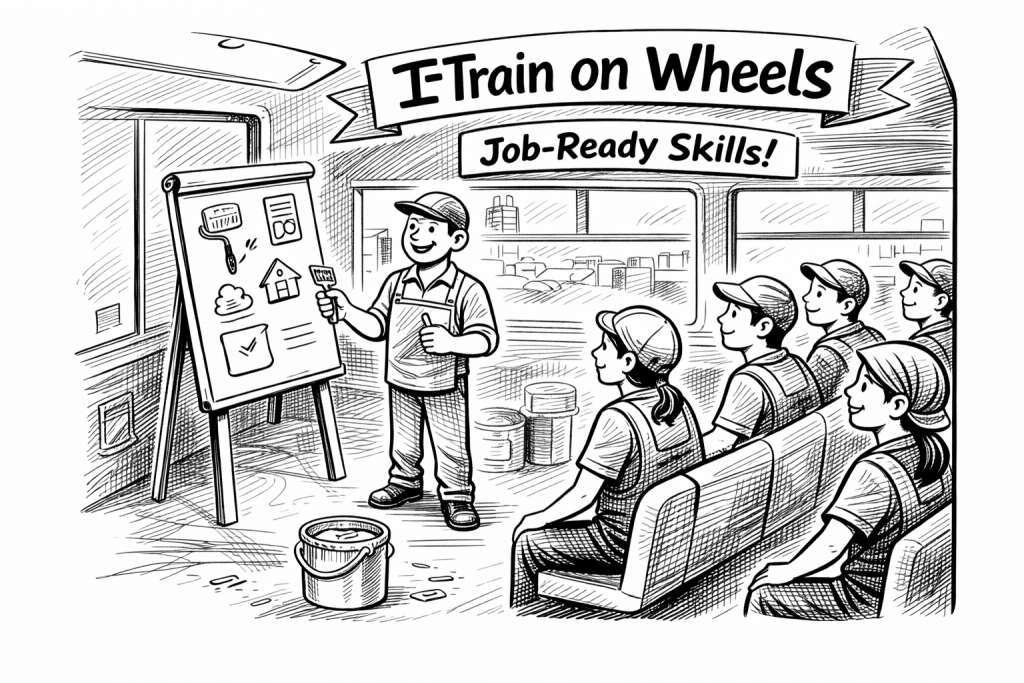
iTrain on Wheels reverses this logic. Instead of asking workers to enter the system, it takes the system to where workers already are. Training is delivered through mobile units, free of cost, near worksites and communities. This single design choice—mobility over centralisation—is the programme’s most important innovation.
It recognises a simple truth: for informal workers, time is income and access determines participation.
Scale that reflects reality, not dilution
Since its inception, iTrain on Wheels has trained 2.98 lakh household paint applicators across 443 districts in 25 states and 3 Union Territories, including 51 Aspirational Districts. In 2024–25 alone, 135,493 workers were trained through 5,924 training sessions, with the programme growing at a 20 percent annual rate.
These numbers matter not because they are large, but because they are coherent. Scale has been achieved without thinning the intervention. Training quality, curriculum consistency and on-ground delivery have been maintained even as geographic coverage expanded.
This is rare in informal labour skilling, where rapid expansion often weakens outcomes.
From skills to incomes: Measuring what matters
Upskilling programmes frequently struggle to demonstrate post-training impact. Certificates are issued, attendance is recorded, but income outcomes remain unclear.
iTrain on Wheels is an exception.
A third-party evaluation conducted for the programme reports that:
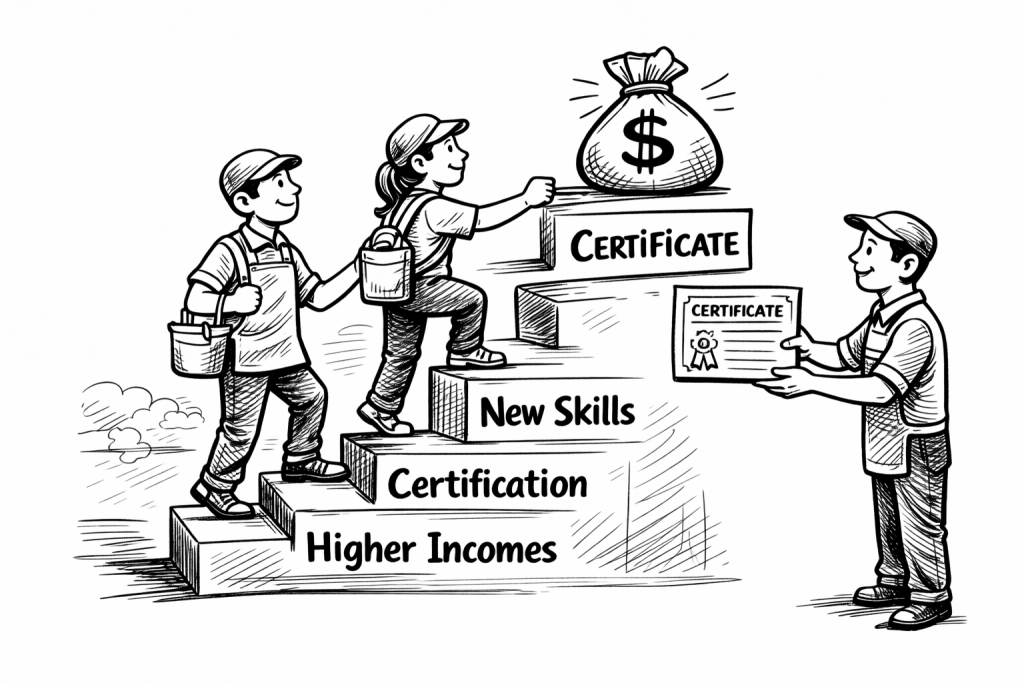
- 97.11 percent of trained applicators experienced income improvement
- 51.58 percent reported that their income at least doubled
- 95.05 percent expanded their client base
- 90.38 percent received formal certification, improving market credibility
These outcomes point to something critical: the market is validating the skills. Workers are not merely trained but are securing more work, commanding higher wages and building reputational capital.
In informal labour markets, where trust and word-of-mouth determine opportunity, this credibility is transformative.
Upskilling as livelihood acceleration, not placement
Unlike formal employment pipelines, informal labour does not culminate in placement letters. Progress looks different: a larger client base, repeat work, the ability to negotiate rates or the capacity to hire others.
The programme’s entrepreneurship orientation recognizes this reality. Training includes soft skills, customer interaction, financial awareness and professionalism—capabilities often absent from technical skilling but essential for income mobility.
Case studies illustrate this clearly. Workers who began as individual applicators now employ small teams. Others have entered stable monthly earning ranges previously inaccessible in the trade. These are not anomalies, instead they reflect a design that treats workers as economic agents.
In this sense, iTrain on Wheels functions as a livelihood accelerator, not a short-term training intervention.
The innovation behind the model
Beyond outcomes, the programme embeds a set of operational innovations that are often overlooked but critical for sustainability:
- GPS-enabled vehicle optimisation improves route planning, cost efficiency and accountability.
- Health and safety capsules, including first-aid training, address occupational risk—an essential but neglected aspect of informal work.
- Trainer soft-skills development ensures consistent delivery quality at scale.
- Standardized yet adaptable curricula allow relevance across diverse regions while maintaining core competencies.
Policy alignment without dependency
iTrain on Wheels aligns with national priorities such as Skill India, PMKVY, PM Vishwakarma, NSDC frameworks and Sector Skill Councils. This alignment ensures relevance, recognition and credibility.
At the same time, the programme does not rely on government delivery infrastructure to function. This independence provides resilience allowing continuity across policy cycles, funding shifts and administrative change.
In a skilling ecosystem often vulnerable to fragmentation, this balance between alignment and autonomy is strategic.
Formalizing work without erasing informality
A persistent policy tension in India is the assumption that informality must be eliminated rather than strengthened. iTrain on Wheels offers a different approach.
By providing certification, safety awareness and market-aligned skills, the programme formalizes outcomes without dismantling informal work structures. Workers retain flexibility while gaining stability and credibility replaces invisibility.
This is particularly important in sectors like construction and home improvement, where informality is not transitional but structural.
Gender inclusion: Early, realistic and necessary
The construction and painting trades remain male-dominated and the programme does not overstate its progress here. Women’s participation is still limited, but intentional.
Female painters have already been trained in states such as Gujarat, Andhra Pradesh, Meghalaya and Rajasthan. Plans for remaining of the 2025–26 include women-centric skill drives, recognizing that even modest female entry into these sectors carries structural significance.
The programme’s realism here is a strength. Inclusion is being built incrementally, not inflated rhetorically.
Why this matters beyond upskilling
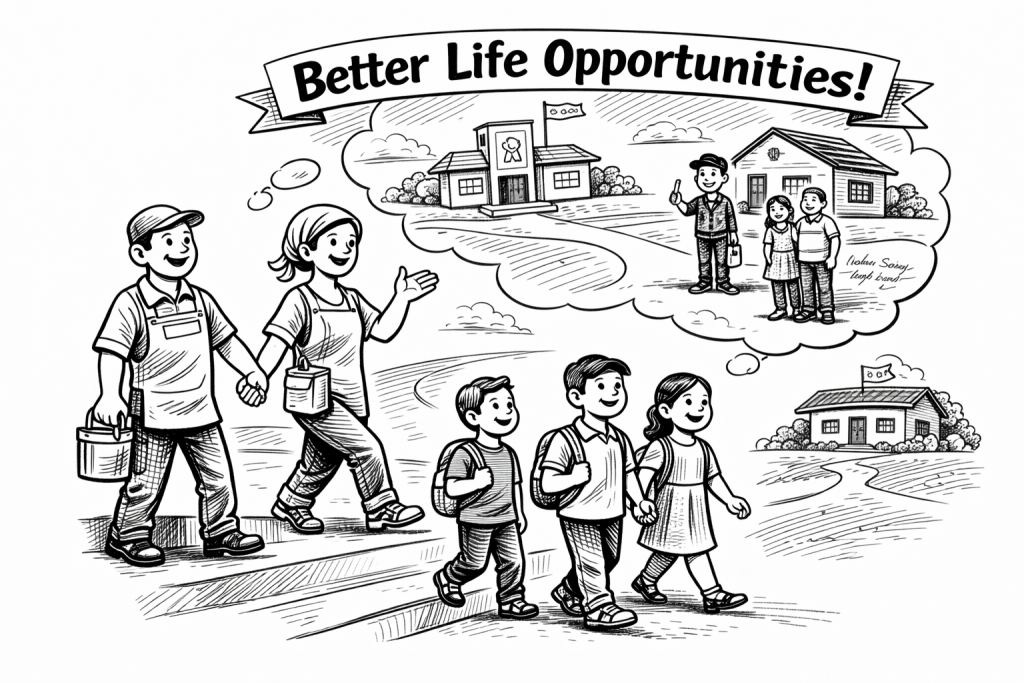
Income stability is not an isolated outcome. It underpins education retention, healthcare access, nutrition and dignity.
By strengthening informal livelihoods, iTrain on Wheels complements Smile Foundation’s work in education and health. Families with predictable incomes are better able to keep children in school, seek timely healthcare and absorb shocks without cascading loss.
In this sense, skilling becomes social protection.
Rethinking the future of work for the informal majority
As India navigates technological change, urbanization and demographic transition, informal labour will not disappear. It will adapt.
The question is whether institutions will adapt with it.
iTrain on Wheels suggests that the future of skilling lies not in credential accumulation, but in contextual capability building designed around how people work, move and earn.
For policymakers, corporates and development actors, the lesson is clear:
Skilling works best when it reduces uncertainty for workers, meets them where they are and delivers outcomes the market recognizes.
From last mile to learning system
What distinguishes iTrain on Wheels is not novelty but coherence. Design, delivery, outcomes and scale reinforce one another.
It positions Smile Foundation not only as an implementing partner, but as a last-mile economic institution capable of translating industrial capability into human outcomes.
As India’s informal workforce seeks formal futures, the path forward will not be linear. But it can be reliable.
Skilling and upskilling, when designed for reality rather than assumption, can be that bridge.