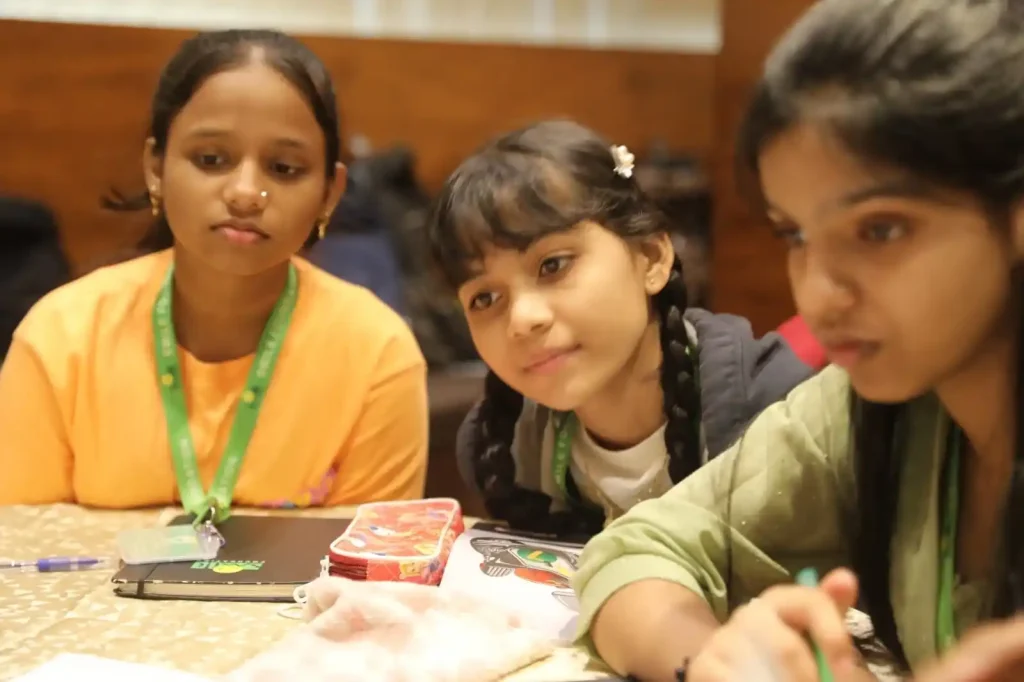
In the rural government school of a small town in Odisha, 14-year-old Nisha sits on the front bench, her notebook filled with carefully drawn diagrams of human anatomy. Her curiosity is boundless, but her access to science role models is not. Her only science teacher — a kind but overworked man nearing retirement — teaches physics, chemistry and biology all in one week. There is no female science teacher in her school. There never has been.
Nisha’s story is echoed across thousands of schools in India. Despite decades of investment in education, only about 13.5% of institutions in India have a female science teacher, according to this study which has substantial impact on the associated skewed number of STEM female teachers in schools.
This is a reflection of how gender intersects with access, aspiration and agency. When girls rarely see women teaching science, the idea of pursuing it as a career becomes distant, even unimaginable.
At its core, the lack of female science teachers is a visibility problem. It’s about who stands at the blackboard, who demonstrates an experiment, who answers the questions that shape how young people perceive knowledge and power. Representation in the classroom is not symbolic—it’s structural.
Why it Matters: The Effects of Representation
A teacher does more than teach. She validates, motivates and models what learning looks like. In science education, long seen as a male-dominated field, having women teachers changes the social script.
Research consistently shows that when girls are taught by female science teachers, their participation and performance in STEM subjects increase. But the impact goes beyond grades. It affects belief systems. A girl who sees a woman explaining Newton’s laws begins to see intelligence, authority and scientific reasoning as gender-neutral attributes.
In many schools, particularly in India’s smaller towns and villages, science is still perceived as ‘difficult’ or ‘not for girls.’ Parents often encourage girls to focus on subjects that seem ‘safer’ or more traditional like languages or home science. The absence of women science teachers reinforces these perceptions.
The result is a feedback loop: few women teachers mean fewer girls pursuing science degrees, which in turn means fewer women returning to teach. Breaking this loop requires deliberate, systemic intervention—something that civil society organisations like Smile Foundation are helping catalyse at the community level.
Barriers that Keep Women out of Science Teaching
The reasons for this gender gap are both structural and cultural.
1. Educational pipeline bottlenecks
In many regions, especially in low-income and rural communities, fewer women complete undergraduate or postgraduate degrees in science — often due to family constraints, early marriage or limited local colleges offering STEM courses. Without this qualification base, the pool of women eligible to teach science shrinks drastically.
2. Institutional bias and recruitment
Schools often prefer male teachers for science subjects, citing perceptions around discipline, mobility or technical competence. For example, a woman teacher may be considered less capable of managing a lab or taking students on field visits. These biases are subtle but widespread.
3. Work-life pressures
Science teaching, particularly in secondary schools, often involves additional administrative responsibilities — exam supervision, lab preparation and extracurricular activities—that require longer hours. For women juggling household or caregiving duties, this becomes a deterrent.
4. Rural assignment reluctance
For many qualified women, rural or semi-urban postings are challenging due to safety concerns, lack of transport or inadequate facilities. This skews gender balance even further in the very regions where representation is most needed.
5. Social conditioning
The larger societal belief that men are better at science continues to influence both student and teacher aspirations. When women internalise these stereotypes, they may opt for subjects seen as more appropriate or manageable.
These challenges are not insurmountable but they require a shift from viewing women teachers as beneficiaries to viewing them as agents of systemic change.
Smile Foundation Approach: Building Confidence through Classrooms
Over the past two decades, Smile Foundation has worked in education, health and livelihood sectors with one consistent thread — community-led empowerment. Within its Mission Education programme, which spans more than 25 states, the organisation focuses on holistic learning models that prioritise inclusion, quality teaching and local ownership.
A significant component of Smile’s education work involves supporting women educators, especially in STEM disciplines. Across many of its project schools, urban learning centres, digital classrooms and residential programmes for girls, Smile Foundation has seen how a single woman teacher can transform the learning environment for hundreds of children.
Take, for instance, Smile Foundation’s residential learning programme for girls in Ladakh. In this mountainous region, secondary schools are often several kilometres apart, and teachers frequently rotate in and out due to harsh conditions. Here, local women trained and supported by Smile serve as both educators and mentors. Many were once students in similar villages; now, they teach physics and environmental science, bridging both the cultural and gender divide.
As one teacher shared:
“When girls see me teaching science, they realise it’s not something that belongs only to boys. It belongs to anyone who is curious.”
This approach, rooted in local leadership and trust, has helped Smile Foundation create a network of women educators who are not only teaching science but redefining what it means to teach with empathy, relevance and community connection.
Changing the Narrative: Women as Science Role Models
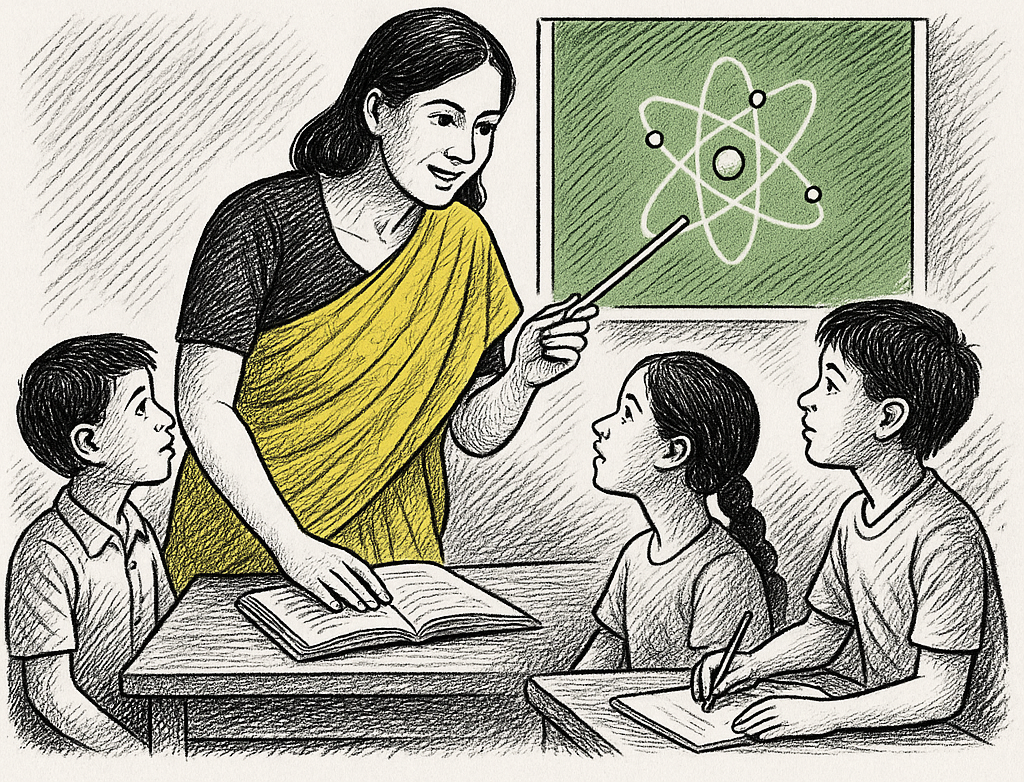
It’s easy to underestimate the symbolic power of a woman with chalk in hand, explaining the solar system or a chemical equation. In villages where girls often drop out after primary school, this image itself is revolutionary.
Smile Foundation leverages this potential by mentoring local women who aspire to become teachers. Many of them start as community volunteers or tutors in Smile’s learning centres, receiving training in child pedagogy, STEM basics and digital literacy. Through this process, women not only gain professional skills but also emerge as visible role models.
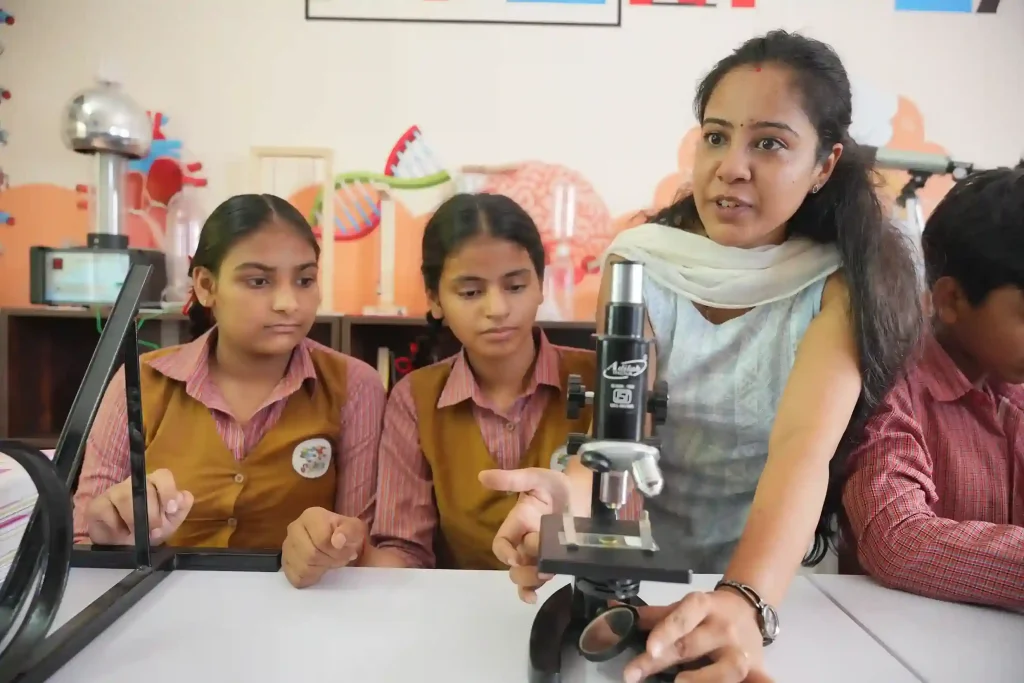
In some Smile-supported schools, female teachers have introduced low-cost science experiments using local materials making science relatable and hands-on. These activities demystify concepts and encourage both girls and boys to participate actively.
When girls see women confidently teaching science, they internalise that confidence themselves. And when parents see women in respected teaching roles, their perception of girls’ education changes too.
Building Ecosystems of Equity
Creating gender balance in science education is not merely about hiring more female teachers, it’s about building an ecosystem where women can thrive as educators. Smile Foundation’s programmes address this through three strategic areas:
1. Training and capacity-building
Smile runs regular teacher development workshops focused on STEM pedagogy, digital tools and classroom leadership. These sessions also emphasise gender sensitivity helping teachers counter bias in their own teaching methods.
2. Technology-enabled teaching
With the introduction of solar-powered digital classrooms in remote areas, Smile Foundation has empowered both male and female teachers to access quality educational content. Women teachers, especially in rural settings, have found these digital aids invaluable, they enable them to explain complex scientific concepts with visual clarity, improving engagement and confidence.
3. Community sensitisation
Through parent–teacher meetings and community outreach sessions, Smile encourages families to support girls pursuing science. In many regions, this has led to tangible outcomes: higher attendance, delayed marriage age and greater continuity from primary to secondary education.
Together, these interventions form a pipeline of empowerment, from student to teacher to role model, creating generational shifts in how girls relate to science.
The Long Shadow of Underrepresentation
The scarcity of female science teachers does not just affect classrooms, it echoes through India’s broader STEM ecosystem. Women remain underrepresented in scientific research, technology jobs and leadership positions. The seeds of this imbalance are sown early, in schools where girls rarely encounter women who teach or practice science.
Without visible female mentors, girls’ participation in science subjects declines sharply after secondary school. According to various education surveys, female enrolment in STEM at the tertiary level remains disproportionately low, hovering around 30–35% nationally.
What begins as an absence in the classroom ends as a gap in the workforce. By the time women reach the professional stage, the gender divide in science has already hardened into habit. This makes the classroom, especially the presence of female science teachers, a frontline site for gender transformation.
When girls have women mentors early on, they are more likely to pursue higher education in STEM fields and challenge societal expectations that limit their professional scope.
Strengthening women’s participation in education
Government initiatives like Beti Bachao Beti Padhao, the National Education Policy (NEP) 2020 and STEM for Girls have all recognised the importance of gender inclusion in education. However, there remains a disconnect between vision and implementation, particularly in teacher recruitment and training.
To strengthen women’s participation in science education, policymakers could focus on:
- Targeted fellowships for women pursuing science degrees who commit to teaching in underserved areas.
- Residential training colleges in rural districts to make science education accessible to women closer to home.
- Safety, transport and housing support for female teachers posted in remote areas.
- Public–civil society partnerships that enable organisations like Smile Foundation to scale their models of local women educators and mentorship-driven teaching.
Bridging this gap is not just about gender justice, it’s about ensuring the quality and continuity of science education itself.
Generational change begins at the blackboard
In one of Smile Foundation’s Mission Education centres in Uttar Pradesh, a mural painted by the students reads:
“Science is the language of the future, and the future belongs to everyone.”
This sentiment captures what’s at stake. When only 13% of India’s schools have female science teachers, millions of girls are effectively being told that science is not theirs to own. Yet, when even one woman stands before a class and explains the world through equations, experiments and empathy, the message changes.
The grandmother who once collected water at dawn now watches her daughter teach health and nutrition as an ASHA worker and her granddaughter dream of becoming an engineer. This intergenerational chain of visibility is what truly shifts mindsets.
It is not about producing a few exceptional women in science; it is about normalising their presence everywhere, from Anganwadi centres to laboratories, from classrooms to policymaking boards.