India is witnessing a transformation in its economic and industrial landscape, powered by the growing influx of STEM-trained (Science, Technology, Engineering and Mathematics) talent. With the country producing over 1.5 million engineers and thousands of graduates in pure sciences and mathematics every year, the absorption of this workforce across high-growth industries has become a key metric of progress. But the question remains: which sectors are absorbing this trained talent fastest—and why
The Shifting Demand for STEM Talent and STEM Jobs
India’s demographic dividend offers an extraordinary opportunity. A majority of the population is under 35 and millions enter the workforce each year. But having a young population is only useful if their skills align with industry demand. STEM education — ranging from engineering and IT to biotechnology and data science — is becoming the currency of employability in a rapidly digitising economy.
Employers increasingly value not just domain knowledge, but also adaptability, critical thinking and digital literacy. Fields like AI, analytics, clean energy and bioinformatics are no longer niches — they are engines of national growth. Government policy, private sector investment and skilling programmes are converging to channel talent into these emerging ecosystems.
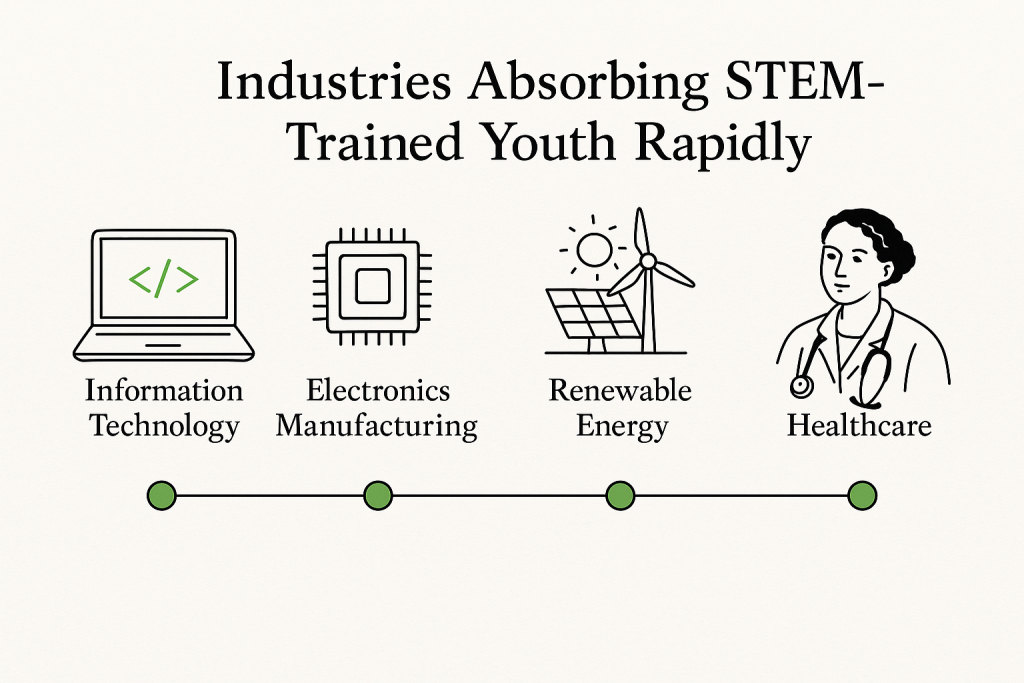
Let’s explore the key sectors absorbing India’s STEM-trained youth the fastest.
1. Information Technology (IT) and Software Services
Why It Leads:
India’s IT industry has long been the poster child for STEM absorption, contributing nearly 8% to the GDP and employing over 4.5 million people. Companies like Infosys, TCS and Wipro, along with emerging SaaS and AI start-ups, are hiring engineers, data scientists and developers at scale.
Cloud computing, machine learning, cybersecurity, and mobile app development continue to be key areas. Even non-tech companies — from banking to retail — are digitising and need software talent.
Entry Point for Many:
STEM youth often find IT services as the easiest entry route — campus placements, training modules and demand for coders create a relatively accessible pathway.

2. Electronics and Semiconductor Manufacturing
Why It’s Growing:
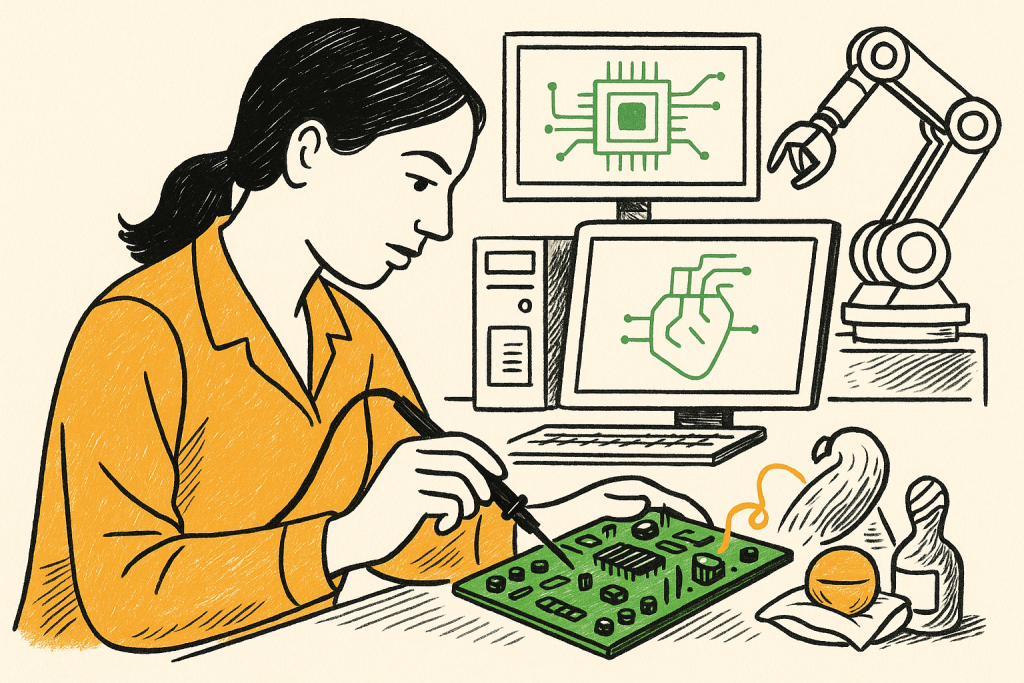
With the launch of India’s Production Linked Incentive (PLI) schemes for electronics and semiconductors, a new wave of demand for hardware engineers, embedded systems specialists and robotics experts is emerging.
From mobile phone assembly lines to chip design labs, the sector is ramping up both domestic production and global supply chain integration. Start-ups working in drone technology, wearables and IoT (Internet of Things) are hiring engineers trained in electronics, instrumentation and materials science.
3. Renewable Energy and Sustainability
Why It’s Strategic:
India’s commitment to generate 500 GW of non-fossil fuel energy by 2030 has created an urgent need for STEM graduates. Roles in solar panel design, battery technology, green hydrogen systems and energy storage solutions are rapidly expanding.
Institutions like TERI and industry leaders like ReNew Power and Adani Green Energy are partnering with engineering colleges for research and hiring. STEM-trained youth are finding work in solar installations, smart grid design, wind energy logistics and even carbon offsetting analytics.

4. Healthcare, Pharmaceuticals and Bio-Sciences
Why It’s Scaling:
The COVID-19 pandemic accelerated hiring in biotech and health-tech. India’s robust generic drug industry is now complemented by a growing interest in vaccine research, diagnostics, digital health platforms and personalised medicine.
Biotech graduates, lab technicians, data analysts, and clinical trial professionals are increasingly absorbed by pharma companies, hospitals and research labs. Technologies like CRISPR, telemedicine and wearable health devices need STEM-literate minds who can build, test and interpret.
Smile Foundation’s own programmes have responded to this trend. Through its STeP initiative, the Foundation has added healthcare skilling modules such as General Duty Assistant (GDA), patient care and digital record management. Many underserved youth, especially women, now receive hands-on training to support clinics, nursing homes and diagnostic labs.

5. Fintech and Data Analytics
Why It’s Exploding:
As India becomes one of the world’s fastest-growing digital economies, the need for data scientists, business analysts and AI engineers is soaring. STEM graduates — especially those comfortable with mathematics, statistics and coding — are being hired in droves by fintech firms, banks, insurance companies and consulting agencies.
Startups like Razorpay, Cred and Zerodha, along with digital arms of traditional banks, require skills in blockchain, payment processing, risk modelling and data visualization. Often, graduates from non-metro cities find new career paths here, especially when they gain exposure to applied STEM learning.

6. E-Commerce, Supply Chain and Logistics Tech
Why It’s Rising:
With the expansion of online commerce, logistics optimisation and warehousing management have gone high-tech. STEM youth with knowledge of process automation, data modelling and systems design are now employed in functions like supply chain analytics, route optimisation and AI-based inventory planning.
Companies like Flipkart, Amazon and BigBasket, along with B2B logistics tech startups, are hiring engineers to streamline everything from delivery networks to predictive demand analytics.
Smile Foundation has adapted its STeP programme to include logistics and e-commerce skill tracks. Modules on digital platforms, warehouse management and customer interface prepare youth for front-line tech roles in the sector — critical in Tier 2 and Tier 3 towns.

7. EdTech and Digital Learning
Why It’s Unique:
While edtech start-ups often hire educators, they also rely heavily on software engineers, UI/UX designers, AI content creators and data teams. With the rise of gamified STEM education and AR/VR platforms for immersive learning, the demand for technically sound teams is rising.
Companies like BYJU’s, Vedantu and Physics Wallah need coders and engineers who understand education. Young STEM graduates with a knack for content design and technology are finding niche roles here.

Bridging the Gap of STEM Jobs: The Role of Organisations Like Smile Foundation
While the industry side is evolving rapidly, not all STEM graduates are equally equipped. Many come from marginalised backgrounds, with limited access to industry-aligned training, exposure or confidence. This is where non-profits like Smile Foundation make a vital difference.
The STeP Programme: Empowering First-Generation Professionals for STEM Jobs
Smile Foundation’s STeP (Smile Twin e-Learning Programme) bridges the skilling-employment gap by equipping underserved youth — especially girls and first-generation learners — with:
- Digital and computer skills
- English communication
- Sector-specific training (retail, digital marketing, healthcare, logistics)
- Personality development and workplace readiness
In recent years, the programme has been updated to reflect industry trends, ensuring STEM-curious students can join sectors like healthcare, e-commerce and data support.
With over 13,750 youth trained and nearly 9,850 placed, Smile Foundation’s model proves that access to industry-relevant training, mentorship, and soft skills is key to helping youth enter and thrive in STEM-heavy fields.
Are We Doing Enough for STEM Jobs? Challenges Ahead
While absorption is growing, challenges remain.
1. Mismatch Between Curriculum and Industry Needs
India’s technical education often lags behind real-world application. Coding is taught in outdated languages and students are unfamiliar with modern tools or platforms unless they seek external training.
2. Urban-Rural Divide
STEM graduates from rural or semi-urban institutions often struggle with soft skills, digital fluency or exposure — putting them at a disadvantage in competitive hiring.
3. Gender Disparity
Women remain underrepresented in STEM employment despite comparable academic performance. Cultural biases, lack of workplace support and role models continue to discourage women from STEM careers.
Smile Foundation’s targeted focus on training young women in logistics, healthcare and digital commerce helps counter this by offering women a path into sectors where they are traditionally underrepresented.
The Future is STEM and STEM Jobs, But Only if It’s Inclusive
India’s journey toward becoming a $5 trillion economy hinges on how well it integrates its STEM-trained youth into its high-growth sectors. From AI to clean energy and from biotech to digital payments, the economy is being rebuilt with the hands and minds of young professionals.
But this promise can only be fulfilled if opportunity meets preparedness. Non-profits, government schemes and private sector partners must collaborate to ensure equitable access to STEM training and real-world pathways.
Smile Foundation’s work in STEM-linked skilling and livelihood training is a powerful example of how inclusion, mentorship and vision can turn marginalisation into participation.
Because the future doesn’t just belong to those who can code or calculate — it belongs to those who were given a fair chance to learn how.