Despite gains in girls’ schooling worldwide, women remain a minority in science, technology, engineering and math (STEM). UNESCO reports that women account for only about 35% of STEM graduates worldwide, a figure unchanged over the past decade. Even as more girls attend school, gendered biases and social norms often limit their subject choices. This global shortfall has economic and social costs: countries miss out on women’s talents in innovation and research, and technologies risk being shaped by a predominantly male perspective.
Globally, STEM fields remain male-dominated. Studies consistently show that at school, girls perform as well as or better than boys in science and math, yet far fewer continue to STEM careers. Girls often match or exceed boys in math and science test scores, but disproportionately drop out of STEM pathways. Despite women earning 54% of all university degrees, they make up only 34% of researchers worldwide.
In many countries, stereotyped teaching and materials reinforce boys’ identification with science. For instance, surveys in Latin America found that up to 20% of math teachers believed mathematics is easier for boys, a bias shown to undermine girls’ confidence. Similarly, experiments reveal that professors rated identical applications from female science students as less competent than those from males. These stereotypes and biases – in classrooms, textbooks, homes and workplaces – create a “leaky pipeline,” where talented girls are channeled away from STEM by invisible barriers.
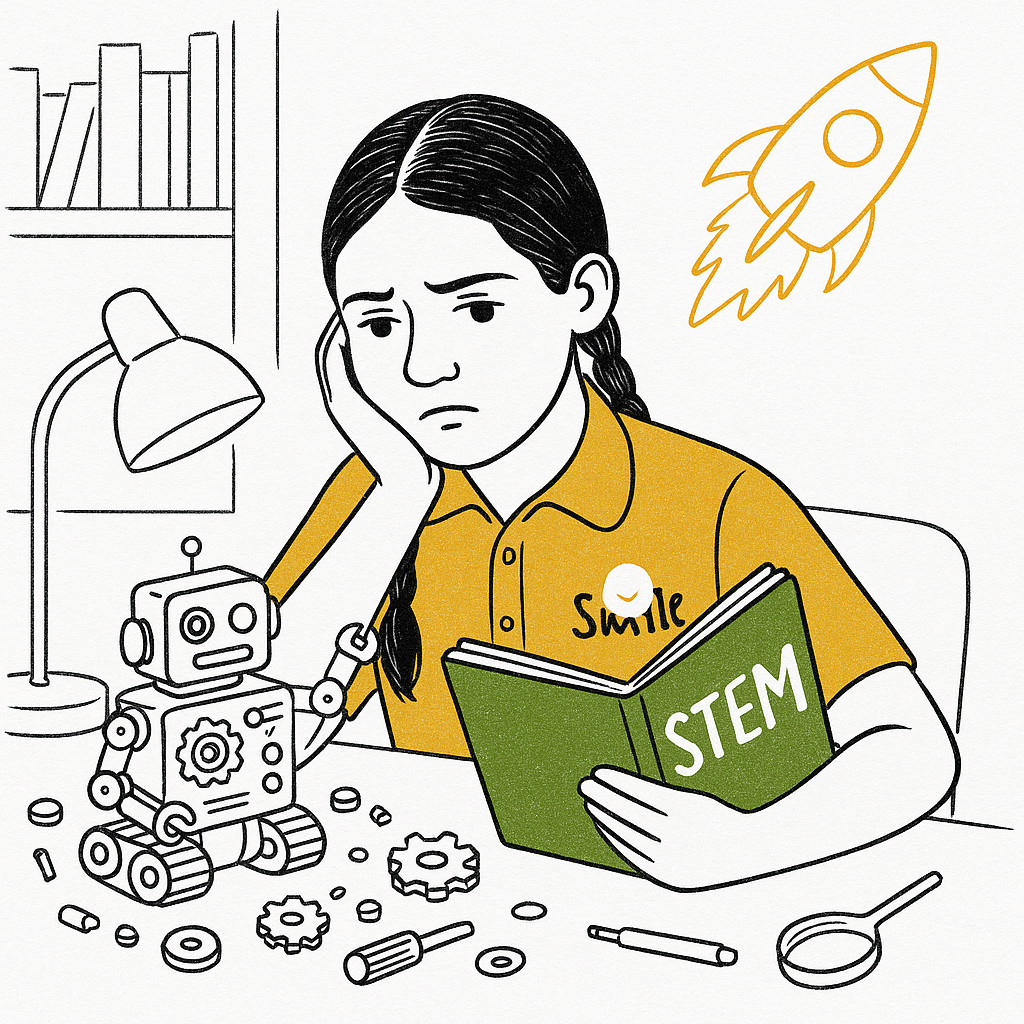
Global research identifies several key barriers for girls in STEM, often interlinked:
- Social norms and stereotypes: Widespread beliefs (e.g. that science/math are “for boys”) discourage girls from pursuing STEM. Parents and teachers may subconsciously steer girls toward traditionally “feminine” fields. Surveys show parents often prefer sons for STEM careers and boys rate male peers as more “knowledgeable” in science, even when girls outperform them.
- Access to education and resources: In many regions, girls face practical obstacles to STEM learning. Poor infrastructure (lack of science labs, computers or internet), long travel distances to school and even safety concerns can limit girls’ schooling, especially in rural areas. Girls are particularly under-represented in STEM education not because they learn less, but because they have fewer opportunities to continue in those subjects.
- Economic constraints: Families under financial strain often prioritise sons’ education, viewing boys as future breadwinners. Studies (e.g. by Sattva Institute) find that the high cost of science degrees leads some families to invest in sons’ schooling over daughters’. Without scholarships or support, talented girls may drop out or choose lower-cost streams.
- Curricular and institutional biases: Even where girls attend STEM classes, curricula and teaching often lack female role models. Textbooks frequently depict scientists as men, reinforcing the idea that STEM fields are male domains. Schools rarely offer targeted encouragement for girls in science and girls report less confidence in subjects like math despite equal ability.
- Workplace and societal discrimination: The bias doesn’t end with education. Women in STEM careers face lower pay, fewer promotions and hostile work cultures. Global surveys (e.g. by Kelly Services) report that a majority of women in tech feel their colleagues believe men are genetically better at math and science. Such discrimination drives many women out of STEM jobs over time.
Collectively, these factors mean that girls’ high academic achievement in early schooling doesn’t translate to STEM careers. For example, girls in many countries match or exceed boys in math/science proficiency, yet globally women make up only about 22–29% of STEM professionals (estimates vary by field and region). This discrepancy – the “double bind” of performing well but being underrepresented – underscores the role of social and cultural barriers over ability.
Gender Gaps in STEM in the Indian Context
Many of the global factors above are pronounced in India, where gender norms and resource gaps intersect. India actually stands out for having a relatively high share of women enrolling in STEM classes, yet their numbers still dwindle. For instance, one analysis finds that women make up about 43% of all STEM graduates in India (the highest rate globally), yet only 27% of these women enter STEM careers. Engineering is even more skewed: Indian women accounted for just 30.2% of undergraduate engineering enrolments in 2020–21, down from 33.7% in 2012. In popular fields like Computer Engineering, women were only ~34% of students.
These gaps reflect both demand-side and supply-side issues. On the supply side, many government schools – especially in rural areas – simply lack STEM infrastructure. A report by Smile Foundation notes that only 32% of India’s schools have a computer and only 24% a “smart” classroom. In village schools, students may never see basic science lab equipment.
Culturally, rural girls face greater discouragement: girls in rural India are 40% less likely than boys to pursue STEM subjects after primary school Early marriage and household expectations can force girls to drop out of school before 10th grade. Safety concerns, long commutes and household chores also disproportionately affect girls’ attendance.
On the demand side, Indian society often steers talented girls away from STEM. Widespread attitudes frame science and technology as masculine fields. Even in urban middle-class families, parents may pressure daughters to choose medicine, teaching or arts over engineering, fearing that STEM careers demand long hours or relocation. A Smile Foundation analysis attributes the decline of women in engineering largely to societal perceptions and workplace challenges.
Economic factors play a role too: STEM degrees (engineering, tech) are expensive and with limited family resources some girls are pushed toward lower-cost degrees. An IWWAGE study highlights that when budgets are tight, Indian families often invest in sons’ technical education rather than daughters’.
The Annual Status of Education Report (ASER 2023) found that of all Class XI+ students, only about 31.7% were in STEM fields (Physics, Chemistry, Math, Biology), vs 55.7% in Arts/Humanities. Within that small STEM cohort, girls – especially from rural or disadvantaged backgrounds – are a minority. Even those who graduate in science or engineering face attrition: workplace surveys indicate women hold just 26% of India’s data-science and AI jobs and only 15% in engineering roles. Thus India mirrors the global trend: good academic performance by girls at school does not translate into equal representation in STEM professions.
Gender Gaps in STEM: Stereotypes, Biases and Systemic Factors
Across India and the world, gender stereotypes play out early. Children internalise notions that boys are “good at math” and girls are “good at reading.” Studies of classroom dynamics show that boys often get more attention in science class and girls receive less encouragement to explore. In India, this can mean that by middle school girls start to self-select out of advanced science courses. Without visible female scientists around them, many girls assume “science isn’t for me.” This is reinforced by media and advertising: most technology and engineering-related ads feature men. Role models and mentors are crucial – when girls see women succeeding in STEM, it challenges stereotypes.
In higher education and work, institutional biases become evident. Indian data suggest that even when women enroll in STEM degrees, far fewer stay. For example, between 2013–14 and 2021–22, India saw a 43% drop in women taking postgraduate engineering and IT courses. Experts attribute this to factors like lack of flexible hours, limited maternity leave and few women-friendly policies. Female engineers report being sidelined for fieldwork or assignments due to “safety” excuses. In corporate tech, women often hit a career ceiling as promotions favour male employees. Such workplace barriers not only deter entry but also push many women out of STEM jobs.
A broader intersectional factor in India is caste and class. Research indicates that girls from lower socioeconomic backgrounds face compounded obstacles: fewer schools, financial poverty and in some cases, discrimination at home or school. There are reports of Dalit girls experiencing harassment and leaving college. Unfortunately, much of this data is qualitative, but it underscores that the issue is not just gender – it’s gender plus other vulnerabilities. This aligns with UN Women’s observation that STEM gaps are largest for girls facing multiple disadvantages (poverty, disability, caste, etc.).
Bringing Data to Life: The “Leaky Pipeline”
The cumulative effect of these biases is that the transition from education to employment in STEM is much smaller for women. UNESCO’s Cracking the Code research shows that globally women earn just 35% of STEM degrees but only about 22–29% of STEM jobs (lower still in many tech fields). Similarly, World Bank analysis finds women are over 50% of university grads but only 34% of researchers. In India, recent data tell a similar story: despite one of the world’s largest young populations of female graduates, women are under 30% of engineering and tech professionals. This “pipeline leak” happens because at each stage – subject choice, college specialisation, job entry and career retention – women drop out at higher rates than men.
Studies also highlight the feedback loop of stereotypes and confidence. Girls who are constantly told (even subtly) that boys are better at science tend to lose confidence, which in turn affects their class participation and exam performance. Over time, a girl’s interest in STEM may wane for lack of positive reinforcement.
In India, concerted efforts have increased girls’ school enrolment, but making STEM relatable and accessible requires changing deep-rooted attitudes. Even the way STEM is taught – often by rote and with few interactive experiments in government schools – can fail to spark girls’ curiosity.
Government and Civil Society Responses
Recognising the gap, the Indian government and international organisations have launched initiatives to boost girls in STEM. For example, Atal Innovation Mission (AIM) has set up thousands of tinkering labs in schools (over 10,000 nationally) to encourage hands-on science learning among students – and many of these explicitly target girls The Rashtriya Avishkar Abhiyan promotes science fairs and mentorship in rural schools, often with a focus on girl students.
The National Education Policy 2020 even mandates coding education from primary grades, which could help normalise tech from an early age. However, reports note that only about half of school STEM policies specifically include measures for girls. Internationally, UNESCO and UNICEF emphasize training teachers in gender-sensitive pedagogy and distributing feminine hygiene products to keep girls in class. UNESCO’s Cracking the Code and other studies have spawned advocacy campaigns (e.g. “#GirlsCrackTheCode”) to raise awareness.
Beyond policy, civil society and the private sector have crucial roles. Non-profits run after-school science clubs, scholarship programmes and campaigns to encourage girls. Companies host “Girls Who Code”–style workshops and offer internships to young women.
The Times of India reports that India’s tech industry has launched skilling programmes: for instance, the Nasscom Foundation collaborates with tech firms to train female STEM graduates in coding and data skills. These efforts acknowledge that women also need mentorship and networks to navigate STEM careers. Early results show promise: where dedicated programmes support girls (with resources, female instructors and encouragement), more girls stay in STEM tracks.
Smile Foundation’s Initiatives for Girls in STEM
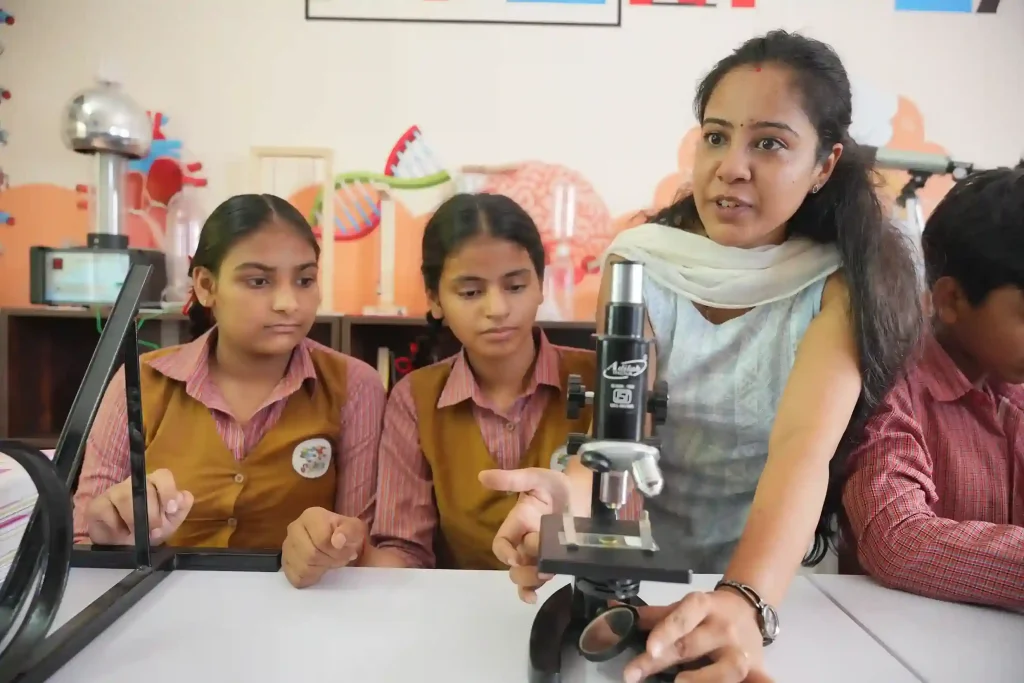
Smile Foundation has implemented several programmes directly addressing these challenges. Our Mission Education initiative brings hands-on science resources to underserved schools. For example, Smile sets up mini science centers and resource kits in government schools, supplies Do-It-Yourself learning kits and organises science clubs and fairs. Teachers receive training in inclusive STEM pedagogy so that girls are actively engaged. The effect is a shift from passive rote learning to active exploration: students (especially girls and first-generation learners) become curious scientists.
Empowering rural schoolgirls in STEM. To counter the lack of role models and labs, Smile also creates supportive environments for girls. In rural innovation ecosystems, we run “girls in STEM” workshops and mentorship drives where local role models (female engineers, scientists) share their stories. Our STEM labs and fairs have led to a an increase in girls’ participation in science activities. In one Uttar Pradesh project (in partnership with CooperSurgical), Smile opened a science lab for girls in a Kasturba Gandhi Balika Vidyalaya (a residential girls’ school). There, village girls build circuits, run experiments and present projects – experiences which improve their understanding of science and math and bolster confidence.
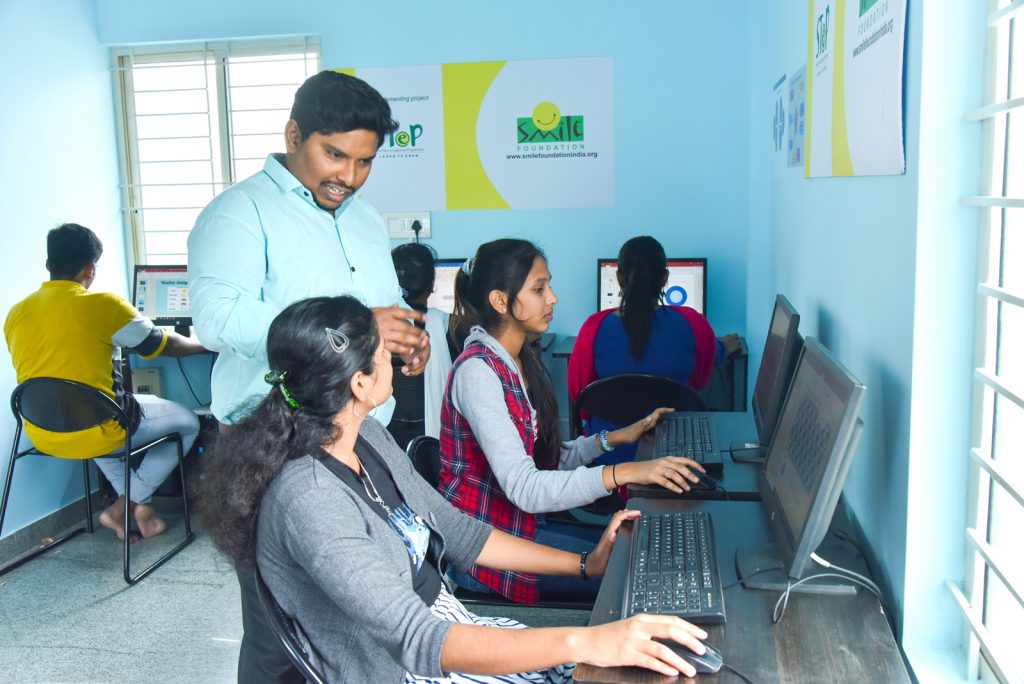
Smile’s broader girl-focused programmes also reinforce STEM inclusion by addressing dropout barriers. Our She Can Fly campaign provides scholarships, stipends and laptops to disadvantaged girls, and organises life-skills workshops to build confidence. By “meeting girls’ needs holistically,” Smile enables many talented girls to stay in school long enough to reach science classes. We also fund tertiary education through our Scholarship Programme, ensuring that girls who excel in school can go on to college and even technical careers.
In rural areas – where barriers are often highest – Smile’s experience underlines a simple truth: talent is universal, access is not. We deploy mobile STEM labs that travel to remote schools with kits and experiments and train local teachers in inquiry-based science education. We engage parents and community leaders to counter stereotypes, emphasising that girls innovating (like the students building pedal pumps or clean-water filters) can solve real village problems. Through these efforts, there is higher attendance and more girls stepping up as science club presidents or fair winners. These examples illustrate how multi-pronged programmes – combining infrastructure, mentorship and cultural outreach – can begin to close the STEM gap at the local level.
Path Forward
The underrepresentation of girls in STEM is a complex, global issue with local roots. On one hand, girls have the aptitude for science and often perform as well as boys in school yet they leave STEM paths in far greater numbers. On the other hand, the reasons are equally clear. Deeply entrenched gender norms, inadequate school resources (especially in rural and low-income areas) and institutional biases throughout education and employment systematically disadvantage girls.
In comparing nations, we see both progress and paradox. Some countries (including India) have high female STEM enrollment rates at the university level, but that does not guarantee workplace parity. More egalitarian societies still experience STEM gender gaps (the so-called “gender-equality paradox”), underscoring that cultural change must accompany any increase in equality.
Ultimately, addressing the gap means tackling it from all sides: reforming school curricula, training and sensitising teachers, providing girls with mentors and role models, offering financial support and safety nets (scholarships, menstrual health) and enforcing gender-friendly workplace policies.
Smile Foundation shows that integrated community programmes can make a difference. By embedding STEM labs, support networks and girl-centric scholarships into their education outreach, they help keep girls on the STEM track. Other countries and organisations offer similar lessons: hands-on STEM programmes that specifically engage girls, national policies that mandate gender equity in science education and public campaigns to shift stereotypes all play a part.
In the end, bridging the gap is not just a matter of fairness, but one of necessity. Innovation requires the brightest minds regardless of gender. When diversity is missing, the technologies we build can be skewed or incomplete. Only by dismantling cultural and structural barriers at every level can we ensure that the next generation of scientists and engineers fully represents half our population.