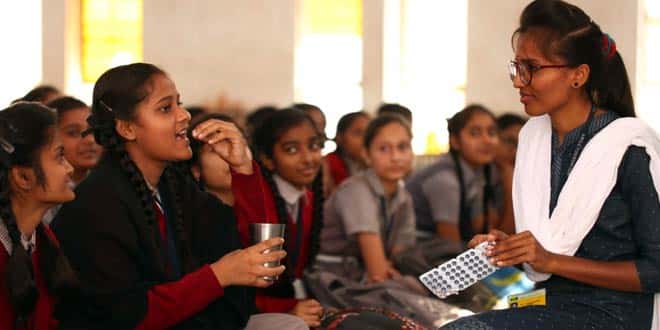

India has long faced a severe anaemia crisis. Recent surveys show over half of Indian women of childbearing age are anaemic – NFHS-5 (2019–21) found 57.0% of women (15–49 yrs) and 52.2% of pregnant women with anaemia. Among children under five, a staggering 67.1% were anaemic. Alarmingly, anaemia in pregnancy is linked to haemorrhage, low birth weight, premature births and even maternal death. In short, anaemia acts like a hidden drain on the nation’s health, sapping energy and increasing illness for mothers and children alike.
In response, the Government of India launched Anaemia Mukt Bharat (AMB) in 2018, aiming to reduce anaemia prevalence by roughly 3% each year. AMB is a “6×6×6” strategy that targets women and children at six life-stages (girls 10–19, adolescent boys/girls, pregnant women, lactating women, children 6–59 months) through six interventions (like iron supplementation, deworming, testing, dietary diversification, treating severe anaemia and behaviour change). For example, routine programmes under AMB include IFA supplementation (daily iron-folic acid for pregnant women; weekly IFA tablets for schoolchildren under WIFS), twice-yearly deworming, nutrition education and fortification (e.g. adding iron to midday meals and take-home rations) and community outreach through campaigns like Poshan Abhiyaan. Despite these efforts, progress has been mixed with nationwide anaemia rates remaining high. Experts note that tablets alone are not enough – without counselling, many beneficiaries skip doses or suffer side effects and diets stay poor in iron. This gap is why India needs innovative, community-driven programmes that complement the government’s efforts.
The Pink Smile Initiative: Community Health on the Move
One such innovation is Pink Smile, a mobile-health partnership between Smile Foundation and PepsiCo India in Mathura, Uttar Pradesh. Launched in early 2025, Pink Smile embeds a women’s health clinic on wheels into the rural villages of Chhata tehsil, directly aligning with AMB goals. The project set out to provide curative, preventive and promotive care for women, adolescents and children right at their doorstep. Key activities include:
- Mobile Camps & Teleconsultations: A specially outfitted van visits villages fortnightly to conduct anaemia screening camps and general health check-ups. Women and girls get their haemoglobin tested on-site and those needing care receive either on-the-spot treatment or referrals. Meanwhile, telemedicine links patients in remote areas with specialist doctors in real time. Smile’s own plan called for “specialised teleconsultation for women, adolescents and children” coupled with MMU-based screening.
- Nutrition Education & Recipe Demos: Community education is a big focus. Health workers hold interactive sessions on iron-rich diets, debunk food myths and even run healthy cooking demonstrations using local, affordable ingredients. Participants learn easy recipes (for example, adding leafy greens or lentils into everyday dishes) and receive illustrated recipe booklets. In fact, Pink Smile’s plan distributed low-cost nutrition recipe kits and organised five cooking demos reaching nearly 400 people.
- Kitchen Gardens: To make iron-rich foods sustainable, Pink Smile helped households start kitchen gardens. The team gave seed packets and guidance so families could grow vegetables like spinach, drumstick leaves and carrots at home or in community plots. This builds on proven approaches: in another Smile programme (Punjab), dozens of school kitchen gardens supplied veggies and helped boost nutrition. Under Pink Smile, a total of 50 kitchen gardens were established across the villages.
- Strengthening Anganwadis/PHCs: Pink Smile works hand-in-hand with existing health infrastructure. For example, they equipped local Anganwadi (childcare) centres and primary health centres with outreach support. Health educators held group meetings, street plays and even “baby-shower” (Godh Bharai) events at the Anganwadi to offer counselling on maternal nutrition and child care. Celebrating Godh Bharai ceremonies has cultural resonance; Pink Smile ran five such events, reaching about 350 expecting mothers. These events provided iron-rich snacks, supplements and one-on-one advice in a festive setting. In sum, the project explicitly ties into national programmes – for instance, Pink Smile coordinates with “Anaemia Mukt Bharat Divas”, Poshan Maah and traditional ceremonies like Godh Bharai.
All these pieces create a comprehensive package: Iron testing and supplements plus dietary guidance, prevention plus treatment and clinical services plus community education. In practice, this means the Pink Smile mobile clinic distributes pills and brings healthcare, knowledge and fresh food to villages, reinforcing the AMB strategy from the grassroots up.
Pink Smile’s Growing Impact (Data Highlights)
Pink Smile’s impact has scaled impressively in its first year. According to the programme’s March 2025 report, 7126 villagers (4941 women, 1416 children, 769 adolescents) were covered by the project. The team performed 1754 haemoglobin screenings for women and adolescents, diagnosing 887 moderate and 70 severe anaemia cases (and saw 62 of the severely anaemic begin to improve). Meanwhile, they treated a total of 2767 patients over six months including 1371 telemedicine consultations.
To reach people’s minds as well as bodies, Pink Smile also delivered robust education and prevention activities. They ran 4 community health awareness sessions (nearly 400 participants) and 5 recipe demonstrations (392 participants) to teach villagers how to cook nutrient-packed meals. Critically, 50 household kitchen gardens were set up so families could grow their own iron-rich vegetables. The project also provided direct nutritional support: 125 severely malnourished (SAM) children received therapeutic foods. All these efforts were tracked through systematic monitoring – for example, 1291 children had their growth checked (1091 normal growth, 141 moderately malnourished, 59 severely malnourished).
These numbers tell a story of wide reach and deep engagement. For instance, the five Godh Bharai ceremonies engaged entire villages: over 350 pregnant women received iron supplements and counselling. Each kitchen garden and cooking demo multiplied the impact by empowering families to feed themselves better – a real example of “nutrition education and kitchen gardens” working together.
In short, Pink Smile’s data shows a multi-layered effect: thousands of tests and treatments plus hundreds of education events and community supports. The programme report summarises significant improvement in anaemia rates, increased nutrition awareness and better household diets via kitchen gardens. These outcomes complement AMB by tackling anaemia not only with pills but also with food, knowledge and local capacity – exactly what experts say is needed to “actually translate policies into food on plates”.
From Data to Lives: The Dream of Anaemia Mukt Bharat
Numbers gain meaning when we see how they change people’s lives. Madhu Devi (name altered for privacy) was one of the many women identified with severe anaemia. She had been chronically fatigued and unable to work. After a Pink Smile screening revealed her low haemoglobin, she received iron supplements and diet counselling. Within months, Madhu regained energy – enough that she told staff she finally had the strength to start a small tailoring business from home. This turnaround echoes the programme’s own “success story” note that Madhu Devi journeyed from severe anaemia to improved health.
Similarly, Kanchan (also a pseudonym), an adolescent girl beneficiary, made a striking recovery. When Pink Smile first tested her at school, Kanchan’s haemoglobin was only 7.5 g/dL (very low). She was started on weekly IFA tablets and nutritious meals from the programme’s kitchen garden. After three months, her level climbed to 13.3 g/dL – more than a normal reading. Kanchan’s story was literally featured in the report (“Hb improved from 7.5 to 13.3 in 3 months”), highlighting how rapid interventions can break the anaemia cycle.
Tackling anaemia does more than improve lab values – it changes daily life. A mother or girl who is no longer anaemic can walk without dizziness, carry a baby safely, study or work without exhaustion and contribute to her family. As one village health worker put it, many women “just thought it’s normal to feel dizzy and look pale” – until Pink Smile taught them otherwise. With a bit of iron and education, these women turned weakness into wellness..
How Pink Smile Fits with National Programmes
It’s useful to compare Pink Smile to the standard anaemia interventions under AMB. In some ways they overlap: both emphasise IFA tablets and deworming. Government programmes send IFA pills to schools and health centres and conduct twice-yearly Deworming Day campaigns. For example, an NHM official described states’ strategies as providing universal prophylactic IFA and deworming to schoolchildren, along with year-round behaviour change campaigns. However, national schemes often struggle with compliance and continuity. Surveys have shown that even when tablets are provided, many beneficiaries stop taking them or do not receive counselling on diet.
Pink Smile complements these efforts by adding the human touch and diet diversity component. It literally goes door-to-door, following up on pills with fresh food and recipes. For instance, under AMB the government’s midday meal programme provides iron-fortified food to schoolchildren, but without local buy-in, lunch programme compliance can waver. Pink Smile’s approach mirrors successful pilots: in Punjab, Smile Foundation mixed iron tablets into the mid-day meal and encouraged kitchen gardens, which led to 100% compliance in schools. Likewise, in Gujarat Smile used an “iron laddoo” (sweet) supplement for adolescent girls, resulting in over 70% of the girls improving their haemoglobin.
Other national schemes like the Poshan Abhiyaan (National Nutrition Mission) emphasise convergence of health and nutrition (e.g. Poshan Maah events, fortified take-home rations). Pink Smile ties directly into these. The project’s design even lists “God Bharai, Anaemia Mukt Bharat Diwas, Poshan Maah” as complementary activities. In practice, aligning with Poshan Abhiyaan means Pink Smile took part in village nutrition drives during September (Nutrition Month) and tagged its camps to national health days.
In summary, while AMB’s blanket strategies (IFA, WIFS, deworming) provide the necessary framework, programmes like Pink Smile are the boots on the ground that boost those measures. By reinforcing IFA with counselling, by making iron-rich food accessible and by engaging communities directly, Pink Smile and similar CSR initiatives help close the implementation gap. They show that solving anaemia requires combining high-level policy with grassroots action.
Scaling and Sustaining Success: Anaemia Mukt Bharat
Continued focus on early detection, preventive care and community-based nutrition efforts will underpin future impact. Governments should encourage more mobile clinics and health camps in anaemia hotspots, possibly by co-funding NGO partnerships. Training and deploying more female health workers (ASHAs, ANMs) to use digital hemoglobinometers could replicate Pink Smile’s forthright screening approach.
Second, connect the dots across programmes. Stakeholders should formally link Pink Smile–style efforts to schemes like AMB and Poshan Abhiyan. For example, tying village health days, NHM funding and corporate CSR can multiply reach. Cross-sector collaboration can develop sustainable solutions to eradicate malnutrition and anaemia. Donors and corporates should invest in such public–private partnerships, knowing that integrated interventions (screenings + nutrition support + education) yield multiplier effects.
Third, promote nutrition at home. Every household could adopt a mini version of this approach. Kitchen gardens and local recipe clubs need support where governments can distribute seeds at Anganwadis and encourage nutrition gardens in schoolyards. Even simple baby-shower camps should be scaled up – health experts say these ceremonies are ideal for reaching pregnant women with iron supplements and advice.
Finally, monitor and celebrate progress. The Anaemia Mukt Bharat Index (a state ranking) has helped spur states to improve, but rural change also requires constant feedback. Healthcare leaders should publicise success metrics like how many villages are anaemia-free, how many children grow up strong. Public awareness must rise that anaemia is preventable. A little creativity – songs, cartoons, community contests – can make people care enough to change their diets.
The Pink Smile initiative shows that Anaemia Mukt Bharat can be advanced with a blend of top-down schemes and bottom-up engagement. By bringing doctors, dentists and dietitians to the village squares (literally on wheels), Pink Smile is turning the anaemia battle into a community mission. Its model – one that grows a smile as pink as the mobile clinic itself – points a hopeful way forward. To finally make anaemia history, India should support and replicate these hybrid approaches: after all, ending a national health crisis requires more than iron tablets, it requires iron-clad partnerships and iron-rich meals in every home.
Sources: Official government data and health bulletins, PepsiCo–Smile Foundation “Pink Smile” project plans and completion report, and expert analyses of anaemia programmes.