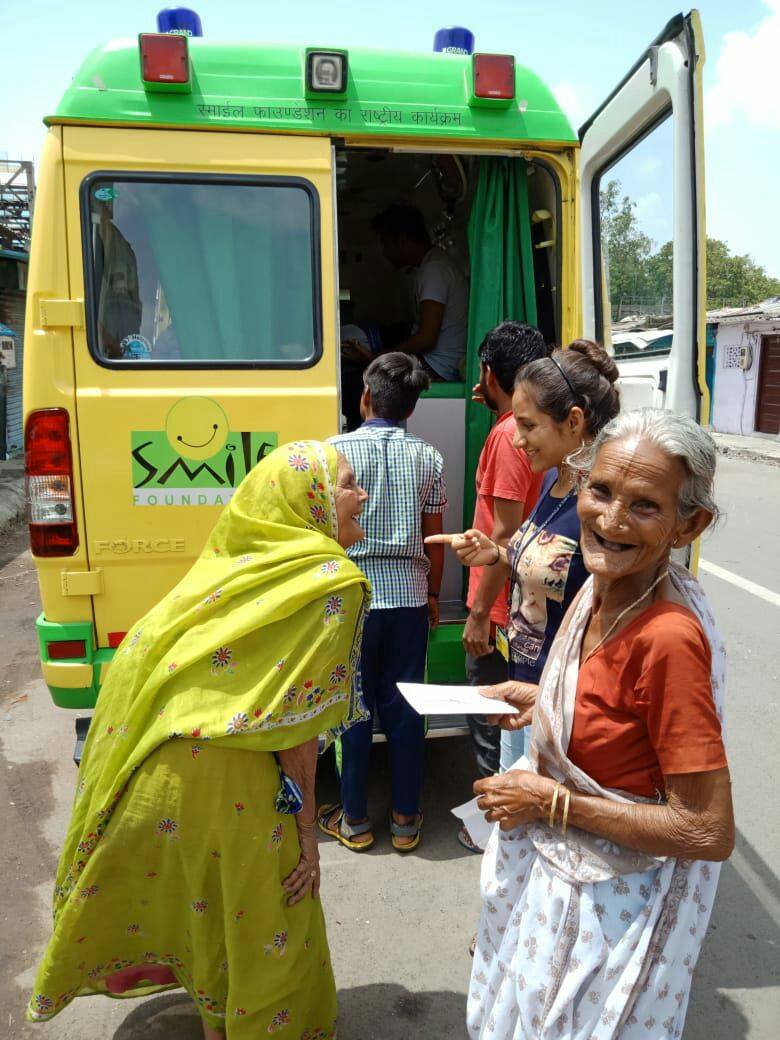

If you think healthcare is about doctors, prescriptions and the occasional hospital visit, think again. For millions across India, especially those on the margins, health means much more than treating illnesses. It’s about dignity, support and the chance to live without fear.
Take Mamtha, for instance. She’s elderly and works breaking stones to support her paralysed husband. Despite her own bodily diseases, she keeps going. For a long time, neither of them had access to regular medical care. But then a mobile medical unit run by Smile Foundation started visiting their village. Suddenly, Mamtha wasn’t invisible anymore. She had a doctor who listened, medicines that helped and a reason to believe things could get better.
Or consider Sarita Devi, who lost her home and her son. Living alone and frequently unwell, she had few people to turn to. Struggling with chronic illness and emotional trauma, she felt abandoned until the same mobile unit brought care right to her doorstep.
These stories are reflections of a healthcare system that often misses those who need it most. And they’re reminders that true healthcare is not just about treating illnesses but meeting people where they are, understanding their realities and building a system that supports them holistically.
Health is more than treating illnesses
In policy circles, we often talk about health in technical terms – mortality rates, hospital beds per capita, insurance coverage. But in everyday life, health is far more intimate. It’s whether you have the strength to go to work. Whether your elderly mother can walk to the bathroom without pain. Whether your child can focus in school instead of battling a persistent fever.
For vulnerable communities, especially in rural and underserved urban areas, even basic healthcare can feel out of reach. Clinics are too far. Hospitals are overcrowded. And private care is prohibitively expensive. What’s left is often neglect – until things spiral into emergencies.
That’s where mobile healthcare models like Smile on Wheels come in. These aren’t just vans with stethoscopes. They’re fully equipped units staffed with doctors, nurses and health educators who offer both curative and preventive care. More importantly, they offer trust and a relationship with communities that builds over time.
Building trust, one visit at a time
Dr Mahesh, Smile Foundation’s medical officer, believes in this every day. He reaches people who have little or no access to medical support. From simple check-ups to patient listening, he brings comfort and awareness to many. As part of Smile on Wheels, each day in different localities, he aims to provide comprehensive health coverage for people. From preventive education to regular check-ups, the programme offers a full package and is not just about treating illnesses. Smile on Wheels focuses on three A’s: availability, affordability and accessibility. It helps build trust between Smile’s team and the community.
Trust isn’t built overnight. But when healthcare workers show up consistently, speak the local language and treat patients with respect, people open up and they follow up too. They begin to see healthcare not as a last resort, but as a normal part of life.
Why preventive care matters
We tend to associate healthcare with crisis—surgery after an accident, IV drips after dengue, antibiotics after infection. But by then, the damage is often done. What’s needed is a shift in how we think about healthcare.
Preventive care – things like screenings, vaccinations, nutrition counselling and health education – keep small problems from becoming big ones. They cost less, require fewer resources and most importantly, reduce suffering.
Smile Foundation integrates preventive care into its mobile clinics. Health workers run regular sessions on hygiene, nutrition, menstrual health and common chronic conditions like diabetes and hypertension. These sessions are especially impactful for women, who are often primary caregivers but lack information about their own health.
When people know what to watch for, and where to go when symptoms show up, they’re less likely to wait until it’s too late.
Mental and emotional health can’t be an afterthought
We often forget that healthcare is not just physical. Emotional and mental health matter too, especially for the elderly, the isolated and the traumatised.
In India, mental health remains deeply stigmatised, particularly in low-income communities. But people like Mamtha and Sarita show us why it can’t be ignored. Chronic stress, grief and loneliness take a toll on the body and the mind. Left unaddressed, they can make recovery harder and illness more persistent.
Smile Foundation incorporates emotional support into its health model. Counsellors and social workers provide not just information, but companionship. Sometimes, that means guiding someone through grief. Other times, it means just listening – really listening – to someone who hasn’t felt heard in years.
Access is the first step, but it’s not the only one
Access is foundational. If people can’t physically reach care, or can’t afford it, nothing else matters. But access alone for treating illnesses doesn’t guarantee quality or continuity.
That’s why mobile healthcare needs to be more than just an emergency stop-gap. Smile on Wheels offers post-consultation follow-ups, chronic disease management and even referrals to secondary and tertiary care where needed.
For example, someone with high blood pressure isn’t just handed medication and sent away. They’re educated about diet and lifestyle changes. They’re checked on regularly. Their data is recorded, monitored and analysed to spot risks early.
This kind of consistent, community-rooted care is what transforms healthcare from a service into a system.
Policy gaps and the role of non-state actors
India’s health policy has made real progress over the last two decades. The National Health Mission, Ayushman Bharat and state-level initiatives have expanded infrastructure and access. But public health systems remain stretched, especially in hard-to-reach areas.
This is where civil society and NGOs like Smile Foundation play a critical role. They act as bridges between state infrastructure and ground-level realities. Between technology and trust. Between diagnosis and dignity.
Our work offers a model that policymakers should study more closely. Community health delivery doesn’t have to mean building more hospitals. It can mean equipping vans, training local health workers and investing in systems that adapt to where people are, not the other way around.
What comprehensive healthcare can also look like
As India moves toward becoming a $5 trillion economy, we can’t afford to leave millions behind when it comes to health. True progress is measured not just by GDP or hospital chains, but by whether Mamtha and Sarita Devi can live with dignity.
So, what should we be aiming for?
- A health system that sees people, not just patients.
- Infrastructure that reaches beyond cities and into forgotten lanes.
- Prevention that is as much a priority as cure.
- Mental health support built into primary care.
- Policies that invest in trust, not just in technology.
Healthcare isn’t just about curing what’s broken. It’s about keeping people whole.
And as Smile Foundation’s Smile on Wheels programme shows, that starts with showing up – day after day, village after village – and reminding people that they matter.